Note: For adults only. Tobacco products carry health risks.
Introduction – “Which Rocky Patel is the best?” is the wrong question
When ten Rocky Patel collections are sitting in front of you, the natural temptation is to create a ranking.
Which one is the best?
Which one is the strongest?
Which one is the most expensive?
Which one received the highest rating?
But that is exactly where the problem begins.
Rocky Patel does not simply reproduce one flavor profile under different bands. The portfolio stretches from the mild Vintage 1999 Connecticut to medium-full blends such as A.L.R. Second Edition and Disciple, moving through Honduran Corojo, aged Broadleaf, San Andrés, Ecuadorian Sumatra and even blends whose complete composition is intentionally kept confidential.
The useful question is therefore not:
“Which Rocky Patel is best?”
It is:
“Which Rocky Patel best matches my palate, my experience and the kind of session I want today?”
That is the purpose of this guide.
1. Why the Rocky Patel portfolio is so diverse
The modern Rocky Patel story developed after the Indian Tabac era, when the company increasingly built its identity around its founder’s name.
The Vintage family became one of the brand’s defining pillars, followed by an increasingly broad portfolio of Honduran and Nicaraguan cigars.
Two ideas are central to the way Rocky Patel presents its blending philosophy:
complexity and consistency.
Those ideas can appear contradictory.
Complexity often requires combining tobaccos from different regions, harvests and primings.
Consistency requires those combinations to continue delivering a recognizable identity from batch to batch.
This helps explain why two Rocky Patel collections can feel radically different even though both belong to the same brand.
2. The Mister Tabaco Rocky Patel map
For quick orientation, the assortment can be divided into several conceptual groups.
For a more delicate profile
Vintage 1999
For balance and broad accessibility
Vintage 1990Number 6Grand ReserveWhite Label
For greater density and complexity
SIXTY
For a more intense medium-full experience
A.L.R. Second EditionDisciple
For exploring Broadleaf and San Andrés
For aged tobacco and an anniversary concept
For exclusivity and old tobacco reserves
Conviction
This is not a quality ranking.
It is a navigation map.
3. Rocky Patel Vintage 1999 – the entry point into the Rocky Patel universe
When someone asks:
“Which Rocky Patel should I start with?”
Vintage 1999 is one of the most logical answers for a smoker seeking a mild profile.
The line is built around a Connecticut shade-grown wrapper and occupies the mild side of the portfolio.
It is also available across a broad range of vitolas, which makes it useful not only as an introductory cigar but also as a format-comparison tool.
What should you look for?
Do not chase power.
Pay attention to:
smoke texture;
creaminess;
toast;
nuts;
light wood;
delicate spice;
finish.
Vintage 1999 is useful because it demonstrates a very important principle:
mild does not mean flavorless.
Who is it for?
beginners;
Connecticut smokers;
relaxed sessions;
smokers who want to explore flavor without excessive physiological strength.
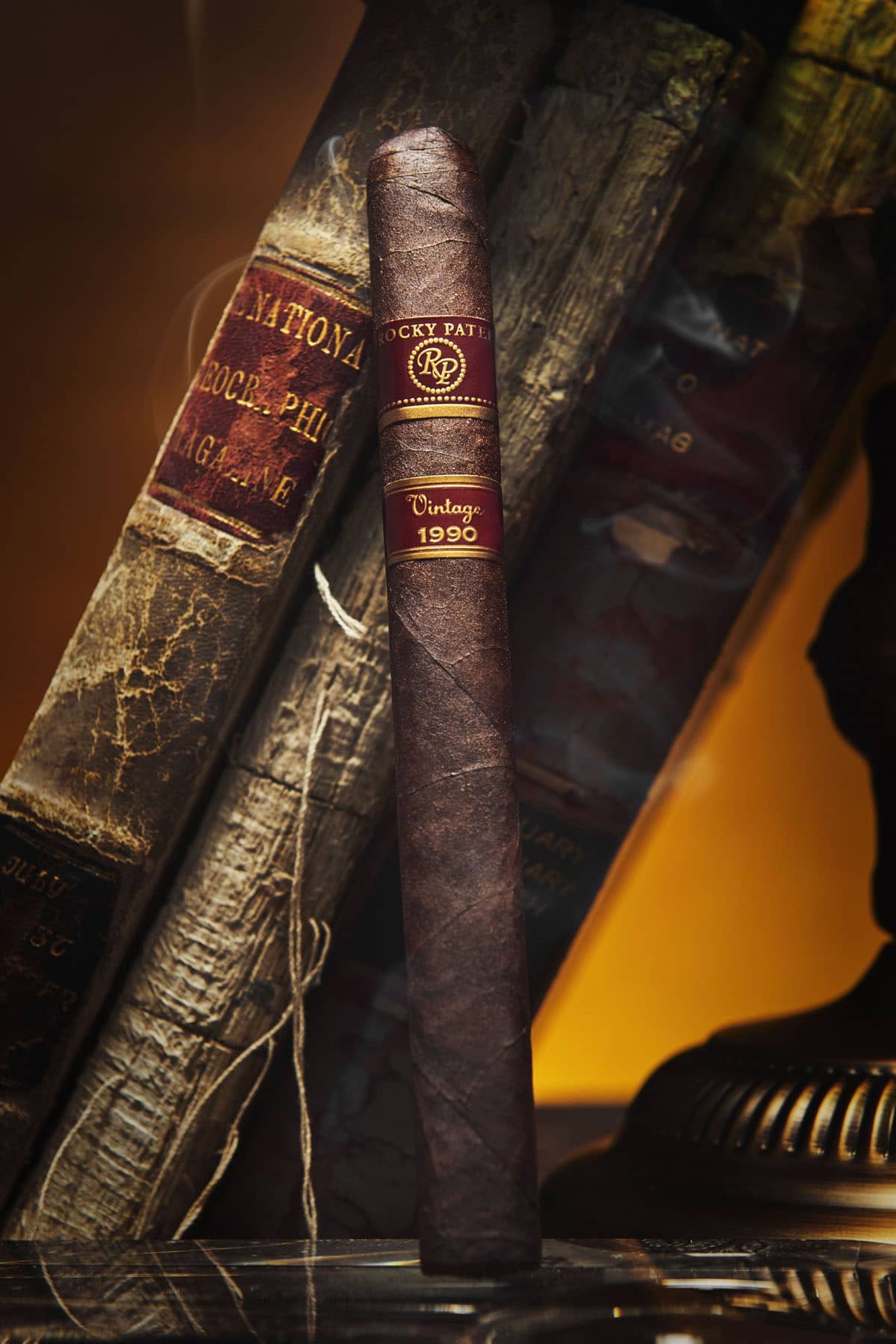
4. Vintage 1990 – aged Broadleaf and deeper character
If Vintage 1999 is about delicacy, Vintage 1990 moves into a richer direction.
The line is built around an aged Honduran Broadleaf wrapper and sits in the medium-to-milder-medium zone.
This makes it highly educational.
Try this comparison
Smoke:
Vintage 1999 → Vintage 1990
in similar vitolas.
Do not ask only:
“Which is stronger?”
Compare:
body;
wrapper expression;
earth;
cocoa;
roasted notes;
sweetness;
finish.
This is one of the most useful pairings for understanding how wrapper character and maturation can reshape the smoking experience.
5. Vintage 1990 vs Vintage 1999 – the 30-second explanation
Vintage 1999
Direction: mild, delicate, Connecticut.
Vintage 1990
Direction: medium leaning milder, aged Broadleaf, deeper character.
If a customer says:
“I want my first Rocky Patel.”
the next question should be:
Do you want delicacy or more depth?
For delicacy:
1999.
For more character:
1990.
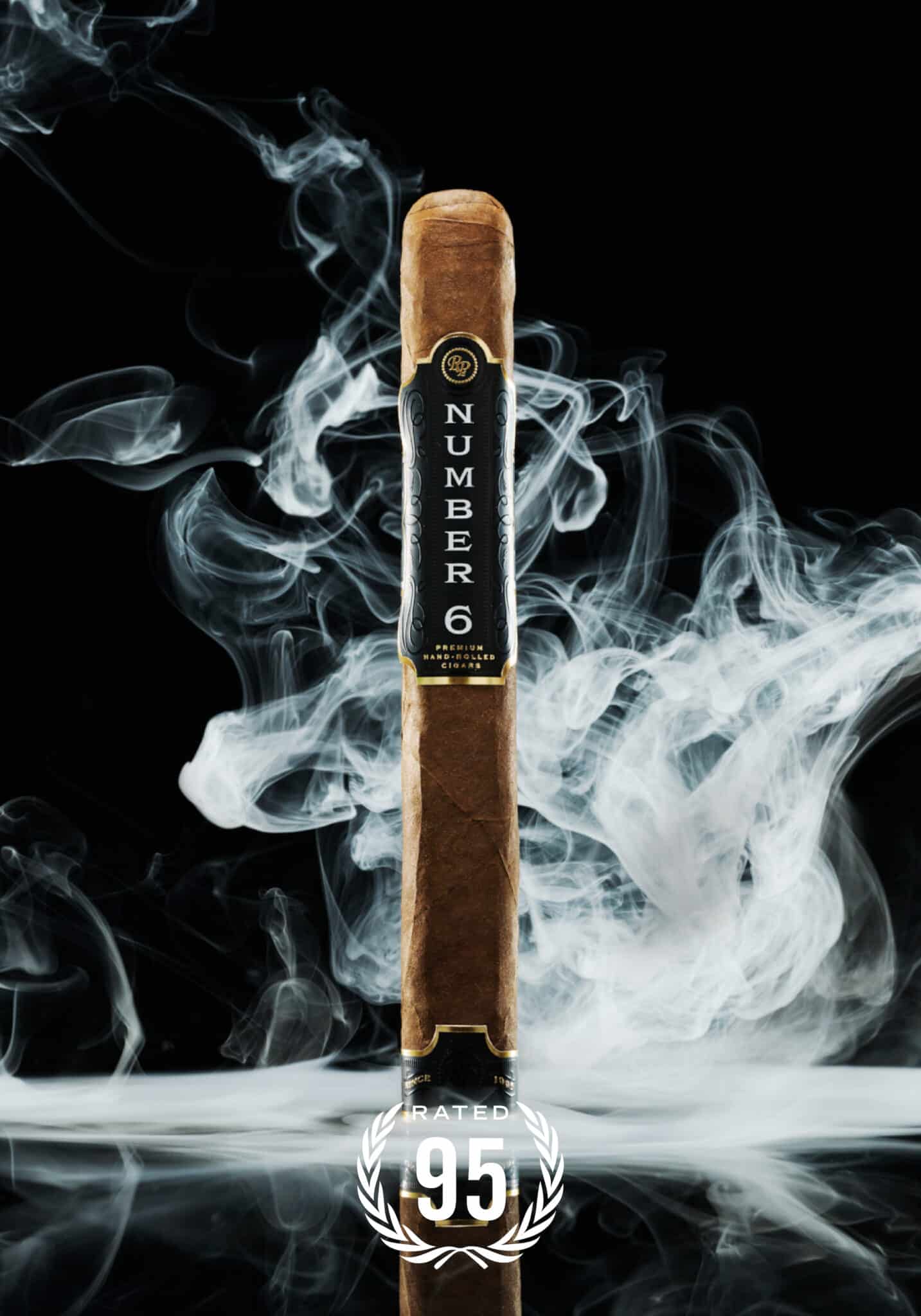
6. Number 6 – perhaps the easiest Rocky Patel to recommend broadly
Rocky Patel Number 6 occupies the middle of the map.
It is a medium-strength Honduran blend built around Honduran Corojo, and its personality is often described through the relationship between:
sweetness and pepper.
One of the great advantages of Number 6 is format availability.
It can be found in several classic vitolas, including Corona, Robusto, Toro and Sixty.
That turns it into an excellent educational cigar.
Why?
Because you can study:
same blend + different vitola.
7. Why Number 6 is so versatile
Number 6 does not try to be the most aggressive cigar in the portfolio.
Its strength is balance.
You get:
sweetness + pepper + medium strength.
That combination gives it broad appeal.
For Mister Tabaco, it is especially useful when someone says:
“I want something flavorful, but I do not want an excessively strong cigar.”
It can also serve as the bridge between a first mild cigar and later exploration of medium-full blends.
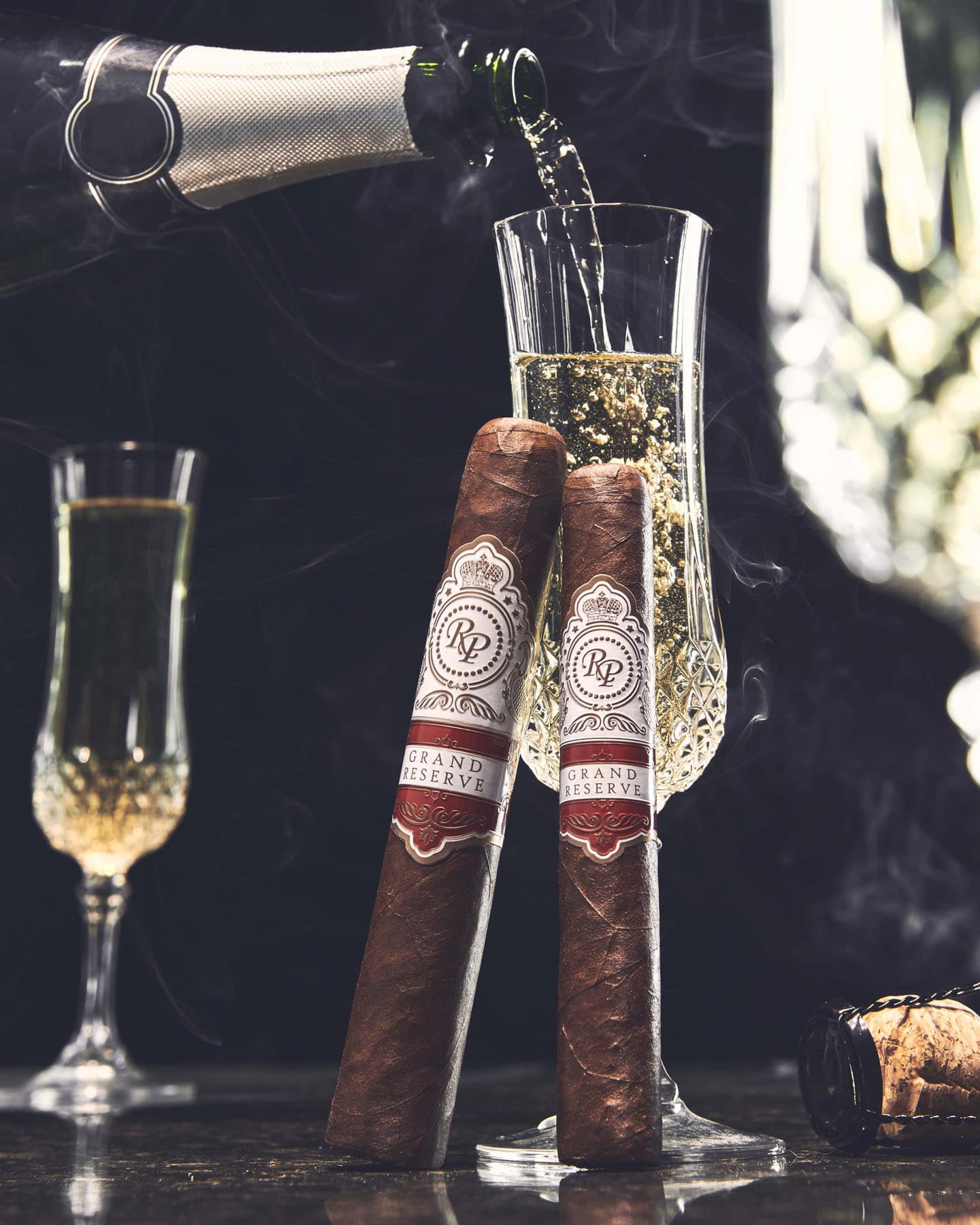
8. Grand Reserve – a Rocky Patel created for international markets
Grand Reserve has a different story.
It was positioned specifically for the international market rather than as a standard U.S.-market release.
The complete blend is intentionally not disclosed in the same level of detail as many other Rocky Patel lines.
That makes it particularly interesting for blind tasting.
A useful exercise
Do not look for a blend sheet.
Instead, smoke it and try to define:
strength;
body;
sweetness;
spice;
texture;
finish.
Then compare your notes with Number 6 or Vintage 1990.
Grand Reserve is a good reminder that knowledge of the tobacco composition can sometimes influence tasting expectations.
9. White Label – Connecticut does not automatically mean mild
White Label is an excellent lesson against cigar stereotypes.
You see a Connecticut wrapper and may immediately assume:
“This will be very mild.”
But White Label sits in the medium range.
Its personality leans into a more elegant spectrum, with impressions commonly associated with:
cedar;
cream;
sweetness;
refined finish.
It is offered in classic vitolas such as Robusto, Toro, Churchill and Sixty.
White Label therefore makes sense for someone who says:
“I like Connecticut, but I want more body than a very mild cigar.”
10. White Label vs Vintage 1999
This is a highly educational comparison.
Both operate in the visual and aromatic world associated with Connecticut.
But they are not identical in strength or expression.
Vintage 1999
More clearly mild.
White Label
More medium-bodied.
The lesson:
Connecticut does not automatically equal mild.
This pair is excellent for studying the difference between wrapper style and overall blend strength.
11. Rocky Patel SIXTY – when San Andrés and aging work together
SIXTY was created around Rocky Patel’s 60th birthday and has become one of the brand’s major anniversary-era lines.
It combines:
San Andrés wrapper;
Nicaraguan binder;
Nicaraguan filler;
medium strength.
One of its defining production ideas is extended rest after rolling.
That matters because the aging story is not limited to the individual tobacco leaves.
The finished cigars are also given substantial time to integrate.
SIXTY is available in Robusto, Toro and Sixty.
The name therefore does not mean the 6 × 60 format is automatically the only “correct” expression.
12. What should you look for in SIXTY?
The profile moves naturally toward darker, roasted and sweeter families.
Useful reference points include:
caramel;
coffee;
espresso;
earth;
cocoa;
texture;
long finish.
Do not force these notes simply because they appear in descriptions.
Taste first.
Compare later.
The more valuable question is not:
“Did I find espresso?”
It is:
“Is this profile darker, rounder or more roasted than Number 6 or Vintage 1999?”
13. SIXTY vs Number 6
This comparison is excellent for medium-strength smokers.
Both occupy roughly the medium zone.
Yet they follow different blending philosophies.
Number 6
Honduras + Corojo + sweetness/pepper.
SIXTY
Nicaragua + San Andrés + extended post-roll rest.
This is a perfect demonstration of why:
the same strength category does not mean the same flavor.
14. A.L.R. Second Edition – when time becomes part of the blend
A.L.R. stands for:
Aged. Limited. Rare.
The line was developed as a limited project around a San Andrés wrapper and extended resting of the finished cigars before release.
A.L.R. Second Edition moves into the medium-full range.
This makes it different from Number 6 or SIXTY even though some tobacco concepts overlap.
A.L.R. is also associated with a box-pressed format, adding another structural element to the smoking experience.
The important point is that A.L.R. should not simply be described as:
“the stronger Rocky Patel.”
Its identity is more accurately expressed as:
aging + integration + structure + medium-full intensity.
15. SIXTY vs A.L.R. Second Edition
On paper, the two lines share several interesting points.
Both:
are Nicaraguan-made;
use San Andrés;
emphasize aging;
exist in Robusto, Toro and Sixty.
But the central difference is:
SIXTY
Medium.
A.L.R.
Medium-full.
A very useful comparative tasting is:
SIXTY Robusto → A.L.R. Second Edition Robusto
By holding vitola approximately constant, you focus more directly on the blend.
16. Disciple – San Andrés in a medium-full expression
Disciple is a Nicaraguan-made cigar built around a Mexican San Andrés wrapper.
It sits in the medium-full range.
Its declared aromatic direction is strongly associated with:
wood;
earth;
pepper.
The line is offered in multiple vitolas, including Half Corona, Robusto, Toro, Bala and Sixty.
The Bala is especially interesting because its geometry differs from a standard parejo.
Disciple is therefore useful not only for studying San Andrés but also for exploring how vitola changes the presentation of a medium-full blend.
17. Disciple vs A.L.R. – two roads to medium-full
Both sit in the medium-full zone.
But they do not communicate the same idea.
Disciple
More direct thematic direction:
wood + earth + pepper.
A.L.R.
More focused on:
aging + integration + limited-production character.
This comparison is useful for discovering whether your palate prefers a more direct structured expression or a more mature, integrated one.
18. DBS – what does Double Broadleaf Selection mean?
DBS is one of the most interesting Rocky Patel cigars from a construction perspective.
The name means:
Double Broadleaf Selection.
But there is an important twist:
the wrapper itself is not Broadleaf.
The outer leaf is Mexican San Andrés.
Beneath it, the architecture combines Broadleaf elements in the binder/filler system.
This makes DBS extremely interesting for anyone studying:
wrapper;
binder;
filler;
Broadleaf;
San Andrés;
blend architecture.
19. Why DBS is a cigar for the curious taster
DBS is a perfect example of why wrapper alone never tells the whole story.
The external leaf is San Andrés.
Yet the identity of DBS depends heavily on the structure beneath it.
That means the better question is not:
“What does the wrapper taste like?”
It is:
“How does the entire Broadleaf/San Andrés architecture influence body, texture and finish?”
This is exactly the kind of cigar that becomes more interesting once you understand how premium blends are constructed.
20. Edge 20th Anniversary – the role of mature tobacco
Edge 20th Anniversary was built around a mature Ecuadorian Sumatra wrapper over Nicaraguan and Honduran tobaccos.
Its story is strongly connected to aged leaf and the anniversary evolution of The Edge family.
The educational question is not simply:
“How old is the wrapper?”
It is:
“What did time add to the tobacco?”
Look for:
integration;
reduced harshness;
spice;
wood;
sweetness;
finish length.
Aged tobacco should be judged by what time accomplished, not by the number of years alone.
21. Grand Reserve vs Edge 20th Anniversary
This is almost a comparison of philosophy.
Grand Reserve
The blend is deliberately less transparent.
The experience comes first.
Edge 20th Anniversary
The mature wrapper story is central to the concept.
One effectively says:
“Taste it without relying on the recipe.”
The other says:
“The mature leaf is part of the story.”
Both approaches can be valuable to an enthusiast.
22. Conviction – when Rocky Patel moves into exclusivity
Conviction occupies a special position in the portfolio.
It is a small-batch, limited-production project built around old Nicaraguan tobaccos and San Andrés.
The blend is associated with a medium-plus profile and dessert/coffee-oriented flavor references such as:
caramel;
honey;
coffee;
espresso;
chocolate;
lingering spice.
It is also box-pressed and deliberately positioned as a rare, highly selected release.
23. Conviction should not be chosen only because it is rare
Rarity creates a psychological trap:
rare = automatically better.
That is not true.
Rarity tells you something about:
production scale;
tobacco availability;
selection;
commercial scarcity.
It does not guarantee that your palate will prefer the blend.
Conviction becomes most meaningful for someone who has already explored:
San Andrés;
medium and medium-full cigars;
aged tobacco;
multiple Rocky Patel families.
At that point, rarity becomes context rather than the only reason to buy.
24. Choosing Rocky Patel by strength
A simplified map:
Mild
Vintage 1999
Medium / medium leaning milder
Vintage 1990Number 6SIXTYGrand ReserveWhite Label
Medium Plus
Conviction
Medium-Full
A.L.R. Second EditionDisciple
DBS and Edge 20th Anniversary are often better understood by studying their blend construction and actual smoking profile rather than forcing them into a simplistic strength ladder.
25. Choosing by wrapper
Connecticut
Vintage 1999White Label
Honduran Broadleaf
Vintage 1990
Honduran Corojo
Number 6
San Andrés
SIXTYA.L.R. Second EditionDiscipleDBS – San Andrés outside with Broadleaf architecture underneathConviction
Ecuadorian Sumatra
Edge 20th Anniversary
This map is very useful if you want to learn which wrappers you tend to enjoy.
But remember:
You are not buying a wrapper. You are buying a blend.
26. Choosing by flavor profile
If you prefer creamy / elegant / lighter profiles:
→ Vintage 1999.
If you prefer aged Broadleaf / rounder / deeper character:
→ Vintage 1990.
If you prefer sweetness + pepper:
→ Number 6.
If you prefer cedar + cream + sweet finish:
→ White Label.
If you prefer coffee / espresso / caramel:
→ SIXTY.
If you prefer wood + earth + pepper:
→ Disciple.
If you want to explore Broadleaf layering:
→ DBS.
If you are especially interested in aged tobacco:
→ Edge 20th Anniversary / A.L.R.
If you want rarity + older tobaccos + coffee/dessert character:
→ Conviction.
27. Choosing by experience level
Your first Rocky Patel
A logical starting point:
Vintage 1999 Robusto / Petite Corona
or:
Number 6 Robusto if you already have some cigar experience.
After a few cigars
Explore:
Vintage 1990White LabelGrand ReserveNumber 6
Intermediate exploration
SIXTYDBS
When you want more intensity and structure
DiscipleA.L.R. Second Edition
For the collector or experienced aficionado
Edge 20th AnniversaryConviction
This is not a prestige ladder.
It is an educational progression.
28. Choosing by vitola
One of the strongest aspects of the Mister Tabaco Rocky Patel assortment is that many collections appear in:
Robusto + Toro + Sixty.
That creates a superb tasting experiment.
For example:
Number 6 Robusto → Number 6 Toro → Number 6 Sixty
or:
A.L.R. Robusto → A.L.R. Toro → A.L.R. Sixty
You change geometry, not the cigar family.
Then observe:
wrapper/filler ratio;
smoke volume;
perceived temperature;
session duration;
transitions;
finish.
This teaches more about vitola than three random cigars from unrelated brands.
29. Which Rocky Patel works with coffee?
If coffee is already a familiar reference point, several directions make sense.
More delicate coffee / cappuccino
Vintage 1999.
Medium roast
Number 6.
Espresso / darker roasted profile
SIXTY.
But for the first analytical tasting of any cigar, water remains the better neutral reference.
Coffee should become a pairing experiment after you already understand the cigar itself.
30. Common mistakes when choosing a Rocky Patel
“San Andrés means strongest”
No.
A cigar can use San Andrés and still sit in the medium zone.
“Connecticut means mild”
Not automatically.
White Label is a good counterexample.
“The most expensive must be the best for me”
No.
“Sixty is always the strongest size”
No.
Vitola is not strength.
“Vintage means every tobacco leaf comes from the year in the name”
Do not assume that.
Check the blend description.
“The highest rating means I must prefer it”
No.
Ratings are information.
Preference is personal.
31. Mister Tabaco Rocky Patel Flight – six cigars for palate education
If the objective is education rather than ranking, a six-cigar sequence could look like this:
#1 Vintage 1999
Lesson: mild + Connecticut.
#2 Vintage 1990
Lesson: aged Broadleaf.
#3 Number 6
Lesson: Corojo + sweetness + pepper.
#4 SIXTY
Lesson: San Andrés + extended aging.
#5 A.L.R. Second Edition
Lesson: medium-full + aging + box press.
#6 DBS or Disciple
Lesson: Broadleaf architecture / San Andrés or wood-earth-pepper profile.
Do not smoke all six in one day.
Use six separate sessions.
Use the same tasting journal.
32. Advanced Flight – “Time & Aging”
For enthusiasts interested specifically in the role of aging:
Vintage 1990
Study the effect of a long-aged Broadleaf wrapper.
SIXTY
Study post-roll maturation.
A.L.R. Second Edition
Study intentional finished-cigar aging and integration.
Edge 20th Anniversary
Study the role of a mature wrapper in an anniversary blend.
Conviction
Study old tobacco reserves in a small-batch limited release.
This becomes a genuine masterclass on how time can enter the architecture of a cigar in different ways.
33. FAQ – Rocky Patel
Which is the mildest Rocky Patel among these collections?
Vintage 1999 is the clearest mild reference.
Which works well for someone who wants medium?
Number 6, SIXTY, Grand Reserve and White Label are strong candidates for exploration.
Is A.L.R. stronger than Number 6?
As a general portfolio position, yes. A.L.R. sits in medium-full territory while Number 6 is medium.
Does San Andrés automatically mean very strong?
No.
What does DBS mean?
Double Broadleaf Selection.
What makes Vintage 1990 distinctive?
Its aged Honduran Broadleaf wrapper.
What makes A.L.R. Second Edition distinctive?
Its emphasis on aging and integration before release.
What makes Edge 20th Anniversary distinctive?
Its mature Ecuadorian Sumatra wrapper and anniversary concept.
Is Grand Reserve a secret blend?
The full recipe is intentionally not disclosed in the same detail as many other collections.
Is Conviction limited?
Yes. It is positioned as a small-batch, limited-production project.
Robusto or Toro?
Choose according to available time, physical comfort and how you want wrapper/filler geometry to express the blend.
There is no universally superior vitola.
34. A mental selection table
If someone says:
“I want something very refined and easy.”→ Vintage 1999.
“I want medium and balanced.”→ Number 6.
“I want Connecticut with more body.”→ White Label.
“I want something built around aged tobacco.”→ Vintage 1990 / SIXTY.
“I want San Andrés and medium-full.”→ A.L.R. / Disciple.
“I want to study Broadleaf.”→ DBS.
“I want an anniversary cigar with mature tobacco.”→ Edge 20th Anniversary.
“I want something rare and elaborate.”→ Conviction.
That is far more useful than:
“Give me the most expensive one.”
Conclusion – there is no final Rocky Patel
The most useful way to understand the brand is not to search for one permanent winner.
Your palate changes.
Your preferred strength may change.
Your appreciation of wrappers changes.
The amount of time you have changes.
Even the same cigar can be more appropriate one evening and less appropriate another.
Vintage 1999 can teach finesse.
Vintage 1990 can teach the effect of aged Broadleaf.
Number 6 can teach balance between sweetness and pepper.
White Label can demonstrate why Connecticut does not automatically mean mild.
SIXTY can introduce San Andrés and post-roll maturation.
A.L.R. can demonstrate a more integrated medium-full aged expression.
Disciple can highlight wood, earth and pepper.
DBS can teach blend architecture and Broadleaf layering.
Edge 20th Anniversary can show how mature tobacco becomes part of an anniversary concept.
Conviction can introduce limited production and older tobacco reserves.
These cigars do not need to be ranked from “weak” to “good.”
They can be used to construct your own aromatic map.
And when you reach the point where you can say:
“I prefer medium strength, body 4/5, San Andrés, coffee and cocoa, a little sweetness, and Toro rather than Sixty,”
you are no longer simply asking for a good cigar.
You know what kind of cigar you are looking for.
Mister Tabaco
At Mister Tabaco, you can turn theory into practical comparisons between blends, vitolas and origins.
Continue the Tobacco Guide
→ What Is Premium Tobacco and How Is It Different from Ordinary Tobacco?
→ Wrapper, Binder and Filler – the anatomy of a premium cigar
→ Maduro Explained Properly – Color, Fermentation, Flavor and the Strength Myth
→ Ligero, Seco and Volado – how leaf position changes a premium cigar
→ How Cigar Tobacco Is Grown – From Seed to Harvest
→ Tobacco Fermentation – The Process That Transforms the Leaf
→ Tobacco Aging – Why Some Cigar Leaves Are Aged for Years
→ How a Master Blender Creates a Cigar
→ Shade-Grown vs Sun-Grown: How Light Changes a Cigar Wrapper
→ Long Filler vs Short Filler – The Real Differences in Cigar Construction
→ Strength vs Body vs Flavor – How to Describe a Cigar Correctly
→ How Vitola Changes Cigar Flavor: Robusto vs Toro vs Churchill vs Sixty
→ How to Choose Your First Premium Cigar – A Complete Beginner’s Guide
→ How to Taste a Premium Cigar and Identify Aromas
→ How to Store Cigars Properly: Humidor, Temperature and Humidity
→ Common Mistakes That Can Ruin the Experience of a Premium Cigar
→ Rocky Patel Guide: Differences Between the Main Collections at Mister Tabaco
→ Rocky Patel Vintage 1990 vs Vintage 1999: Aged Broadleaf or Delicate Connecticut?
→ Rocky Patel Number 6 vs DBS: Balanced Corojo or Broadleaf Architecture?
→ Rocky Patel SIXTY vs A.L.R. Second Edition: Two San Andrés Interpretations, Two Aging Philosophies
→ How to Choose a Rocky Patel by Experience, Strength and Flavor Profile
Explore the Cigar Guide
→ How to Choose Your First Cigar
→ Which Rocky Patel Cigar Should You Choose as a Beginner?
→ How to Smoke a Cigar Properly
→ Robusto, Toro or Churchill? Cigar Size Guide
→ How to Store Cigars Properly
→ Cuba vs Nicaragua vs Dominican Republic vs Honduras
→ How to Identify Cigar Flavors
→ Cigar Pairing with Whisky, Rum, Cognac or Coffee
→ 10 Common Cigar Mistakes Beginners Make
→ How to Choose a Cigar as a Gift or for a Special Occasion
Tobacco products are intended for adults only. Smoking seriously damages your health.