
Note: For adults only. Tobacco products carry health risks.
Introduction – two Vintage cigars, two very different interpretations
At first glance, Rocky Patel Vintage 1990 and Rocky Patel Vintage 1999 appear to belong to the same story.
Same producer.
Same Vintage family.
A year displayed prominently on the band.
Many overlapping vitolas.
Yet from a tasting perspective, the differences between them are far more important than their similar names suggest.
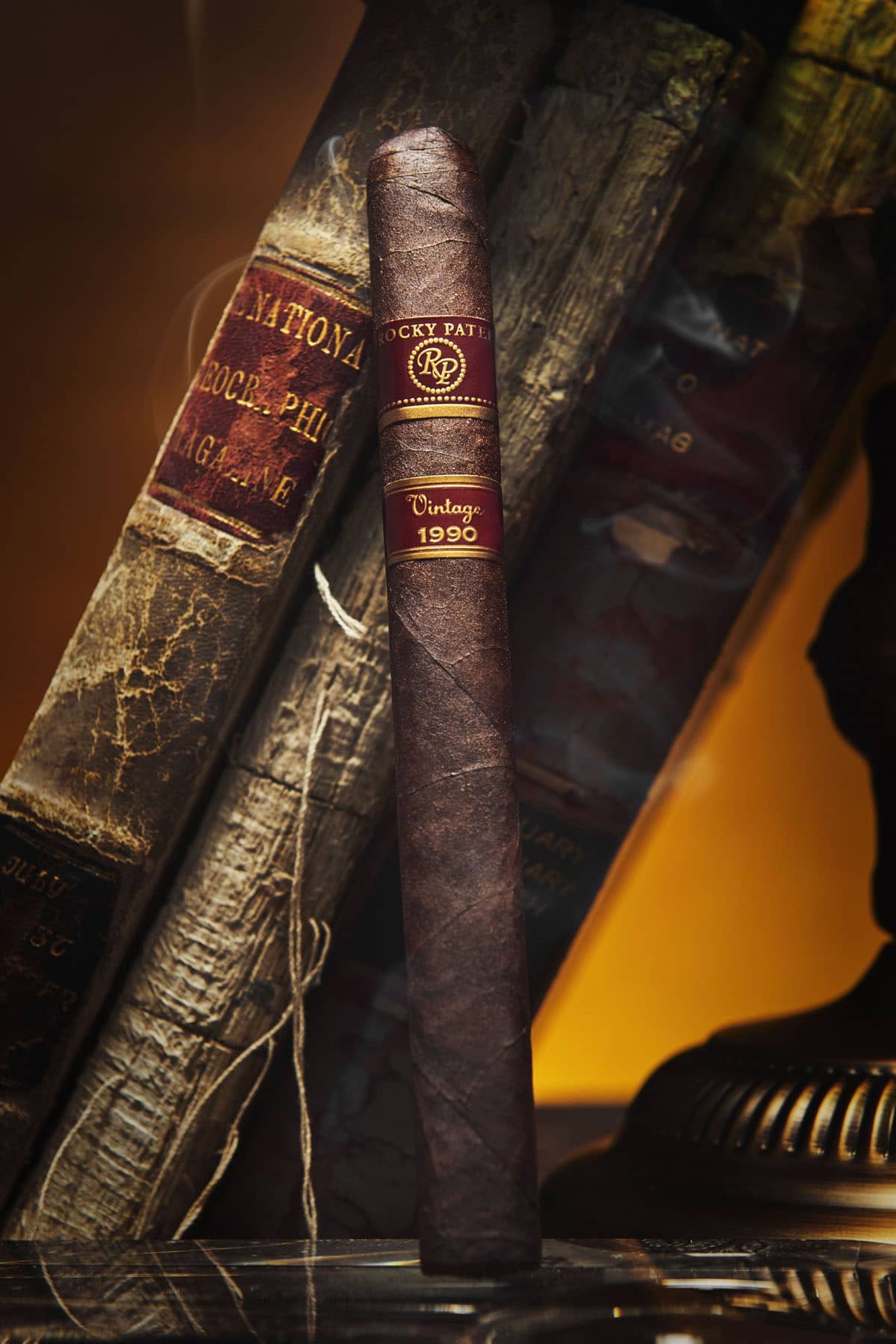
Vintage 1990 Broadleaf is built around an aged Honduran Broadleaf wrapper and sits in the medium range while leaning toward the milder side.
Vintage 1999 Connecticut, by contrast, occupies a clearly mild position and is built around a Connecticut shade-grown wrapper.
So we are not simply comparing:
1990 vs 1999.
We are comparing two philosophies:
aged Broadleaf vs Connecticut Shade.
Depth vs delicacy.
Medium leaning mild vs mild.
That is precisely why this pair is one of the most useful educational comparisons in the Rocky Patel portfolio.
1. First, what does “Vintage” actually mean at Rocky Patel?
The word Vintage can create confusion.
In wine, we are accustomed to a vintage referring directly to a harvest year.
In the Rocky Patel portfolio, Vintage is also the name of a major family of cigars.
Therefore, the reader should not automatically assume:
“Vintage 1990 means every tobacco leaf was harvested in 1990.”
What matters is the actual specification of the blend.
And once we examine Vintage 1990 and Vintage 1999 as blends, they separate very quickly.
Their names connect them.
Their tobacco architecture differentiates them.
2. Rocky Patel Vintage 1990 – aged Broadleaf is the central idea
If Vintage 1990 had to be summarized in one sentence, it would be:
An aged Broadleaf expression designed around balance rather than brute force.
The line uses an extensively aged Honduran Broadleaf wrapper and is positioned in the medium range, but closer to the milder side.
This matters for two reasons.
First, Broadleaf is often mentally associated with dark, dense and powerful cigars.
Second, Vintage 1990 demonstrates how maturation can change the way such tobacco expresses itself.
Aging does not necessarily erase character.
It can soften harsh edges while preserving depth.
This is one of the best practical examples of why “older tobacco” should be discussed in terms of what time changed—not simply the number of years involved.
3. Rocky Patel Vintage 1999 – Connecticut as an exercise in finesse
Vintage 1999 moves in almost the opposite direction.
It sits clearly in the mild category and is built around a Connecticut shade-grown wrapper.
The tasting question should therefore not be:
“How powerful is it?”
A better question is:
“How much subtlety can I detect?”
Useful areas to observe include:
creaminess;
smoke texture;
toast;
nuts;
light wood;
restrained sweetness;
delicate spice;
finish.
Vintage 1999 teaches an essential cigar lesson:
flavor intensity and nicotine strength are not the same thing.
A cigar can be mild and still reward careful attention.
4. Broadleaf vs Connecticut Shade – where the real comparison begins
To understand these two cigars, ignore the years in their names for a moment.
The key external difference is:
Vintage 1990 → Honduran Broadleaf
Vintage 1999 → Connecticut Shade
The aged Broadleaf in Vintage 1990 contributes to a darker, deeper direction.
The Connecticut wrapper in Vintage 1999 supports a lighter and more delicate expression.
But avoid turning this into a simplistic rule:
Broadleaf = cocoa.
Connecticut = cream.
A cigar is the entire blend.
The wrapper matters, but it never works alone.
That is precisely what makes this comparison educational: two radically different wrapper philosophies are integrated into cigars from the same broader family.
5. The strength difference is smaller than appearance suggests
Visually, Vintage 1990 may look considerably more imposing.
The darker wrapper can create an assumption:
“This is obviously the strong one.”
But the real difference is more nuanced.
Vintage 1999 is mild.
Vintage 1990 is medium, leaning toward the milder side.
So this is not necessarily a comparison of:
1/5 vs 5/5.
It is a comparison between two relatively accessible cigars with different personalities.
That makes Vintage 1990 a particularly logical step after Vintage 1999.
6. Vintage 1999 – what to observe in the first third
The first third should be approached slowly.
A common beginner mistake with a mild cigar is to puff too frequently because it feels “light.”
That creates heat.
And heat can destroy exactly the subtlety that makes Vintage 1999 interesting.
During the opening section, pay attention to:
smoke texture;
sweetness level;
toast;
creaminess;
pepper intensity.
Do not try to identify ten separate aromas.
A better question is:
“What kind of delicacy does this cigar have?”
That is a much more useful starting point.
7. Vintage 1990 – what to observe in the first third
With Vintage 1990, the analytical question changes.
You are now dealing with aged Broadleaf and a somewhat deeper profile.
Look for changes in:
depth;
body;
texture;
earth;
wood;
roasted character;
cocoa-like impressions;
darker sweetness;
rounded spice.
You do not need to identify these exact notes.
Treat them as flavor families.
The educational value lies in the contrast with Vintage 1999.
8. The best method: do not smoke both on the same day
For a serious comparison, smoking the two cigars back-to-back is not ideal.
The second cigar will be evaluated with a palate already influenced by the first.
A better method is:
same vitola or very similar sizes;
same neutral drink;
similar storage conditions;
similar meal context;
different days;
same tasting sheet.
This reduces unnecessary variables.
The cleaner the comparison, the more useful the conclusion.
9. Robusto vs Robusto – where I would begin
Both lines are available in comparable Robusto formats.
That gives us one of the best possible educational setups:
Vintage 1999 Robusto
vs
Vintage 1990 Robusto.
Now the geometry is largely controlled.
The central variable becomes:
the blend.
This is far more informative than comparing a small Vintage 1999 with a large-ring-gauge Vintage 1990 and then attributing every difference to the wrapper.
If your objective is to understand the two families, Robusto vs Robusto is the cleanest beginning.
10. Toro vs Toro – when you want more time to study development
Toro extends the session.
That creates more room to observe:
first-third identity;
middle transitions;
final concentration;
finish development.
Robusto may answer:
“Which overall profile do I prefer?”
Toro can answer:
“How does each profile develop over time?”
For someone already familiar with both lines, Toro vs Toro may ultimately be the more interesting experiment.
11. Sixty vs Sixty – a lesson in ring gauge
Both lines are also available in large-ring-gauge formats.
This introduces another educational variable.
A Sixty does not automatically mean:
stronger.
A larger ring gauge changes the ratio between wrapper and the quantity of filler.
As a result, a Sixty can express the same general blend differently from a Robusto.
A useful sequence is therefore:
Robusto vs Robusto;
Toro vs Toro;
Sixty vs Sixty.
This way you first learn:
blend difference
and then:
vitola effect.
Trying to learn both at the same time makes interpretation harder.
12. Petite Corona – when geometry increases focus
Narrower formats are also useful for comparison.
A Petite Corona changes the wrapper-to-filler relationship and can present the blend in a more concentrated way.
For the advanced taster, this can become very revealing.
If you especially enjoyed the wrapper character in a larger format, a narrower vitola may offer another perspective.
But avoid the shortcut:
“Smaller ring gauge = automatically stronger.”
The more accurate statement is:
a narrower vitola can change how the blend is perceived.
13. The two lines share a surprisingly broad vitola library
One of the strongest reasons to compare Vintage 1990 and Vintage 1999 is that both families exist in many overlapping formats.
That gives enthusiasts an almost laboratory-like setup.
You can:
keep vitola constant and change the blend;
keep the blend constant and change the vitola.
That is one of the best methods for developing sensory understanding.
Instead of randomly moving from cigar to cigar, you isolate variables.
And isolated variables teach faster.
14. What does the aging story tell us about Vintage 1990?
This is where Vintage 1990 becomes especially educational.
Its wrapper is presented as a long-aged Honduran Broadleaf.
The idea behind that maturation is critical.
Aging is not supposed to erase the tobacco.
It is supposed to help integrate it.
That can mean:
less aggression;
softer pepper;
more rounded sweetness;
better integration;
longer finish;
more mature texture.
So Vintage 1990 becomes a practical example of the statement:
Aging does not necessarily make tobacco weak. It can make it refined.
That links directly with the broader educational topic of tobacco aging.
15. Vintage 1999 has its own aging story as well
It would be incorrect to create the contrast:
1990 = aged
and:
1999 = not aged.
The entire Vintage philosophy is built around mature tobacco and carefully developed materials.
Vintage 1999 simply expresses that philosophy through a different type of leaf.
Its Connecticut shade-grown wrapper leads the cigar into a more delicate direction.
So the meaningful contrast is not:
aged vs unaged.
It is:
aged Broadleaf expression vs mature Connecticut expression.
That is much more precise.
16. Which one is more complex?
It is tempting to answer:
Vintage 1990.
But complexity requires a careful definition.
A darker or stronger cigar is not automatically more complex.
Complexity means:
transitions;
layering;
changing relationships between flavors;
development across the cigar;
evolving finish.
Vintage 1990 may appear more obviously layered because its profile is darker and deeper.
Vintage 1999 may require more attention precisely because its signals are more subtle.
A delicate cigar can still be complex.
It may simply express complexity at a lower volume.
17. Which one is better for a first premium cigar?
For someone with little or no cigar experience, I would generally begin with:
Vintage 1999.
The reason is simple:
mild strength leaves more room to focus on technique.
A beginner can learn:
pacing;
draw;
temperature;
cutting;
lighting;
basic aroma recognition.
Then:
Vintage 1990
becomes a logical second step.
It adds depth without requiring an abrupt jump into a medium-full profile.
That progression is educational:
delicacy → depth.
18. Which one is better for an experienced smoker?
There is no automatic answer.
Experience does not mean:
“I now need stronger cigars.”
An experienced smoker may choose Vintage 1999 precisely because subtle Connecticut cigars can be rewarding when the palate is trained enough to notice fine differences.
On the other hand, if the objective is:
Broadleaf;
deeper flavor;
aging character;
richer body;
then Vintage 1990 is the more logical option.
Experience does not choose the winner.
Preference does.
19. Which one makes more sense earlier in the day?
From a purely sensory perspective, Vintage 1999 naturally fits situations where the palate is relatively fresh and the smoker wants subtlety.
Its mild profile can make it especially useful for a quiet analytical session.
Still water is the cleanest tasting partner.
A lighter coffee may be interesting after you already understand the cigar.
But if you are studying the blend itself, neutral conditions remain more informative.
20. Which one makes more sense after a meal?
Vintage 1990 can become especially interesting when the palate is ready for something deeper.
The aged Broadleaf and medium-to-milder-medium positioning give it more presence without automatically pushing into aggressive strength.
But context still matters.
A very sweet dessert, powerful spirit or extremely bitter coffee can overwhelm cigar nuance.
If the goal is comparison:
start with water.
Pairing should be the second experiment.
21. The biggest mistake: comparing only strength
If the final conclusion is merely:
“Vintage 1990 is somewhat stronger than Vintage 1999,”
we have missed most of what matters.
Compare separately:
Strength
Physiological impact.
Body
Density and weight of smoke.
Flavor intensity
How clearly aromas present themselves.
Texture
Creamy, dry, dense, silky or rough.
Complexity
How the cigar develops and layers.
Finish
What remains after the smoke leaves the mouth.
Only then can you decide which cigar actually fits your preference.
22. Mistake #2 – assuming the darker wrapper must be dramatically stronger
This pair is almost perfect for dismantling that myth.
Vintage 1990 is darker and uses Broadleaf.
Vintage 1999 uses Connecticut Shade.
Yet the difference in official positioning is not remotely equivalent to:
very mild vs extremely strong.
This teaches a general lesson:
Dark wrapper does not automatically equal high nicotine strength.
Read the blend.
Then taste it.
Do not use color as your only strength scale.
23. Mistake #3 – assuming Vintage 1990 is “better” because it is deeper
More intense does not mean better.
A double espresso is not automatically “better” than a delicate filter coffee.
They are different experiences.
Vintage 1999 may be the better choice when you want:
finesse;
creaminess;
relaxation;
brighter aromatic character.
Vintage 1990 may be better when you want:
depth;
Broadleaf character;
fuller body;
mature tobacco expression.
The winner depends on the question.
24. A practical tasting-journal comparison
Use the same template for both cigars.
Record:
wrapper aroma before cutting;
cold draw;
strength;
body;
first third;
second third;
final third;
sweetness;
pepper;
creaminess;
roasted notes;
earth/wood;
finish;
burn;
draw;
“When would I choose this cigar again?”
That last question is more useful than:
“Which one is objectively better?”
A much better question is:
“What occasion and mood suits each one?”
25. Mister Tabaco Vintage Flight – Level 1
For someone beginning to study Rocky Patel:
Session 1
Vintage 1999 Robusto
Objective:
understand mild strength, Connecticut and delicacy.
Session 2
Vintage 1990 Robusto
Objective:
observe aged Broadleaf, deeper body and a darker aromatic direction.
Use the same drink.
Ideally water.
This makes the contrast easier to understand.
26. Mister Tabaco Vintage Flight – Level 2
After Robusto vs Robusto, repeat the exercise with:
Toro vs Toro.
Now the question becomes:
not simply:
“Which line do I prefer?”
but:
“How does the difference between the lines evolve during a longer session?”
The additional time allows transitions to become easier to observe.
27. Mister Tabaco Vintage Flight – Level 3
Then move to:
Vintage 1999 Sixty vs Vintage 1990 Sixty.
At this point, you already know the blends.
Now you can study the effect of large ring gauge without confusing it entirely with blend identity.
After six sessions:
1999 Robusto;
1990 Robusto;
1999 Toro;
1990 Toro;
1999 Sixty;
1990 Sixty;
you will understand these two families far more deeply than from simply reading product descriptions.
28. What should ratings tell us?
Both lines have received strong recognition over the years.
That can help provide context.
But a rating must never be reduced to:
92 > 91, therefore one cigar is objectively better.
Ratings are structured tasting opinions.
Your own preference is a separate variable.
A trained smoker can completely reasonably prefer Vintage 1999 even if another source rates Vintage 1990 higher.
The point of a comparative article is not to replace your palate with someone else’s score.
It is to help you use your palate more intelligently.
29. Which one makes more sense in a diversified humidor?
Ideally:
both.
Why?
Because they are not redundant.
Vintage 1999 fills the role of:
mild / Connecticut / delicate.
Vintage 1990 fills the role of:
aged Broadleaf / deeper / medium leaning mild.
If your humidor contains only dense San Andrés and medium-full cigars, Vintage 1999 adds contrast.
If you own only very delicate Connecticut cigars, Vintage 1990 adds depth without forcing an extreme jump in strength.
A well-designed humidor should not contain only “the strongest cigars.”
It should contain options.
30. How do I choose quickly between Vintage 1990 and Vintage 1999?
Use this simple rule:
Choose Vintage 1999 if you want delicacy, mild strength and Connecticut character.
Choose Vintage 1990 if you want greater depth, aged Broadleaf and a medium profile leaning toward the milder side.
And if you are unsure:
do not simply choose one.
Compare them.
That is the more interesting answer.
31. FAQ – Vintage 1990 vs Vintage 1999
Which one is milder?
Vintage 1999.
Vintage 1990 is positioned slightly higher in intensity, but still on the accessible side of the medium spectrum.
Which one uses Broadleaf?
Vintage 1990 uses an aged Honduran Broadleaf wrapper.
Which one uses Connecticut?
Vintage 1999 uses a Connecticut shade-grown wrapper.
Is Vintage 1990 dramatically stronger?
No. It should not be treated as a huge leap from Vintage 1999.
Which is better for beginners?
Vintage 1999 is the more logical first reference.
What should come after Vintage 1999?
Vintage 1990 is a natural progression toward more depth without jumping immediately into medium-full territory.
Can I compare them in Robusto?
Yes, and that is one of the best comparisons.
Can I compare them in Toro?
Yes. Toro provides a longer session for studying development.
Can I compare them in Sixty?
Yes. That becomes a useful large-ring-gauge experiment.
Which one is better?
There is no universal answer.
The choice depends on whether you prefer Connecticut delicacy or aged Broadleaf depth.
Can I compare two different vitolas?
You can, but if your objective is to study the blend itself, using the same or very similar vitola is much more informative.
Does darker wrapper mean higher nicotine strength?
No.
This pair is a very good example of why wrapper color alone is not a reliable strength scale.
32. Mister Tabaco comparative verdict
I would not declare one absolute winner.
I would frame the decision like this:
Vintage 1999 wins when you want:
delicacy, an accessible first premium cigar, Connecticut character and a session where finesse matters more than power.
Vintage 1990 wins when you want:
more depth, aged Broadleaf, more body and a practical example of how aging can refine wrapper tobacco.
Both win when:
you taste them comparatively and understand why two cigars in the same family can deliver such different experiences.
That is the real educational value.
Conclusion – two Vintage cigars, two lessons about tobacco
Rocky Patel Vintage 1990 and Vintage 1999 are not simply two versions of the same cigar.
They are two lessons.
Vintage 1999 says:
A mild cigar can still deliver elegance and flavor without chasing strength.
Vintage 1990 says:
A mature Broadleaf wrapper can keep its character while becoming more refined.
Vintage 1999 teaches:
Connecticut + finesse + mild strength.
Vintage 1990 teaches:
Broadleaf + aging + depth.
And because both families can be explored across several comparable vitolas, the educational opportunity becomes even stronger.
If you are beginning:
start with Vintage 1999.
Then:
move to Vintage 1990.
If you already have experience:
compare them in the same vitola.
And if you want to continue:
compare each line in Robusto, Toro and Sixty.
At that point, you are no longer studying only two cigars.
You are learning how:
wrapper + aging + strength + vitola
interact inside one smoking experience.
Mister Tabaco
At Mister Tabaco, you can turn theory into practical comparisons between blends, vitolas and origins.
Continue the Tobacco Guide
→ What Is Premium Tobacco and How Is It Different from Ordinary Tobacco?
→ Wrapper, Binder and Filler – the anatomy of a premium cigar
→ Maduro Explained Properly – Color, Fermentation, Flavor and the Strength Myth
→ Ligero, Seco and Volado – how leaf position changes a premium cigar
→ How Cigar Tobacco Is Grown – From Seed to Harvest
→ Tobacco Fermentation – The Process That Transforms the Leaf
→ Tobacco Aging – Why Some Cigar Leaves Are Aged for Years
→ How a Master Blender Creates a Cigar
→ Shade-Grown vs Sun-Grown: How Light Changes a Cigar Wrapper
→ Long Filler vs Short Filler – The Real Differences in Cigar Construction
→ Strength vs Body vs Flavor – How to Describe a Cigar Correctly
→ How Vitola Changes Cigar Flavor: Robusto vs Toro vs Churchill vs Sixty
→ How to Choose Your First Premium Cigar – A Complete Beginner’s Guide
→ How to Taste a Premium Cigar and Identify Aromas
→ How to Store Cigars Properly: Humidor, Temperature and Humidity
→ Common Mistakes That Can Ruin the Experience of a Premium Cigar
→ Rocky Patel Guide: Differences Between the Main Collections at Mister Tabaco
→ Rocky Patel Vintage 1990 vs Vintage 1999: Aged Broadleaf or Delicate Connecticut?
→ Rocky Patel Number 6 vs DBS: Balanced Corojo or Broadleaf Architecture?
→ Rocky Patel SIXTY vs A.L.R. Second Edition: Two San Andrés Interpretations, Two Aging Philosophies
→ How to Choose a Rocky Patel by Experience, Strength and Flavor Profile
Explore the Cigar Guide
→ How to Choose Your First Cigar
→ Which Rocky Patel Cigar Should You Choose as a Beginner?
→ How to Smoke a Cigar Properly
→ Robusto, Toro or Churchill? Cigar Size Guide
→ How to Store Cigars Properly
→ Cuba vs Nicaragua vs Dominican Republic vs Honduras
→ How to Identify Cigar Flavors
→ Cigar Pairing with Whisky, Rum, Cognac or Coffee
→ 10 Common Cigar Mistakes Beginners Make
→ How to Choose a Cigar as a Gift or for a Special Occasion
Tobacco products are intended for adults only. Smoking seriously damages your health.