
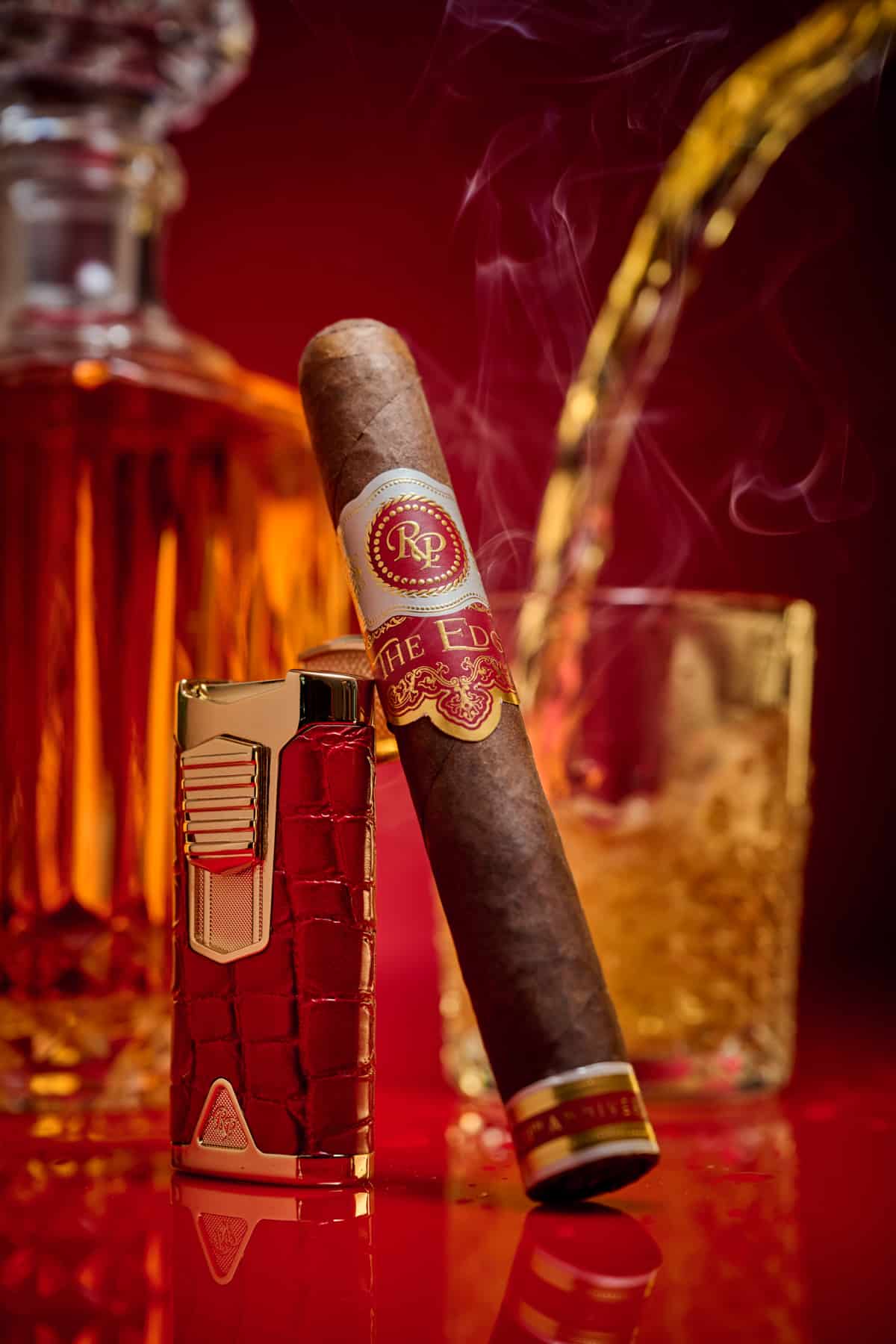
A premium cigar begins as a plant, but harvested tobacco is nowhere near ready to smoke. Fresh leaves are green, moist and chemically raw. Curing changes their color and reduces moisture, yet the leaf still contains harsh, undesirable characteristics. One of the decisive transformations happens later, in the tobacco warehouse: fermentation.
During fermentation, cured tobacco is conditioned with moisture and arranged in large stacks known as pilónes. Pressure, moisture and natural enzymatic and microbial activity generate heat inside the stack. The temperature is monitored; when the tobacco reaches the maker’s target, the pilón is dismantled, the leaves are redistributed and the stack is built again. Cigar Aficionado documents pilónes weighing several thousand pounds and temperatures that can approach 140°F in some processes. Rocky Patel describes approximately 2,500-pound pilónes and a working range around 110–130°F in its own process. These figures are not universal recipes: leaf type, thickness, priming and the blender’s goal determine the protocol.
1. Curing and fermentation are not the same process
Curing begins after harvest. Leaves hang in barns while moisture declines and chlorophyll breaks down; green turns to yellow and eventually brown. Fermentation follows curing. The leaf is carefully reconditioned and stacked so that heat-producing transformations can refine it.
Think of curing as preparing the raw material, fermentation as refining it, and aging as the slow maturation that follows. Using these terms interchangeably hides some of the most important work in premium cigar production.
2. What exactly is a pilón?
A pilón is an engineered stack of tobacco, not a random pile. Leaves are normally classified so that tobacco of similar size, structure and type ferments together.
The mass of tobacco creates pressure. Moisture and biological activity generate heat. Because the center becomes warmer than the outer layers, the stack must be managed continuously.
Rocky Patel states that its leaves are rehydrated and hand-stacked into pilónes of roughly 2,500 pounds. When the desired temperature is reached, the tobacco is turned. The company describes fermentation lasting from about six months to more than a year depending on the tobacco.
3. Where does the heat come from?
No fire is used. The heat is produced within the mass of conditioned leaf.
Residual moisture and organic compounds support enzymatic and microbial processes. In a large, compressed stack, the energy from those processes raises the internal temperature. This is why fermentation is both natural and highly managed.
Temperature is therefore a key operational signal. Experienced tobacco workers do not simply wait for a calendar date. They monitor the pilón, smell the leaf, feel it and judge how it is progressing.
4. Why the pilón must be turned
The tobacco in the center experiences more heat than the tobacco on the outside. If the stack were never moved, fermentation would be uneven and the central leaves could be damaged.
During a turn, workers dismantle the pilón and redistribute the hands of tobacco. Inner leaves move outward; outer leaves move inward; upper and lower sections can change positions. The pilón is then rebuilt.
Rocky Patel describes turning its stacks every 7–10 days in the process shown on its website, subject to the target temperature. Other producers use different schedules. The skill lies in reading the leaf rather than blindly following a timer.
5. Ammonia, bitterness and harshness
Under-fermented tobacco may smell strongly of ammonia and taste sharp, bitter or raw. Fermentation helps remove impurities and changes the chemical character of the leaf.
Cigar Aficionado has described fresh fermentation rooms as eye-stinging because of ammonia released from the bulks. As processing progresses, harshness falls and the tobacco’s more attractive aromatic potential becomes clearer.
Fermentation does not literally add chocolate, coffee, nuts or spice. Those tasting terms are sensory associations used to describe aromas and flavors perceived in processed tobacco.
6. Different leaves ferment at different rates
A thin wrapper leaf and a thick ligero leaf cannot automatically be treated the same way. Thickness, oil content, plant position, seed variety and growing region all affect fermentation.
Delicate tobacco can require gentler cycles. Thick, powerful leaf may need more time or repeated cycles. Cigar Aficionado contrasts relatively thin Connecticut Shade with heavier Broadleaf, which often demands more intensive processing.
This is why “fermented for X months” is not, by itself, a quality statement. The relevant questions are: which tobacco, at what moisture and temperature, for what purpose?
7. Why wrapper fermentation is especially demanding
The wrapper is the visible outer leaf and an important contributor to flavor. Premium wrapper must remain supple, structurally sound and visually attractive.
Overly aggressive fermentation can damage the leaf or strip away qualities the blender wants to preserve. Insufficient fermentation can leave green, bitter or ammoniacal characteristics.
Producing wrapper tobacco therefore requires precision at every stage, from field selection to sorting and fermentation.
8. Fermentation, color and the road to Maduro
Maduro is often misunderstood as a synonym for “very strong.” It is not.
Dark Maduro wrappers generally come from suitable leaf processed through longer or more intensive controlled fermentation. The process can deepen color and help develop impressions such as cocoa, coffee, earth, molasses or sweetness. None of those descriptors automatically determines nicotine strength.
Mexican San Andrés is a classic example of a leaf capable of substantial fermentation. Reporting from the Turrent family’s operations in San Andrés Tuxtla describes very large pilónes of black tobacco reaching around 140°F before being turned.
A later article in this series will separate four ideas that are often confused: wrapper color, fermentation, flavor and strength.
9. What happens when fermentation stops too early?
Under-fermented tobacco can retain sharp, vegetal, bitter or ammonia-like qualities. In a cigar these notes can overwhelm the blend.
A humidor cannot necessarily “repair” this problem. Aging and fermentation are different processes. A poorly processed cigar does not automatically become excellent because it spends two years in a box.
Age is therefore not proof of correct fermentation.
10. What if fermentation goes too far?
Excessive heat, moisture or time can damage the leaf, flatten its character or even ruin an entire pilón.
Jorge Padrón has discussed the real production risk of losing tobacco during rigorous fermentation, noting that the company would rather accept losses than knowingly use under-fermented leaf.
Premium fermentation is not about maximizing time or heat. It is about stopping at the correct point.
11. Natural fermentation versus forcing a dark appearance
Consumers sometimes assume that the darkest wrapper must be the most premium. Color can be misleading.
The goal in premium production is controlled transformation of the leaf, not simply forcing a black appearance. Dark tobacco is not automatically older, sweeter, stronger or more expensive.
Judge a cigar by the producer, blend, provenance and smoking experience—not by wrapper shade alone.
12. What comes next: aging
After fermentation, tobacco is sorted again and commonly packed into bales for slower maturation.
Cigar Aficionado describes fermented leaf aging in bales for two to several years in many premium-cigar programs. Moisture is lower than during active fermentation, so the same level of heat is not produced.
Aging can soften rough edges and add nuance. It is the subject of the next article in this series.
13. Why old tobacco inventories matter to master blenders
A master blender does not merely work with “Nicaraguan” or “Honduran” tobacco. The real palette includes farms, lots, primings, seed varieties and crop years.
Large inventories of properly fermented and aged tobacco allow a manufacturer to preserve a brand’s character despite agricultural variation. One crop may be stronger, another sweeter or thinner. Blending across lots helps maintain consistency.
For a serious cigar house, the tobacco warehouse is therefore one of its most important assets.
14. Practical examples from Mister Tabaco’s Rocky Patel selection
Rocky Patel Vintage 1990
A useful cigar for discussing mature tobacco and the difference between refinement and raw intensity.
Rocky Patel Vintage 1999
An excellent comparison point against Vintage 1990, especially for observing how a different wrapper changes creaminess, sweetness and perceived strength.
Rocky Patel SIXTY
A richer profile where fermentation of robust tobacco is crucial: the leaf must be refined without erasing its personality.
Rocky Patel A.L.R. Second Edition
A.L.R. stands for Aged, Limited and Rare. It naturally opens the discussion about what happens after fermentation and why additional maturation can matter.
Rocky Patel DBS
A useful counterpoint for smokers seeking more structure and intensity. Powerful components require particularly careful processing to remain balanced.
Product availability can change; link only active Mister Tabaco products when the article is published.
15. Can a smoker recognize well-processed tobacco?
There is no single foolproof test, but there are clues.
A well-made cigar should not be dominated by ammonia. Smoke may be intense without being crudely aggressive. Aromas should have some clarity and the cigar should be able to show development rather than persistent raw-leaf harshness.
Still, a rough experience does not prove faulty fermentation. Incorrect storage, smoking too quickly, construction, lighting technique or simple personal preference can create similar symptoms.
16. Five common myths about fermentation
“Longer fermentation always means better tobacco”
False. The process must fit the leaf.
“Maduro automatically means strong”
False. Color and nicotine strength are different variables.
“Aging fixes bad fermentation”
Not reliably. They are distinct processes.
“Every leaf in a cigar is fermented identically”
Not necessarily. Wrapper, binder and filler may come from different lots and protocols.
“A black wrapper proves premium quality”
No. Color alone is not a quality certificate.
17. A tasting exercise for the reader
Choose two contrasting cigars—perhaps a Rocky Patel Vintage 1999 and a SIXTY or DBS, if available.
Record the wrapper aroma, cold draw, first ten minutes, pepper level, perceived sweetness, smoke texture, associations such as cocoa/coffee/wood/nuts/earth/cream, and changes through the second half.
The goal is not to “guess the fermentation.” It is to train your palate to notice how differently processed tobaccos contribute to a blend’s personality.
18. FAQ
How long does tobacco fermentation take?
It can take months and, for some tobaccos and protocols, more than a year. Rocky Patel describes roughly six months to more than one year for its process.
Does a finished cigar ferment?
Finished cigars are normally aged rather than subjected to the same active pilón fermentation. Post-roll aging allows the tobaccos to stabilize and marry.
Why does fermenting tobacco smell like ammonia?
Volatile compounds and impurities are being released from the leaf during active processing.
Is fermentation just drying?
No. Curing/drying and fermentation are separate stages.
What is a pilón?
A controlled stack of conditioned tobacco in which pressure, moisture and natural activity generate fermentation heat.
Why is a pilón turned?
To redistribute the tobacco, manage heat and make processing more uniform.
Is Maduro created only by fermentation?
Fermentation is crucial, but leaf variety, thickness, harvest and producer technique also matter.
Is a darker cigar stronger?
Not necessarily. Strength depends on the entire blend, especially filler composition, not simply wrapper color.
Can I ferment cigars in my humidor?
Not in the industrial pilón sense. A humidor is designed for stable cigar storage, not active leaf fermentation.
Why are some tobaccos fermented more than once?
Some leaf needs additional cycles to reach the producer’s desired balance, color and aromatic profile.
19. Conclusion: where patience becomes flavor
Nature builds the leaf in the field. Curing removes its green character and begins the transformation. Fermentation is where raw agricultural material is refined into tobacco that a master blender can seriously use.
The best fermentation does not feel like a trick. The smoker never sees the months of monitoring, the hot pilónes, the repeated turning or the tobacco sacrificed to quality control. The smoker experiences the result: less harshness, clearer flavor, better balance and greater depth.
Mister Tabaco
At Mister Tabaco, you can turn theory into practical comparisons between blends, vitolas and origins.
Continue the Tobacco Guide
→ What Is Premium Tobacco and How Is It Different from Ordinary Tobacco?
→ Wrapper, Binder and Filler – the anatomy of a premium cigar
→ Maduro Explained Properly – Color, Fermentation, Flavor and the Strength Myth
→ Ligero, Seco and Volado – how leaf position changes a premium cigar
→ How Cigar Tobacco Is Grown – From Seed to Harvest
→ Tobacco Fermentation – The Process That Transforms the Leaf
→ Tobacco Aging – Why Some Cigar Leaves Are Aged for Years
→ How a Master Blender Creates a Cigar
→ Shade-Grown vs Sun-Grown: How Light Changes a Cigar Wrapper
→ Long Filler vs Short Filler – The Real Differences in Cigar Construction
→ Strength vs Body vs Flavor – How to Describe a Cigar Correctly
→ How Vitola Changes Cigar Flavor: Robusto vs Toro vs Churchill vs Sixty
→ How to Choose Your First Premium Cigar – A Complete Beginner’s Guide
→ How to Taste a Premium Cigar and Identify Aromas
→ How to Store Cigars Properly: Humidor, Temperature and Humidity
→ Common Mistakes That Can Ruin the Experience of a Premium Cigar
→ Rocky Patel Guide: Differences Between the Main Collections at Mister Tabaco
→ Rocky Patel Vintage 1990 vs Vintage 1999: Aged Broadleaf or Delicate Connecticut?
→ Rocky Patel Number 6 vs DBS: Balanced Corojo or Broadleaf Architecture?
→ Rocky Patel SIXTY vs A.L.R. Second Edition: Two San Andrés Interpretations, Two Aging Philosophies
→ How to Choose a Rocky Patel by Experience, Strength and Flavor Profile
Explore the Cigar Guide
→ How to Choose Your First Cigar
→ Which Rocky Patel Cigar Should You Choose as a Beginner?
→ How to Smoke a Cigar Properly
→ Robusto, Toro or Churchill? Cigar Size Guide
→ How to Store Cigars Properly
→ Cuba vs Nicaragua vs Dominican Republic vs Honduras
→ How to Identify Cigar Flavors
→ Cigar Pairing with Whisky, Rum, Cognac or Coffee
→ 10 Common Cigar Mistakes Beginners Make
→ How to Choose a Cigar as a Gift or for a Special Occasion
Tobacco products are intended for adults only. Smoking seriously damages your health.