
1. Where Aging Begins in the Life of a Tobacco Leaf
The sequence is fundamental: Harvesting → Curing → Fermentation → Aging During curing, freshly harvested tobacco leaves gradually lose moisture and change from green to brown. Fermentation is different. Conditioned leaves are assembled into large piles traditionally known as pilónes. Moisture, pressure and naturally occurring biological and chemical processes generate heat inside the pile. During controlled fermentation, harsh characteristics are reduced, ammonia dissipates and the chemical composition of the tobacco changes. Aging generally occurs once the active fermentation stage has been completed, although manufacturers may use multiple fermentation and resting cycles depending on the tobacco. At this stage, the tobacco is considerably drier and is commonly stored in bales. The critical difference is intensity. Fermentation is comparatively active and generates substantial heat. Aging is slower and more gradual. That is why saying that tobacco was “fermented for five years” is not the same as saying that it was “aged for five years.”
2. What Is Bale Aging?
A bale is a compact package of tobacco that has already undergone the necessary fermentation. Relatively dry leaves are arranged, compressed and wrapped, traditionally in materials such as burlap. The exact dimensions and weight of tobacco bales vary between producers and operations. What matters is the principle: the leaf can remain in this stable format for years and, in exceptional circumstances, much longer. Why use bales? Because they provide an environment suitable for extremely slow development. The objective is no longer the intense fermentation taking place inside a pilón. The manufacturer now wants stability, time and subtle transformation. A useful analogy is the difference between a strong fire and glowing embers: Fermentation is the fire. Aging is the slow ember.
3. What Changes in Tobacco During Aging?
Aging is not simply storage. The compounds inside the leaf continue to evolve gradually. Over time, properly aged tobacco may lose some of its raw vegetal character and harsh edges. Aromatic components become more integrated, while the sensory impression can become rounder and more refined. For the cigar smoker, successful aging may translate into:
- less harshness;
- lower perceived acidity;
- a rounder texture;
- greater integration between flavors;
- more refined impressions of nuts, dried fruit, wood, cocoa, cream or spices.
This does not mean aging artificially introduces these flavors. No one is putting cocoa, cedar or dried fruit into the tobacco. Instead, slow transformations in the leaf alter the way its existing aromatic compounds are perceived. This distinction is essential. Aging refines the raw material. It does not replace it.
4. Why Stronger Tobacco Can Benefit from Extended Aging
Ligero and other thick, oily, powerful leaves can require considerable time to become properly integrated into a premium cigar blend. This reveals one of the interesting paradoxes of premium cigar production. A master blender does not necessarily want to eliminate the tobacco’s power. The goal is often to remove brutality without removing character. A mature ligero leaf may remain intense while becoming more refined. Pepper can feel more polished. Natural sweetness may become easier to detect. Transitions between different aromatic impressions may become clearer. Consequently, the expression “mellowed with age” should not automatically be interpreted as “weak.” A tobacco can become smoother without becoming boring.
5. Does Older Automatically Mean Better?
No. This is perhaps the most important principle in the entire discussion about cigar aging. Not every cigar improves indefinitely. There is a point of diminishing returns, and the ideal aging window depends on the tobacco and the blend. Mediocre tobacco does not become extraordinary simply because it spends ten years in a warehouse. If the leaf was poorly cultivated, badly fermented or incorrectly stored, time cannot manufacture quality from nothing. Furthermore, excessive aging can sometimes remove characteristics that originally made a blend exciting. A young cigar may offer energetic pepper, vivid aromatic contrast and a certain freshness. With extended aging, those elements may become softer and more integrated—but sometimes also less energetic. The intelligent question is therefore not: “How old is this tobacco?” It is: “What has this tobacco gained through aging?”
6. Aging Tobacco vs Aging a Finished Cigar
These two concepts are often confused. Pre-roll aging This occurs before the cigar is rolled. Individual tobacco leaves are fermented and subsequently aged before being selected for a blend. This is where bale aging and the manufacturer’s tobacco reserves become particularly important. Post-roll aging A second maturation stage can occur after the cigar has been rolled. Wrapper, binder and filler leaves have previously been handled independently and may have slightly different moisture levels. Once combined into a cigar, they become a single physical system. Manufacturers can therefore place finished cigars in aging or resting rooms. This allows moisture levels to stabilize and the components of the blend to integrate. A manufacturer can consequently use tobacco that has already been aged for many years and then age the finished cigar for additional months—or even years.
7. What Does “Marrying” Mean After Rolling?
“Marrying” sounds poetic, but it describes a practical phenomenon. A premium cigar usually contains several components: Wrapper + Binder + Filler The filler itself may contain tobaccos from different regions, farms, primings or harvests. Each leaf has followed its own journey through cultivation, curing, fermentation and aging. Once the cigar is rolled, these separate components begin functioning together. Resting allows moisture to stabilize throughout the cigar and can help the overall aromatic profile become more coherent. This is one reason a cigar smoked immediately after production may sometimes appear less integrated than the same blend after an appropriate resting period. It also helps explain why cigars may occasionally benefit from rest after transportation or significant environmental changes.
8. Box Aging – What Can the Consumer Do at Home?
There is another form of aging: aging performed by the cigar owner. Boxes or individual cigars can be kept under stable humidor conditions for months or years. This can become a fascinating experiment. But it should not become a religion. Not every cigar improves with prolonged storage. An intelligent experiment is to purchase several cigars from the same batch and compare them at different intervals:
- smoke one now;
- another after six months;
- another after twelve months;
- another after twenty-four months.
Use the same tasting criteria each time. Record:
- strength;
- body;
- flavor;
- pepper;
- sweetness;
- texture;
- complexity;
- finish;
- overall balance.
This experiment can teach you more about aging than simply reading marketing descriptions.
9. Why Cigar Manufacturers Maintain Huge Tobacco Libraries
Tobacco is an agricultural product. Two consecutive harvests are never perfectly identical. Rainfall, temperature, wind, soil conditions and harvest timing can influence leaf thickness, oils, sugars, combustion and intensity. Yet consumers expect a familiar cigar line to maintain a reasonably consistent profile from year to year. This is where tobacco reserves become strategically important. Serious manufacturers maintain bales from different crops and lots. A master blender can draw from these reserves to compensate for agricultural variation and maintain the identity of an established blend. A warehouse filled with aged tobacco is therefore more than inventory. It is an aromatic library.
10. The Hidden Cost of Ten-Year-Aged Tobacco
When you read “10-year-aged tobacco,” think about economics as well as flavor. The tobacco first had to be cultivated or purchased. Then it had to be sorted. Fermented. Packed. Stored. Inspected. Protected. Warehouse space costs money. Inventory ties up capital. There are natural losses and risks associated with long-term storage. And throughout those ten years, the producer cannot convert that particular tobacco into immediate revenue. This is why genuinely valuable old tobacco reserves can become strategically important for limited editions, anniversary releases and blends built specifically around mature leaf. Time is not free. In premium cigar manufacturing, time itself becomes part of the production cost.
11. Rocky Patel Vintage 1990 – A Practical Example of an Aged Wrapper
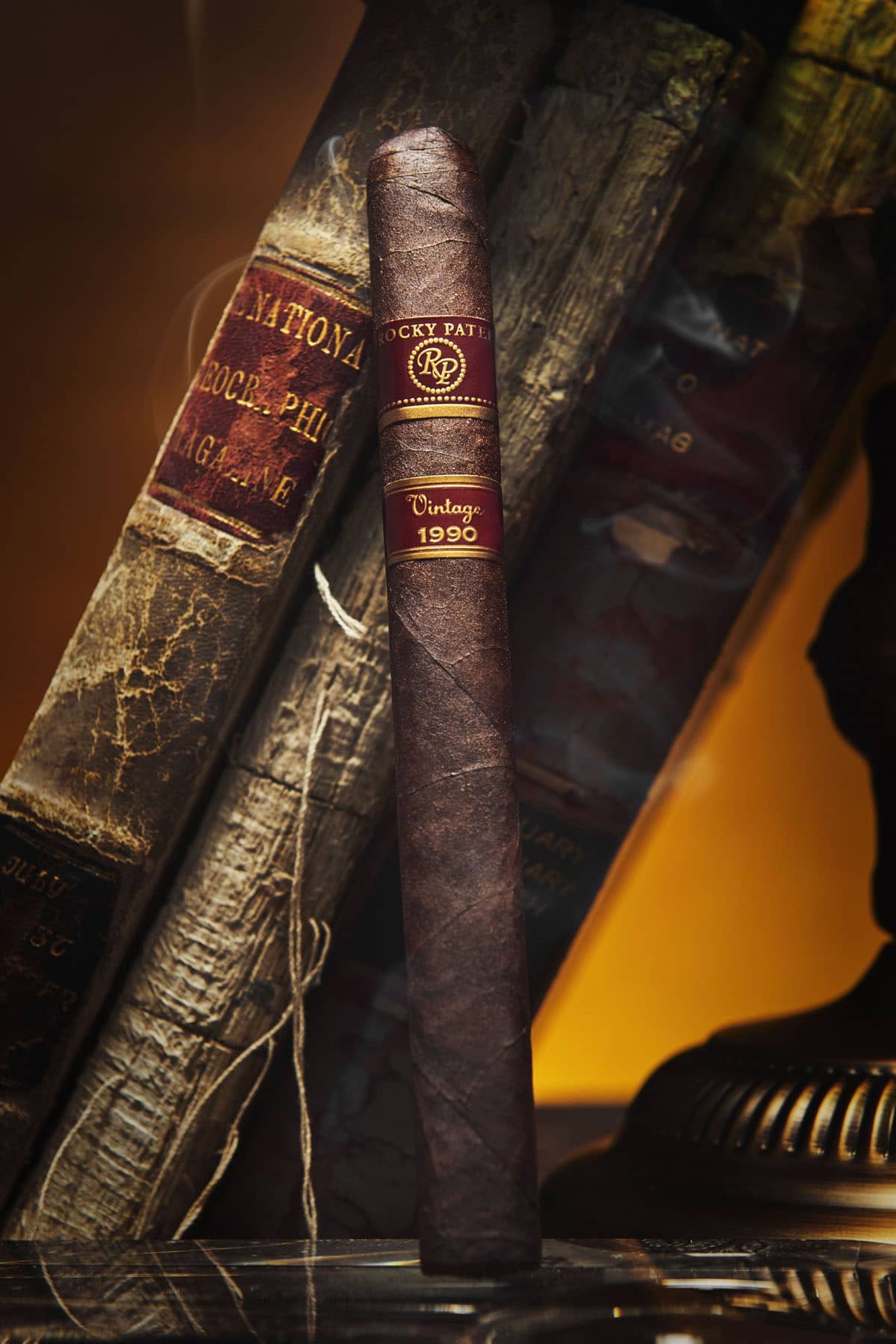
Rocky Patel Vintage 1990 is an excellent real-world example. The manufacturer describes the cigar as medium-bodied, leaning toward the milder side, and highlights a 12-year-old Honduran Broadleaf wrapper. Rocky Patel specifically notes that the wrapper softened in strength over the years while gaining complexity and character. This is almost a textbook illustration of successful aging. The objective was not to erase the identity of the tobacco. It was to transform it. A Broadleaf wrapper that might have been more direct and forceful when younger can become rounder, more integrated and more layered after prolonged maturation. Mister Tabaco’s range allows this concept to be explored across vitolas such as Robusto, Toro and Six by Sixty.
12. Rocky Patel A.L.R. Second Edition – When Aging Continues After Rolling
A.L.R. stands for: Aged. Limited. Rare. What makes A.L.R. Second Edition especially relevant to this subject is that aging does not end with the individual leaves. The finished cigars themselves were deliberately rested before release. Published information about the line describes the cigars as spending approximately two years aging after rolling. This is post-roll aging on a commercial scale. From a business perspective, that decision is significant. The manufacturer has already paid to cultivate or acquire the tobacco, ferment it, age it, blend it and roll the finished cigar. The product physically exists. But instead of selling it immediately, the company keeps it in storage because the blend is expected to benefit from additional integration. For enthusiasts, A.L.R. Second Edition therefore provides a particularly useful case study in post-roll maturation.
13. Edge 20th Anniversary – When Mature Tobacco Becomes Part of the Story
Rocky Patel The Edge 20th Anniversary offers another approach. The cigar uses an Ecuador Sumatra wrapper over Nicaraguan and Honduran tobaccos, and the line is positioned as an anniversary interpretation of The Edge. The Ecuadorian Sumatra wrapper is described as having been aged for more than ten years. This creates a useful comparison: Vintage 1990 emphasizes a 12-year-aged Honduran Broadleaf wrapper. A.L.R. Second Edition demonstrates extended post-roll aging. Edge 20th Anniversary illustrates the use of mature tobacco as a defining element of an anniversary blend. Three cigars. Three different ways in which time becomes part of cigar architecture.
14. “Vintage Tobacco” Does Not Always Mean the Same Thing
The word vintage requires careful interpretation. In wine, vintage usually refers to a specific harvest year. In cigars, commercial usage can vary. Sometimes the word refers to tobacco from a particular crop. Sometimes it emphasizes the age of a particular component. Sometimes it is simply part of the name of a cigar line. The informed consumer therefore asks more precise questions:
- Which component was aged?
- For how many years?
- Was it aged before or after rolling?
- Is a harvest year specified?
- Is the manufacturer talking about the wrapper or the entire blend?
These questions are far more informative than simply seeing the word Vintage printed on a box.
15. How Aromas Change Over Time
Successful aging often reduces harsh contrasts and encourages integration. A young cigar may display very direct pepper, vegetal impressions and a clear separation between sweetness, wood and earth. After maturation, those same characteristics may feel more connected. But there is a trade-off. If you enjoy the energy of young tobacco—the immediate pepper, aromatic attack and sharp contrast—a heavily aged cigar may seem too restrained. Another smoker may interpret exactly the same development as refinement. Aging is therefore not a ladder where every additional year automatically means “better.” It is more like a curve. The ideal point depends on both the blend and the smoker.
16. How to Choose Cigars for Home Aging
Start with a simple principle: Age a cigar that is already good. Do not use aging as an attempt to rescue a cigar you fundamentally dislike. Interesting candidates often have:
- sufficient body and flavor;
- robust tobacco;
- excellent construction;
- a profile that feels youthful or energetic;
- enough aromatic structure to evolve.
Buy several identical cigars whenever possible. Smoke one early and keep the others under stable conditions. Most importantly, do not attempt to accelerate aging by aggressively increasing humidity. Higher humidity does not create “faster maturity.” It can create poor combustion, storage problems and potential deterioration. Time cannot be replaced by excessive humidity.
17. Seven Common Myths About Cigar Aging
Myth 1: “The older the cigar, the better.” False. Every blend has its own development curve. Myth 2: “A ten-year-old cigar must be stronger.” Not necessarily. Perceived harshness can soften with maturation. Myth 3: “Aging and fermentation are the same thing.” They are not. Fermentation is substantially more active and generates heat. Myth 4: “I can accelerate aging with higher humidity.” No. You are more likely to create storage and combustion problems. Myth 5: “Any inexpensive cigar becomes premium after five years.” No. Raw-material quality remains fundamental. Myth 6: “If the box says Vintage, every leaf has the same age.” Do not assume this. Check the actual blend specification. Myth 7: “Every cigar should be stored for years before smoking.” No. Many cigars are specifically prepared by manufacturers to perform well when released.
18. Mister Tabaco Experiment – Three Forms of Aging
A fascinating educational tasting can be built around three Rocky Patel cigars. Rocky Patel Vintage 1990 Focus on the concept of an extensively aged wrapper. Ask yourself: Is the profile rounded? Does it feel integrated? Is there complexity without excessive aggression? Rocky Patel A.L.R. Second Edition Think about post-roll aging. Focus on the integration between wrapper, binder and filler. Look for coherence and transitions. Rocky Patel Edge 20th Anniversary Focus on the role of mature tobacco within an anniversary blend. Do not try simply to select a winner. Ask the more interesting question: How does each cigar use time differently? That question transforms the session from ordinary smoking into comparative sensory education.
19. FAQ – Tobacco Aging
How long is premium cigar tobacco aged? Often several years after fermentation, although the period depends heavily on the type of tobacco and the producer’s objectives. Certain reserves can be maintained considerably longer. What is bale aging? The slow maturation of relatively dry, fermented tobacco stored in compact bales. Is aging simply continued fermentation? No. Slow transformations continue, but bale aging is not the same active, heat-generating process as fermentation in a pilón. Why are cigars aged after rolling? To help stabilize moisture and allow wrapper, binder and filler to become more integrated. What is box aging? Long-term storage of finished cigars—often in their original boxes—under controlled humidor conditions. Is a twenty-year-old cigar automatically extraordinary? No. Depending on the original blend and storage conditions, it can be exceptional, flat or damaged. Does aging eliminate nicotine? A cigar may feel smoother and more integrated with age, but aging should not be treated as a predictable method of “removing” nicotine. Why do manufacturers preserve tobacco from different harvests? For blending flexibility, complexity and consistency from one production year to another. What does “12-year-old wrapper” mean? For Rocky Patel Vintage 1990, the manufacturer specifically identifies a Honduran Broadleaf wrapper aged for twelve years. What makes A.L.R. Second Edition relevant to aging? The finished cigars were deliberately aged for about two years after rolling before release. Is aging at home worthwhile? It can be an excellent experiment if storage conditions are stable. Keep several examples of the same cigar and taste them at different intervals rather than aging the entire batch indefinitely.
20. Conclusion – Time Is an Ingredient, Not a Guarantee
A master blender cannot purchase ten years of aging at the last minute. If a manufacturer wants a twelve-year-old wrapper today, someone had to make the decision to preserve that tobacco more than a decade ago. That is what makes aging so fascinating. When we examine a premium cigar, we are not looking only at soil, seed variety, fermentation and the craftsmanship of the torcedor. We are also looking at decisions made years earlier. Rocky Patel Vintage 1990, A.L.R. Second Edition and Edge 20th Anniversary illustrate different ways in which time can become part of a cigar’s identity. But the most important lesson remains simple: Time does not automatically create quality. Time can refine. Time can integrate. Time can soften harsh edges. Time can reveal the potential already present in excellent tobacco. That is why aging in the premium cigar world is not simply waiting. It is a deliberate stage in the construction of flavor.
Mister Tabaco
At Mister Tabaco, you can turn theory into practical comparisons between blends, vitolas and origins.
Continue the Tobacco Guide
→ What Is Premium Tobacco and How Is It Different from Ordinary Tobacco?
→ Wrapper, Binder and Filler – the anatomy of a premium cigar
→ Maduro Explained Properly – Color, Fermentation, Flavor and the Strength Myth
→ Ligero, Seco and Volado – how leaf position changes a premium cigar
→ How Cigar Tobacco Is Grown – From Seed to Harvest
→ Tobacco Fermentation – The Process That Transforms the Leaf
→ Tobacco Aging – Why Some Cigar Leaves Are Aged for Years
→ How a Master Blender Creates a Cigar
→ Shade-Grown vs Sun-Grown: How Light Changes a Cigar Wrapper
→ Long Filler vs Short Filler – The Real Differences in Cigar Construction
→ Strength vs Body vs Flavor – How to Describe a Cigar Correctly
→ How Vitola Changes Cigar Flavor: Robusto vs Toro vs Churchill vs Sixty
→ How to Choose Your First Premium Cigar – A Complete Beginner’s Guide
→ How to Taste a Premium Cigar and Identify Aromas
→ How to Store Cigars Properly: Humidor, Temperature and Humidity
→ Common Mistakes That Can Ruin the Experience of a Premium Cigar
→ Rocky Patel Guide: Differences Between the Main Collections at Mister Tabaco
→ Rocky Patel Vintage 1990 vs Vintage 1999: Aged Broadleaf or Delicate Connecticut?
→ Rocky Patel Number 6 vs DBS: Balanced Corojo or Broadleaf Architecture?
→ Rocky Patel SIXTY vs A.L.R. Second Edition: Two San Andrés Interpretations, Two Aging Philosophies
→ How to Choose a Rocky Patel by Experience, Strength and Flavor Profile
Explore the Cigar Guide
→ How to Choose Your First Cigar
→ Which Rocky Patel Cigar Should You Choose as a Beginner?
→ How to Smoke a Cigar Properly
→ Robusto, Toro or Churchill? Cigar Size Guide
→ How to Store Cigars Properly
→ Cuba vs Nicaragua vs Dominican Republic vs Honduras
→ How to Identify Cigar Flavors
→ Cigar Pairing with Whisky, Rum, Cognac or Coffee
→ 10 Common Cigar Mistakes Beginners Make
→ How to Choose a Cigar as a Gift or for a Special Occasion
Tobacco products are intended for adults only. Smoking seriously damages your health.