
Note: For adults only. Tobacco products carry health risks.
Introduction – “a wrapper aged for more than 10 years” sounds impressive, but what does it actually mean?
Some numbers immediately capture the attention of cigar enthusiasts.
10 years.
15 years.
20 years.
When these numbers appear next to premium tobacco, a very common assumption follows:
“The older the tobacco, the better the cigar must be.”
But premium cigars are more complicated than that.
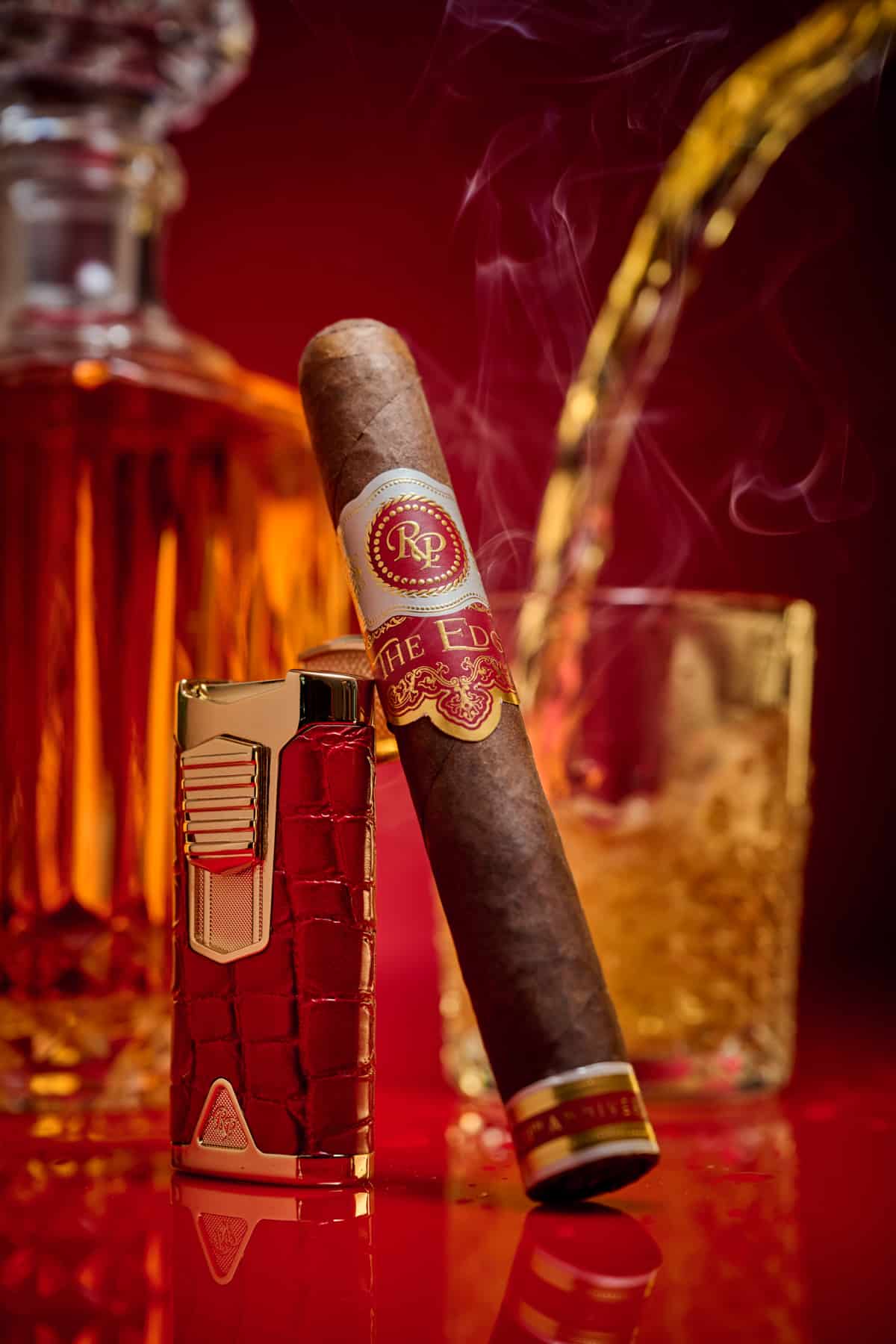
Rocky Patel The Edge 20th Anniversary is an excellent cigar for exploring this question because its concept revolves around an Ecuadorian Sumatra wrapper aged for more than a decade, paired with Nicaraguan and Honduran tobaccos inside the blend.
That is an impressive specification.
But the useful question is not:
“How old is the wrapper?”
The more important question is:
“What did time actually do to the tobacco?”
Did it reduce harshness?
Did it integrate spice?
Did sweetness become more rounded?
Did the finish become longer and more coherent?
Did the wrapper become more interesting—or simply older?
That is what turns Edge 20th Anniversary from an anniversary product into a real lesson about tobacco aging.
1. First, what is The Edge family?
The Edge is one of the better-known families within the Rocky Patel portfolio.
It should not be understood as one unchanging recipe.
Over time, Rocky Patel has used The Edge name across different expressions and wrapper styles.
That is important because it means:
The Edge is a family concept, not a single blend repeated forever.
The 20th Anniversary version therefore needs to be evaluated as its own cigar.
Its identity comes from the anniversary theme, the mature Ecuadorian Sumatra wrapper, and the way that wrapper is integrated with the rest of the blend.
2. What do we know about Edge 20th Anniversary?
The core technical picture is straightforward:
Wrapper: Ecuadorian SumatraBinder/Filler: Nicaragua and HondurasKey concept: very mature tobacco, especially the wrapper
This matters because the cigar is not simply:
“an aged tobacco cigar.”
A more precise description would be:
a Nicaragua–Honduras blend built around a very mature Ecuadorian Sumatra wrapper.
That difference in wording is important.
It reminds us that one old component does not operate alone.
The entire cigar still depends on how the blender makes the wrapper, binder and filler work together.
3. Why Ecuador matters for wrapper tobacco
Wrapper tobacco has an unusually demanding job.
It must deliver:
visual quality;
elasticity;
structural integrity;
clean combustion;
aroma;
flavor.
A leaf may taste excellent but still be unsuitable as wrapper if it tears easily or burns poorly.
Ecuador has become especially important in premium cigar production because its conditions can produce high-quality wrapper leaf with desirable texture and combustion properties.
Within that tradition, Ecuadorian Sumatra has become an important tool for blenders.
In Edge 20th Anniversary, that wrapper is not simply selected.
It is also given significant time to mature.
That makes the cigar particularly interesting from an educational perspective.
4. Sumatra is not a flavor note
A frequent beginner mistake is to see:
Sumatra wrapper
and expect a flavor called “Sumatra.”
But Sumatra is not:
cocoa,
cedar,
coffee,
or pepper.
It refers to a tobacco tradition/type whose final expression changes according to:
growing region;
soil;
climate;
priming;
curing;
fermentation;
aging;
blend architecture.
Two cigars with Ecuadorian Sumatra wrappers do not have to taste identical.
That is one of the most important principles in cigar education:
Tobacco name does not equal one fixed flavor.
5. Edge 20th Anniversary vs Vintage 1992 – an advanced Sumatra experiment
This creates a very interesting comparative idea.
Rocky Patel Vintage 1992 is another line strongly associated with mature Ecuadorian Sumatra.
Edge 20th Anniversary also centers on mature Ecuadorian Sumatra, but the tobacco underneath is configured differently.
That creates an excellent question:
“How much of what I taste comes from the wrapper, and how much comes from the rest of the blend?”
This is a much more advanced way to taste cigars.
Instead of asking:
“Does Sumatra taste like spice?”
you start asking:
“How does Sumatra behave when placed over different binder and filler systems?”
That is where understanding begins to move beyond marketing language.
6. Ten years of aging – what it does NOT mean
Aged for more than ten years does not automatically mean:
ten times more flavor;
ten times more smoothness;
ten times more complexity;
ten times more value to your palate.
Age is information about process.
It is not a mathematical guarantee of quality.
Poorly processed tobacco does not automatically become extraordinary just because it sits for a long time.
And a badly designed blend cannot be rescued by one very old component.
Aging works only within a broader chain of quality.
7. What time can potentially do to tobacco
Instead of asking whether you can “taste ten years,” look for the potential effects of age.
Integration
Do the flavors feel connected or disconnected?
Pepper
Sharp or rounded?
Texture
Rough or refined?
Sweetness
Separate or integrated?
Finish
Short and abrupt, or long and coherent?
Harshness
Do rough edges remain?
Those questions are far more useful than trying to identify a literal “aged” flavor.
Aging changes presentation, not necessarily one specific aroma.
8. Aging is not the same as fermentation
This distinction is essential.
Fermentation is a controlled transformation of tobacco after curing.
It changes the leaf chemically and helps reduce undesirable compounds.
Aging is the slower developmental period that follows.
The two processes work together.
But they are not interchangeable.
When a producer highlights a wrapper aged for many years, this refers to the leaf’s maturation history—not a replacement for proper fermentation.
Aging only makes sense when the earlier processing was already done correctly.
9. Aged leaf vs aging the finished cigar
There is another distinction that often creates confusion.
In the previous comparison between SIXTY and A.L.R., we discussed post-roll aging.
That means the cigar is already assembled and then given additional resting time.
Edge 20th Anniversary is especially interesting because the story focuses on aged tobacco before rolling, particularly the mature wrapper.
So we have two different ideas:
Aged leaf
The tobacco is aged before becoming part of the finished cigar.
Post-roll aging
The completed cigar rests after rolling.
Both can influence the final experience.
But they are different stages.
10. Why an aged wrapper is especially interesting
The wrapper occupies a unique position.
It is:
the visible leaf;
directly exposed during combustion;
aromatically important;
mechanically delicate.
So when a wrapper has been aged for a very long time, the taster can observe not only flavor but also behavior.
Pay attention to:
elasticity;
surface condition;
burn;
whether the wrapper burns in harmony with the filler;
how its contribution changes across the cigar.
A premium wrapper must work both technically and aromatically.
Age has no value if the leaf cannot still perform both functions.
11. Nicaragua + Honduras – why the interior matters enormously
The mature Ecuadorian Sumatra wrapper sits over a Nicaragua–Honduras architecture.
That is not background information.
It is fundamental.
The internal tobaccos influence:
combustion;
strength;
body;
spice;
sweetness;
smoke density;
finish.
Therefore, reducing the cigar to:
“an Ecuadorian Sumatra cigar”
would be incomplete.
A better formulation is:
aged Ecuadorian Sumatra + Nicaragua/Honduras architecture.
That language reminds the reader that the entire blend matters.
12. What Nicaragua may contribute
“Nicaraguan tobacco” is not one flavor.
Even within Nicaragua, tobacco from different growing regions can behave very differently.
Depending on the leaf and region, Nicaraguan tobacco may contribute:
strength;
earth;
spice;
sweetness;
richness;
mineral character;
aromatic depth.
But the relevant question is not:
“What does Nicaragua taste like?”
It is:
“What role is the Nicaraguan component playing in this specific blend?”
In Edge 20th Anniversary, the internal tobaccos must support the mature wrapper rather than overwhelm it.
13. What Honduras contributes
Honduras is also central to Rocky Patel’s blending history.
Honduran tobacco can bring its own combinations of:
earth;
spice;
wood;
sweetness;
structure;
combustion.
Again, these are families, not fixed formulas.
The important point is the interaction.
Edge 20th Anniversary is not built from one prestigious old leaf sitting on top of neutral filler.
The inside has its own identity.
The blender’s job is to make the entire system feel intentional.
14. Flavor profile – how to explore it without inventing tasting notes
For Edge 20th Anniversary, a responsible tasting approach is to work with broad sensory families rather than pretend that one exact flavor list is universal.
Possible areas to explore include:
wood;
spice;
earth;
sweetness;
nuts;
coffee;
cocoa;
leather;
mineral impressions;
toast.
But these are not required answers.
If your cigar gives you:
wood + dry spice + coffee
write that.
If you get:
earth + sweetness + nuts
write that instead.
The purpose of tasting is not to reproduce somebody else’s vocabulary.
It is to improve your own.
15. Do not read detailed tasting notes first
Edge 20th Anniversary has a strong story attached to it:
20th Anniversary
10+ years
Ecuadorian Sumatra
That creates a high risk of expectation bias.
Your brain can begin saying:
“Old tobacco must be extremely smooth.”
Or:
“Sumatra must mean spice.”
A better method:
read only the technical specifications;
taste;
take notes;
read external reviews afterward.
Then compare.
This helps you separate your own sensory experience from suggestion.
16. First third – look for identity, not spectacle
Do not force the cigar to prove that it is special immediately.
Let it establish itself.
Record:
Strength: ?/5Body: ?/5Flavor intensity: ?/5
Then note:
sweetness?
pepper?
wood?
earth?
creaminess?
dryness?
A cigar with very mature tobacco does not need to begin explosively to demonstrate quality.
Maturity may appear as restraint and control.
17. Second third – where complexity should begin to reveal itself
Complexity does not mean a new flavor every three puffs.
Look instead for changes in proportion.
For example:
first third:
wood + sweetness + light spice
second third:
earth + roasted character + longer finish
That is meaningful development.
Ask:
did one flavor become stronger?
did another disappear?
did texture change?
did pepper become softer or stronger?
did the finish lengthen?
Complexity is coherent evolution.
Not chaos.
18. Final third – the real stress test
The final third can reveal a great deal.
As the cigar shortens, it often becomes:
warmer;
more concentrated;
more peppery;
potentially more bitter.
The relevant question is:
Does the blend remain balanced under greater heat and concentration?
For a cigar built around mature tobacco, that is especially interesting.
Watch:
harshness;
bitterness;
spice;
sweetness;
finish;
burn temperature.
And do not rush.
If you overheat the cigar, you are testing your smoking pace more than the tobacco’s maturation.
19. What does “smooth” really mean with aged tobacco?
“Smooth” is one of the most overused words in cigar marketing.
It may mean:
little harshness;
refined texture;
controlled pepper;
easy delivery;
gradual transitions.
But smooth does not mean mild.
A cigar can be powerful and still feel smooth.
So when evaluating Edge 20th Anniversary, separate:
Strength
from:
Smoothness
from:
Body
from:
Flavor intensity.
That distinction prevents major tasting errors.
20. Old tobacco vs good tobacco – they are not synonyms
This may be the most important lesson in the entire article.
Good cigar tobacco depends on:
quality plant material;
cultivation;
curing;
fermentation;
sorting;
aging;
blending.
Aging is one part of the chain.
Not the whole chain.
An old wrapper matters only if:
it was good tobacco in the first place;
it was processed correctly;
it remained structurally usable;
the blender integrated it intelligently.
Age alone is not quality.
21. Rocky Patel uses time in several different ways
Across the Rocky Patel portfolio, time appears repeatedly—but not always in the same form.
Aged Broadleaf.
Vintage 1992
Mature Ecuadorian Sumatra.
SIXTY
Post-roll maturation.
Aging of the finished cigar as a core product concept.
Edge 20th Anniversary
Very mature Ecuadorian Sumatra wrapper.
These are different strategies.
That is important.
“Aged cigar” can describe more than one production philosophy.
22. Edge 20th Anniversary vs SIXTY – two different forms of aging
This comparison is extremely useful.
SIXTY
Educational focus:
what happens after the cigar is rolled.
Edge 20th Anniversary
Educational focus:
what happens to a major tobacco component before the cigar is rolled.
SIXTY teaches post-roll integration.
Edge 20th teaches mature-leaf selection.
Both involve time.
But the time is being applied at different stages of the process.
23. Edge 20th Anniversary vs A.L.R. – aging as specification vs aging as identity
A.L.R. literally means:
Aged. Limited. Rare.
There, aging is the commercial identity of the line.
Edge 20th Anniversary uses aged tobacco as a defining technical component of an anniversary blend.
So:
A.L.R.
Aging is the concept.
Edge 20th Anniversary
Aging is a major material/production characteristic inside the concept.
Both are legitimate.
But they tell different stories.
24. Edge 20th Anniversary vs Vintage 1992 – one of the best Sumatra comparisons
For a smoker interested in wrapper education, this can be an excellent experiment.
Both involve mature Ecuadorian Sumatra.
But the internal architecture differs.
So ask:
what characteristics feel common?
where does sweetness differ?
where does spice differ?
which has more body?
which has the longer finish?
how much does the interior appear to reshape the wrapper?
This helps answer the important question:
How much does wrapper matter—and how much does the rest of the blend matter?
The answer is always:
both.
25. Edge 20th Anniversary vs Decade – anniversary blending and Sumatra
Another interesting conceptual comparison comes from Rocky Patel Decade.
Decade is also an anniversary-oriented cigar and is associated with Sumatra.
That demonstrates something useful about Rocky Patel’s blending style:
the producer may return to a wrapper family without simply recreating the same cigar.
This is another reason to avoid statements such as:
“I have smoked one Sumatra, so I know what all Sumatra cigars taste like.”
You do not.
Wrapper is one variable.
Blend architecture changes everything.
26. What an intermediate smoker can learn from Edge 20th Anniversary
For the intermediate smoker, Edge 20th Anniversary becomes especially useful after the basics are already understood:
Strength;
Body;
Flavor;
Wrapper;
Binder;
Filler.
The next question becomes:
“Can I identify the effects of mature tobacco?”
That is harder.
There is no instant answer.
You need reference points.
Ideally, compare it with other Sumatra cigars or other aged-tobacco Rocky Patel lines.
Edge 20th Anniversary works best as part of an educational sequence, not simply as an expensive special cigar.
27. What an experienced aficionado can learn
The experienced smoker can ask a deeper question:
“How much aging is enough?”
If 10 years is good, is 15 automatically better?
No.
At some point, the blender must balance:
evolution;
preservation of character;
structural quality;
availability;
intended flavor profile.
Aging has a purpose.
It is not a competition.
The oldest leaf does not automatically win.
28. How I would taste it at Mister Tabaco
Before lighting
Inspect the wrapper.
Do not judge it only by color.
Look at:
texture;
elasticity;
aroma at cold.
Cold draw
Evaluate:
resistance;
sweetness;
wood;
spice;
other impressions.
First third
Establish the baseline.
Second third
Study transitions.
Final third
Evaluate integration under increasing heat.
Use water.
For the first analytical session, avoid a powerful whisky, cognac or espresso.
First understand the cigar itself.
29. Mister Tabaco “Time & Sumatra Flight”
A very interesting educational flight, depending on availability, could include:
Rocky Patel Vintage 1992
Lesson: mature Ecuadorian Sumatra.
Rocky Patel Edge 20th Anniversary
Lesson: mature Ecuadorian Sumatra + Nicaragua/Honduras.
Rocky Patel Decade
Lesson: anniversary blending + Sumatra in another architecture.
Do not smoke all three in one day.
Three sessions.
Same tasting sheet.
Same water.
Now you are actually studying Sumatra, not simply reading the name on the band.
30. Mister Tabaco “Aging Flight”
If your main interest is time rather than wrapper:
Vintage 1990
Lesson: aged Broadleaf.
SIXTY
Lesson: post-roll aging.
A.L.R. Second Edition
Lesson: aging of the finished cigar as product identity.
Edge 20th Anniversary
Lesson: wrapper matured for more than a decade.
This reveals an important truth:
“Aged cigar” can mean several different things.
Understanding that difference makes future buying decisions much more intelligent.
31. Common mistakes when discussing Edge 20th Anniversary
“The entire cigar is more than 10 years old”
Not necessarily. The key aging claim concerns the mature wrapper/tobacco used in the blend.
“Ten years automatically means better than five”
False.
“Aged tobacco means mild”
False.
“Smooth and mild are the same thing”
False.
“Sumatra has one specific taste”
False.
“The wrapper determines the entire profile”
False.
“If the leaf was aged before rolling, the finished cigar can no longer evolve”
False. Leaf age and finished-cigar evolution are separate concepts.
“Ratings determine whether I will like it”
False.
32. Edge 20th Anniversary tasting checklist
Ask yourself:
Does the wrapper appear well integrated physically?
Is the cold draw open or restrictive?
Strength 1–5?
Body 1–5?
Flavor intensity 1–5?
Is the sweetness bright or dark?
Is pepper sharp or rounded?
Do I notice wood, earth or roasted character?
How much does the second third change?
Does the final third remain controlled?
Is the finish short, medium or long?
Am I experiencing refinement or simply intensity?
Would I compare it with another Sumatra?
That turns “10+ years” from a marketing number into a sensory experiment.
33. FAQ – Edge 20th Anniversary and aged tobacco
What wrapper does Rocky Patel Edge 20th Anniversary use?
Ecuadorian Sumatra.
What is special about the wrapper?
It is presented as very mature, with more than a decade of aging.
What tobaccos are used inside?
The blend incorporates Nicaraguan and Honduran tobacco.
Is the entire cigar more than 10 years old?
That should not automatically be assumed. The aging story focuses especially on the mature tobacco used in the wrapper.
What does Sumatra mean?
It refers to a tobacco tradition/type; in this case the wrapper is grown in Ecuador.
Does aged tobacco automatically mean a mild cigar?
No.
Are aging and fermentation the same?
No. They are different stages.
What other Rocky Patel cigar is useful for a Sumatra comparison?
Vintage 1992 is a particularly interesting reference.
Is Edge 20th Anniversary ideal for a complete beginner?
It is more educational once the smoker already understands some basic cigar concepts and can compare it with other lines.
How should I taste it for the first time?
With water, a relatively neutral palate and without reading detailed tasting notes beforehand.
34. Mister Tabaco verdict – why Edge 20th Anniversary is worth studying, not just buying
Edge 20th Anniversary makes sense for the smoker who wants to understand:
Ecuadorian Sumatra;
aged wrapper tobacco;
Nicaragua–Honduras blending;
aging vs strength;
aged leaf vs aged finished cigar;
integration and complexity.
The least useful approach would be:
“It has 10+ year tobacco, therefore it must be superior.”
A much better question is:
“What effect can I actually perceive from that mature tobacco?”
That is where informed tasting begins.
Conclusion – time is not an ingredient; it is a tool
Rocky Patel Edge 20th Anniversary is built around a compelling idea:
very mature Ecuadorian Sumatra + Nicaraguan and Honduran tobacco.
But the most valuable part is not the number of years.
It is the question those years create:
What did time do to the tobacco?
Aging is not:
vanilla.
Cocoa.
Coffee.
Cedar.
It is not one flavor note.
It is a process that can influence how flavor is delivered.
Potential effects may include:
integration;
roundness;
complexity;
texture;
finish;
reduction of harsh edges.
But these effects always depend on the quality of the original tobacco and the intelligence of the final blend.
That is why Edge 20th Anniversary makes most sense in context.
Vintage 1990 demonstrates aged Broadleaf.
Vintage 1992 explores mature Ecuadorian Sumatra in another architecture.
SIXTY demonstrates post-roll maturation.
A.L.R. makes aging part of the cigar’s identity.
Edge 20th Anniversary places a very mature Ecuadorian Sumatra wrapper at the center of the story.
And from that comparison we learn perhaps the most important lesson:
We are not buying years. We are buying what the blender managed to do with those years.
The correct question is not:
“How old is it?”
It is:
“What did it become?”
Mister Tabaco
At Mister Tabaco, you can turn theory into practical comparisons between blends, vitolas and origins.
Continue the Tobacco Guide
→ What Is Premium Tobacco and How Is It Different from Ordinary Tobacco?
→ Wrapper, Binder and Filler – the anatomy of a premium cigar
→ Maduro Explained Properly – Color, Fermentation, Flavor and the Strength Myth
→ Ligero, Seco and Volado – how leaf position changes a premium cigar
→ How Cigar Tobacco Is Grown – From Seed to Harvest
→ Tobacco Fermentation – The Process That Transforms the Leaf
→ Tobacco Aging – Why Some Cigar Leaves Are Aged for Years
→ How a Master Blender Creates a Cigar
→ Shade-Grown vs Sun-Grown: How Light Changes a Cigar Wrapper
→ Long Filler vs Short Filler – The Real Differences in Cigar Construction
→ Strength vs Body vs Flavor – How to Describe a Cigar Correctly
→ How Vitola Changes Cigar Flavor: Robusto vs Toro vs Churchill vs Sixty
→ How to Choose Your First Premium Cigar – A Complete Beginner’s Guide
→ How to Taste a Premium Cigar and Identify Aromas
→ How to Store Cigars Properly: Humidor, Temperature and Humidity
→ Common Mistakes That Can Ruin the Experience of a Premium Cigar
→ Rocky Patel Guide: Differences Between the Main Collections at Mister Tabaco
→ Rocky Patel Vintage 1990 vs Vintage 1999: Aged Broadleaf or Delicate Connecticut?
→ Rocky Patel Number 6 vs DBS: Balanced Corojo or Broadleaf Architecture?
→ Rocky Patel SIXTY vs A.L.R. Second Edition: Two San Andrés Interpretations, Two Aging Philosophies
→ How to Choose a Rocky Patel by Experience, Strength and Flavor Profile
Explore the Cigar Guide
→ How to Choose Your First Cigar
→ Which Rocky Patel Cigar Should You Choose as a Beginner?
→ How to Smoke a Cigar Properly
→ Robusto, Toro or Churchill? Cigar Size Guide
→ How to Store Cigars Properly
→ Cuba vs Nicaragua vs Dominican Republic vs Honduras
→ How to Identify Cigar Flavors
→ Cigar Pairing with Whisky, Rum, Cognac or Coffee
→ 10 Common Cigar Mistakes Beginners Make
→ How to Choose a Cigar as a Gift or for a Special Occasion
Tobacco products are intended for adults only. Smoking seriously damages your health.