Posted on Leave a comment

GURKHA YEAR OF THE DRAGON vs YEAR OF SNAKE

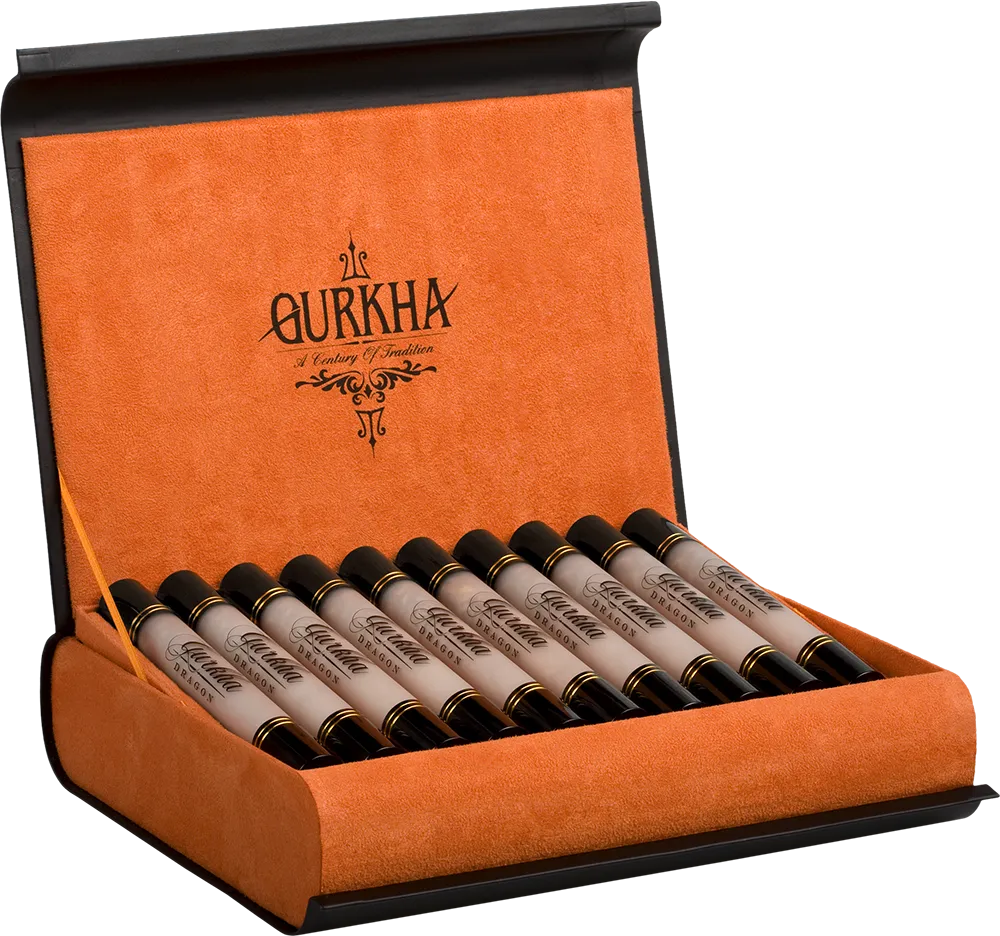
Gurkha Year Of The Dragon

Zodiac Editions and Three Very Different Ways to Interpret the Same Idea

For adults only. Tobacco products carry health risks.

Introduction – one concept, multiple master blenders

Gurkha’s Zodiac project is unusual because the name does not define a single blend.

Year of the Dragon expanded into collaborations involving El Artista, AJ Fernandez, E.P. Carrillo, Oliva and Oscar Valladares. Year of Snake subsequently focused the idea around three manufacturers: Casa Carrillo, Oscar Valladares and Oliva.

This makes Zodiac much more than commemorative packaging.

It becomes a study of:

factory identity, tobacco origin, wrapper selection, vitola and blending philosophy.

1. The original Year of the Dragon

The project began with a Tabacalera El Artista-produced Figurado measuring 6¾ × 52.

Gurkha presented it in numbered red piano-finish boxes decorated with gold dragons, with 15 cigars per box and 1,000 boxes announced. The blend was described as proprietary.

That could have been the entire project.

Instead, Gurkha expanded it dramatically.

2. Dragon becomes a collaboration series

Four additional partners joined:

AJ Fernandez

E.P. Carrillo

Oliva

Oscar Valladares.

Each was given its own blend, format and packaging identity.

The result was effectively five interpretations of “Dragon.”

3. Five Dragons

Maker

Size

Presentation

El Artista

6¾ × 52 Figurado

Red

AJ Fernandez

6⅝ × 52 Box Pressed

Green

E.P. Carrillo

6⅝ × 54 Toro

Black

Oliva

6½ × 60

Orange

Oscar Valladares

6 × 52

Yellow

Even the vitolas differ.

This matters because the project was never designed around strict sensory uniformity.

4. AJ Fernandez Dragon

Published architecture:

Wrapper: Ecuadorian HabanoBinder: NicaraguanFiller: NicaraguanOrigin: NicaraguaSize: 6⅝ × 52 Box Pressed.

This is essentially an Ecuador-over-Nicaragua structure.

It offers an excellent opportunity to examine how an Ecuadorian wrapper interacts with a Nicaraguan core.

5. Why Box Pressed matters

Blend is only part of the experience.

A box-pressed format can alter:

tactile feel;

mouthfeel;

perceived draw;

smoking rhythm;

overall handling.

Therefore, comparative tasting should never treat vitola as irrelevant.

6. Oliva Dragon – a radically different architecture

Oliva went with:

Mexican San Andrés wrapper

Cameroon binder

Nicaraguan filler

in a 6½ × 60 Salomon, produced in Nicaragua.

Compare that with AJ Fernandez:

Ecuadorian Habano / Nicaragua / Nicaragua

versus:

San Andrés / Cameroon / Nicaragua.

Same Dragon theme.

Completely different tobacco architecture.

7. San Andrés and Cameroon

A tasting can explore whether the San Andrés contributes darker earthy, cocoa or roasted impressions while Cameroon adds aromatic sweetness or spice.

Those are tasting families, not guarantees.

The key question is:

Can you separate wrapper character from the rest of the blend?

That makes the Oliva version particularly educational.

8. Oscar Valladares Dragon – Honduras

Oscar Valladares produced a 6 × 52 Toro featuring:

Corojo wrapper

Honduran binder

Honduran filler

and Honduran production.

This becomes especially important because Oscar returns for Year of Snake.

9. Year of Snake changes the experiment

Gurkha reduced the collaboration group to three:

Casa Carrillo

Oscar Valladares

Oliva.

The official collection therefore represents three production countries:

Dominican Republic, Honduras and Nicaragua.

That turns Year of Snake into an unusually useful comparative tasting collection.

10. Oscar Valladares Snake

Official specifications:

Wrapper: HabanoBinder: HonduranFiller: HonduranOrigin: HondurasSize: 6 × 52 ToroStrength: Strong.

Compare it with Oscar’s Dragon:

Dragon = Corojo/Honduras/Honduras.

Snake = Habano/Honduras/Honduras.

This creates a fascinating wrapper-focused comparison.

11. Oscar Dragon vs Oscar Snake

Keep the producer and Honduran core relatively consistent.

Change the wrapper direction.

Then evaluate:

sweetness;

spice;

pepper;

earth;

wood;

body;

aroma;

finish.

It is a much more useful tasting exercise than simply asking:

“Which one is better?”

12. Casa Carrillo Snake – the multinational blend

Casa Carrillo takes a very different approach:

Wrapper: Ecuadorian CorojoBinder: Ecuadorian SumatraFiller: Dominican + Mexican + NicaraguanOrigin: Dominican RepublicSize: 6½ × 52 ToroStrength: Strong.

This is the most geographically diverse Snake blend.

Four tobacco origins participate in its architecture.

13. How to approach the Casa Carrillo version

Do not obsess over identifying every country blind.

Instead ask:

Does the cigar evolve?

Does sweetness change?

Does spice build?

Does the finish become darker?

Does the wrapper dominate?

Does the core become more obvious in the second half?

Complexity is often about development, not simply the number of flavors you can name.

14. Oliva Snake

Oliva’s Year of Snake uses:

Mexican San Andrés wrapper

Nicaraguan binder

Nicaraguan filler

Nicaraguan production

in a 6⅝ × 52 Toro, officially classified Strong.

And this gives us another excellent comparison.

Because Oliva’s Dragon also used San Andrés.

15. Oliva Dragon vs Oliva Snake

Dragon

San Andrés / Cameroon / Nicaragua6½ × 60 Salomon.

Snake

San Andrés / Nicaragua / Nicaragua6⅝ × 52 Toro.

Wrapper family and Nicaraguan filler remain.

Binder and vitola change.

This is a perfect demonstration of why:

wrapper alone does not define a cigar.

16. The three Snakes

Version

Wrapper

Binder

Filler

Origin

Strength

Oscar Valladares

Habano

Honduras

Honduras

Honduras

Strong

Casa Carrillo

Ecuadorian Corojo

Ecuadorian Sumatra

DR/Mexico/Nicaragua

Dominican Republic

Strong

Oliva

Mexican San Andrés

Nicaragua

Nicaragua

Nicaragua

Strong

Three Strong cigars.

Three very different architectures.

17. Honduras vs Dominican Republic vs Nicaragua

Snake can almost function as a terroir class.

Oscar emphasizes Honduras.

Casa Carrillo creates a multinational Dominican-made blend.

Oliva builds around San Andrés and Nicaragua.

But country stereotypes should be avoided.

Origin matters alongside:

seed variety, farm, priming, fermentation, aging, factory, blender and vitola.

18. Strong does not mean identical

Gurkha officially rates all three Year of Snake cigars Strong.

Yet they need not share the same:

body,

pepper,

sweetness,

aromatic intensity,

or complexity.

Remember:

Strength ≠ Body ≠ Flavor.

19. Dragon vs Snake conceptually

Dragon is broader.

Five makers.

More formats.

More visual identities.

More interpretations.

Snake is tighter:

three makers,

three production countries,

three Strong blends,

three broadly comparable Toro formats.

For structured comparative tasting, Snake may actually be the cleaner experiment.

20. Which is more collectible?

Dragon has the historical appeal of being Gurkha’s first Chinese Zodiac project, while Snake is the second.

Dragon also offers greater breadth.

Snake offers greater comparative coherence.

Collectors may value those attributes differently.

21. Limited does not mean investment

A limited-edition cigar is not automatically an investment.

Secondary-market desirability can depend on:

scarcity,

reputation,

storage,

condition,

provenance,

and collector demand.

Buy primarily because the cigar or collection interests you—not because appreciation is guaranteed.

22. A Mister Tabaco Zodiac tasting

A strong educational format would be:

Flight 1: Oscar Dragon vs Snake.

Flight 2: Oliva Dragon vs Snake.

Flight 3: Oscar Snake vs Casa Carrillo Snake vs Oliva Snake.

Each flight answers a specific blending question.

That is more useful than smoking the entire collection at once.

23. How to make the comparison fair

Use comparable storage conditions.

Avoid strongly flavored drinks.

Take notes before reading marketing material.

Do not judge an entire line from a single poorly constructed sample.

When precision matters, smoke the cigars on different days.

Comparative tasting is an experiment; control the variables you can.

24. Common mistakes

“Year of Snake is one cigar.”No—it is a three-cigar collaboration collection.

“Dragon is one blend.”No—the project expanded to five interpretations.

“All Snakes are Strong, so they taste similar.”False.

“San Andrés automatically means maximum strength.”False.

“Limited Edition means better.”False.

“More countries in the blend means greater complexity.”Not necessarily.

25. Which should you choose?

Choose Oscar Valladares Snake to explore a Honduras-centered architecture.

Choose Casa Carrillo Snake for the most multinational blend.

Choose Oliva Snake for San Andrés over a Nicaraguan core.

Explore Year of the Dragon when the breadth of the Zodiac project and multiple manufacturers interests you most.

Explore Year of Snake when you want a more systematic three-country comparison.

26. FAQ

How many official Year of Snake interpretations are there?Three.

Are all three Strong?Yes, according to Gurkha.

What countries produce them?Honduras, Dominican Republic and Nicaragua.

Which uses San Andrés?Oliva.

Which uses Ecuadorian Corojo?Casa Carrillo.

Was Dragon larger as a project?Yes. It ultimately involved five manufacturing partners.

27. Verdict

The brilliance of Gurkha Zodiac is not simply the artwork.

It is the idea that one theme can be interpreted through several factories.

Dragon demonstrates breadth.

Snake provides a particularly clean comparison between:

Honduras

Dominican Republic

and:

Nicaragua.

For an enthusiast, the most interesting question becomes:

How much of a cigar’s personality comes from its brand—and how much comes from the blender, factory, tobacco and construction behind it?

Mister Tabaco

At Mister Tabaco you’ll find a selection of Gurkha cigars, from accessible collections to rarer, long-aged editions. Explore our dedicated series on the brand to compare collections and choose the right blend for you.

Continue the Gurkha Series

The Gurkha Story: From a Forgotten Box in Goa to the “Rolls Royce of Cigars”

Gurkha Cigars: Brand History, Philosophy and Guide to the Collections Available at Mister Tabaco

Gurkha Ghost Connecticut vs Ghost vs Ghost Gold vs Ghost Maduro: What Are the Differences and Which Should You Choose?

Gurkha Cellar Reserve 15 Year: What Does 15-Year-Aged Tobacco Really Mean?

Bourbon Collection vs Grand Reserve: Two Different Interpretations of Spirits-Inspired Cigars

Black Dragon vs Green Dragon vs Red Dragon: Three Names, Three Identities

HMR vs HRH vs Maharaja vs Raja vs Sultan

GURKHA YEAR OF THE DRAGON vs YEAR OF SNAKE

Tobacco products are intended for adults only. Smoking seriously damages your health.
Posted on Leave a comment

Stanley Tobacco – From Twist Tobacco’s First Brand to an International RYO Portfolio

For adults only. Tobacco products are addictive and carry serious health risks.

A modern tobacco brand, not a nineteenth-century heritage house
Stanley's story begins in:
2004.
That year Johan and Regine Vandermarliere founded Twist NV in Belgium, and Stanley was developed as the company's first brand and launched on the Belgian market.
This makes Stanley fundamentally different from brands built on centuries of corporate history.
Its importance comes from another fact:
Stanley is the founding brand of Twist Tobacco.

Who makes Stanley?
Stanley is produced by:
Twist Tobacco NV
a Belgian family-owned company headquartered in Wetteren near Ghent. Twist states that the Vandermarliere family founded the company in 2004 and continues to own it completely.
The company specializes in:
RYO – Roll Your Own
and:
MYO – Make Your Own.
That specialization gives Stanley a distinctly modern fine-cut identity.

Nine tobacco varieties
Twist states that Stanley's blend brings together:
nine carefully selected tobacco varieties
and uses leaf sourced from approximately:
ten countries.
This is an important technical point.
Nine tobacco varieties do not mean nine added flavors.
They describe the tobacco architecture itself.
The manufacturer does not list all nine varieties on the public Stanley brand page, so they should not be invented.

Global leaf, Belgian blending identity
Stanley should therefore be described as:
a Belgian tobacco brand with internationally sourced leaf.
It should not be interpreted as tobacco grown entirely in Belgium.
The Belgian identity comes from:
manufacturer,
blending,
production,
brand development.
The agricultural raw materials are international.

From 2004 to more than 60 countries
Twist's official timeline shows rapid development.
2004 – Twist is founded and Stanley is launched.2009 – the company moves into a new 8,000 m² facility.2010 – active in 10 countries.2013 – Redfield is created.2019 – active in 30 countries.2025 – Twist reports presence in 60 countries and 80 employees.
Stanley therefore developed within a company that internationalized rapidly.

Packaging architecture
Stanley is offered by Twist in multiple formats:
Pouches: 10–50 gCans: 10–250 gBuckets: 50–900 g.
This flexibility matters because RYO/MYO brands need to adapt to different market structures and purchasing formats.
A locally available 40 g pouch should not be mistaken for the brand's entire global format range.

Stanley in Moldova
Local listings show at least:
Stanley Natural 40 g
Stanley Halfzware 40 g
Stanley Virginia Blend 40 g.
These products should be treated as separate blend expressions.
The name Stanley identifies the brand.
Terms such as Virginia Blend, Halfzware and Natural identify different product propositions.

Stanley versus Mac Baren
This comparison is particularly revealing.
Mac Baren
Historical roots in 1826, strong pipe-tobacco heritage, later extended into Fine Cut.
Stanley
Created in 2004 inside a modern company focused specifically on RYO and MYO.
So:
Mac Baren moves from heritage toward modern RYO.
while:
Stanley begins with modern RYO and builds heritage forward.
Neither model is automatically superior.
They simply represent different industrial histories.

Brand-level fact versus product-level fact
Twist states that Stanley's brand identity combines nine tobacco varieties.
That does not automatically prove that every Stanley SKU has an identical nine-variety recipe.
Professional product analysis should separate:
brand fact
from:
SKU-specific fact.
The same rule applies to terms such as:
Natural,
Virginia Blend,
Halfzware.
Their exact technical meaning must be confirmed for the individual product.

Stanley and no-additive claims
Twist explicitly describes another brand, Bronx, as tobacco with no additives.
The general Stanley page does not make the same claim.
Therefore, Stanley should not automatically be described as additive-free.
This is an important editorial principle:
use a no-additive claim only where the manufacturer makes it for the specific product.

Stanley brand sheet
Country: BelgiumManufacturer: Twist Tobacco NVLaunch: 2004Brand role: Twist Tobacco's first brandCompany founders: Johan and Regine VandermarliereManufacturer location: Wetteren, BelgiumSpecialization: RYO / MYOBrand-level leaf sourcing: approximately 10 countriesBrand-level tobacco varieties: nineFormats: pouches, cans and bucketsTwist international presence: more than 60 countries by 2025.

Common misconceptions
Stanley Tobacco is British.No. It is a Belgian Twist Tobacco brand.
Stanley has existed for more than a century.No. It was developed in 2004.
It is produced by Mac Baren.No.
All Stanley leaf is Belgian.No. Twist describes sourcing from around ten countries.
Stanley contains nine flavors.No. Twist refers to nine tobacco varieties.
Stanley Natural automatically means additive-free.That should not be assumed from the name alone.
Every Stanley SKU must have the same nine-variety recipe.The public brand-level statement does not establish that.

Mister Tabaco Verdict
Stanley represents a very different type of tobacco history.
It does not rely on centuries of corporate heritage.
Instead, it begins in 2004 as the first brand of a newly established Belgian RYO/MYO specialist.
Twist describes Stanley through an unusually broad raw-material architecture:
NINE TOBACCO VARIETIES
from roughly:
TEN COUNTRIES.
The company then grew from a Belgian start-up into an exporter present in more than 60 countries.
So Stanley can be understood through this chain:
GLOBAL LEAF

MULTI-VARIETY BLENDING

BELGIAN RYO/MYO EXPERTISE

INTERNATIONAL PRODUCTION

STANLEY
Mac Baren shows us heritage accumulated over generations.
Stanley shows us:
how a modern tobacco brand begins building heritage from day one.

Discover the rolling tobacco selection available at Mister Tabaco

Posted on Leave a comment

HMR vs HRH vs Maharaja vs Raja vs Sultan

Gurkha HMR

Ultra-Luxury, Collector’s Corner and Why the Exact SKU Matters

For adults only. Tobacco products carry health risks.

Introduction – this is the part of the Gurkha portfolio where product identification matters most

HMR.

HRH.

Maharaja.

Raja.

Sultan.

These names communicate much more than tobacco.

They communicate:

rarity, prestige, collecting, presentation and storytelling.

The first mistake would be to turn them into a simple hierarchy.

The second would be even more serious: assuming that every cigar carrying one of these names in a local catalog is automatically identical to the ultra-expensive official collector edition shown on Gurkha’s website.

The Mister Tabaco list provided includes HMR at MDL 405, Maharaja at MDL 550, HRH at MDL 432, Raja at MDL 385 and Sultan at MDL 342.

By contrast, Gurkha’s official Maharaja page describes a limited 7.5×52 Medium Maduro/Dominican/Dominican edition presented at $6,000 per cigar, while official HMR is an exceptional 15-year-wrapper/12-year-binder-and-filler expression associated with cognac and highly restricted production.

Therefore:

Exact SKU verification must come before publishing official collector-edition specifications on the Mister Tabaco product pages.

1. Ultra-luxury is not a flavor profile

Gurkha currently places HMR and Maharaja in its Ultra Premium collection, which the company describes around ultra-luxury and exclusivity.

That positioning does not automatically tell us:

strength;

body;

flavor;

wrapper;

complexity.

Luxury and sensory profile are different dimensions.

2. What is HMR?

HMR means:

His Majesty’s Reserve.

Gurkha’s official specification lists:

Wrapper: 15-year Connecticut MaduroBinder: 12-year DominicanFiller: 12-year DominicanOrigin: Dominican RepublicSize: Churchill 7½×52Strength: Mild to Medium.

That final point is crucial.

One of Gurkha’s most extravagant cigars is not marketed as one of its strongest.

3. HMR and aged tobacco

The architecture is explicitly age-driven.

A 15-year wrapper sits over 12-year Dominican binder and filler.

So HMR is not primarily a lesson in brute strength.

It is a lesson in:

maturation;

integration;

scarcity;

preservation of old tobacco;

blending with mature components.

Once again:

old does not mean strong.

4. HMR and cognac

Gurkha explicitly associates HMR’s aged Dominican tobacco with an exclusive cognac component during its production concept.

That means HMR combines two separate themes:

aged tobacco

and:

cognac-associated aromatic influence.

They should not be collapsed into one idea.

5. How should HMR be tasted?

Do not search for a flavor called “15 years.”

Instead assess:

Smoothness – is harshness controlled?

Integration – do the components feel cohesive?

Aromatic intensity – how noticeable is the cognac-related character?

Tobacco character – does tobacco remain clearly present?

Finish – long, elegant, sweet, dry?

Strength – how powerful does it actually feel?

This gives prestige a measurable sensory framework.

6. Maharaja – secret blend, but not completely undocumented

Gurkha calls Maharaja a secret blend, yet still publishes the principal architecture:

Wrapper: MaduroBinder: DominicanFiller: DominicanOrigin: Dominican RepublicSize: 7.5×52Strength: Medium.

“Secret blend” therefore does not mean “no information.”

It means some of the deeper varietal or production details remain proprietary.

7. Maharaja proves that Maduro is not Full

Once again:

Maduro wrapper

but:

Medium strength.

This is an excellent counterexample to the common myth:

dark cigar = strongest cigar.

Possible sensory families can be explored, but the official strength rating should guide expectations more than wrapper color.

8. HMR vs Maharaja – two luxury philosophies

HMR

Focuses on:

15-year wrapper;

12-year binder and filler;

cognac association;

Mild–Medium strength;

scarcity.

Maharaja

Focuses on:

Maduro;

Dominican architecture;

Medium;

secret-blend positioning;

elaborate limited presentation.

In simple terms:

HMR = age + cognac + scarcity

while:

Maharaja = Maduro + Dominican structure + luxury presentation.

9. Which is stronger?

Officially:

HMR: Mild to Medium

Maharaja: Medium.

So the more exclusive or expensive cigar is not automatically stronger.

That is one of the clearest lessons in the entire Gurkha cluster.

10. HRH – entering Collector’s Corner

Gurkha currently positions HRH in Collector’s Corner, publishes an MSRP of $350,000, and describes it as an exceptional private blend centered on luxury, rarity and craftsmanship. The public page does not provide wrapper, binder, filler, size or strength.

The correct editorial response is not to fill in the blanks.

It is to say:

The manufacturer does not publicly disclose those details on the current page.

11. Collector value vs smoking value

HRH demonstrates an important distinction.

Collector-oriented products can derive part of their proposition from:

scarcity;

presentation;

provenance;

private-blend status;

limited availability.

This can create high collector value.

But:

collector value is not a mathematical flavor score.

Someone may admire a collectible product while genuinely preferring a much less expensive cigar for everyday smoking.

12. Raja – what is actually public?

Gurkha’s official Raja page places it in Collector’s Corner and publishes an MSRP of $75,000, but does not expose a complete blend specification on the current page.

Therefore, exact wrapper/filler claims require product-specific documentation.

13. Sultan

Sultan also appears in Collector’s Corner.

Gurkha currently publishes a $250,000 MSRP and describes it as an exceptional private blend designed for the true cigar connoisseur, emphasizing luxury, rarity and craftsmanship. The complete technical recipe is not disclosed on that page.

Again:

price and rarity describe positioning, not flavor.

14. HRH vs Raja vs Sultan – what can we responsibly compare?

Product

Official category

Gurkha published MSRP

Full public blend

HRH

Collector’s Corner

$350,000

No

Sultan

Collector’s Corner

$250,000

No

Raja

Collector’s Corner

$75,000

No

These figures refer to the official Gurkha products/pages.

They should not automatically be attached to the Mister Tabaco inventory without exact SKU confirmation.

15. Why Mister Tabaco must verify the physical products

The supplied local prices are dramatically different from Gurkha’s official collector-edition prices.

Before a page states that a local cigar is the official $350,000 HRH or $250,000 Sultan edition, verify:

band;

secondary band;

box;

coffin or tube;

SKU;

supplier invoice;

country of origin;

vitola;

distributor documentation.

This is as much a site-development and catalog-data issue as a cigar issue.

16. Why names can recur in different contexts

Premium cigar brands can have:

historical editions;

reissues;

private blends;

regional versions;

sampler releases;

individual cigars removed from special sets;

distributor-specific presentations.

The product name alone may therefore be insufficient.

An accurate ecommerce catalog should ideally track:

brand + line + vitola + SKU + blend + origin + packaging.

17. What does private blend really mean?

It does not mean:

“automatically superior.”

It means the full recipe may be proprietary or reserved for a particular release.

From a tasting perspective, that can be exciting.

From a catalog perspective, it must be labeled honestly.

There is a major difference between:

undisclosed by the manufacturer

and:

unknown because the retailer has not identified the SKU.

18. Luxury, rarity, quality and preference

Keep four ideas separate.

Luxury

The total presentation and prestige experience.

Rarity

How scarce the product is.

Quality

How successfully the product is made.

Preference

How much you personally enjoy it.

One cigar can score differently on all four dimensions.

19. Is a $6,000 cigar twenty times tastier than a $300 cigar?

That is the wrong equation.

Extreme pricing can include:

old tobacco inventories;

scarcity;

limited production;

packaging;

humidors;

collector demand;

exclusivity;

brand storytelling.

Flavor does not scale linearly with price.

At the extreme luxury level, the buyer may purchase:

the cigar + the object + the story + scarcity.

20. What HMR teaches us

Official HMR combines exceptionally mature tobacco with a cognac-oriented concept and severe scarcity, yet Gurkha rates it Mild to Medium.

Its proposition is not maximum power.

It is:

age + integration + rarity + aromatic concept.

21. What Maharaja teaches us

Maharaja demonstrates that a geographically straightforward Maduro/Dominican/Dominican architecture can still sit in an extreme luxury context through selection, rarity, presentation and positioning.

The number of countries in a blend does not determine the sophistication of the total experience.

22. How to taste ultra-luxury without price bias

Price creates enormous expectation bias.

If someone tells you a cigar costs thousands of dollars, you naturally expect transcendence.

When possible:

taste blind.

Or at least write down sensory scores before looking at price and marketing.

This separates:

what the cigar did

from:

what the story told you to expect.

23. HMR vs Maharaja tasting framework

HMR

Evaluate:

smoothness;

aged character;

integration;

tobacco/cognac balance;

finish.

Maharaja

Evaluate:

Maduro expression;

body;

Dominican structure;

sweetness;

smoke density;

development.

The question is not immediately:

“Which is worth more?”

It is:

“What experience is each designed to deliver?”

24. HRH, Raja and Sultan – ideal semi-blind candidates

Because their current official public pages do not provide complete technical recipes, tasting them without extensive preconceptions can be educational.

Score:

StrengthBodySweetnessPepperCreaminessEarthWoodCoffee/CocoaComplexityFinish

Then predict:

wrapper family?

strength?

Only afterward compare against verified documentation.

25. Who is official HMR for?

Especially interesting for:

aged-tobacco enthusiasts;

collectors;

smokers interested in cognac-associated cigars;

smokers studying smoothness vs strength;

Gurkha historians and brand enthusiasts.

Not primarily for someone seeking the strongest Gurkha.

26. Who is Maharaja for?

For someone interested in:

Maduro;

Dominican architecture;

Medium strength;

long 7.5×52 format;

ultra-luxury presentation;

limited-edition storytelling.

But the exact Mister Tabaco SKU must be confirmed before assigning these official details to the local product page.

27. Who are HRH, Raja and Sultan for?

In Gurkha’s official universe, these belong to Collector’s Corner and are aimed strongly at connoisseurship, exclusivity, scarcity and private-blend collecting.

They therefore naturally appeal to:

collectors;

experienced aficionados;

luxury-product buyers;

people interested in provenance and presentation.

28. Common mistakes

“HMR is the strongest Gurkha.”False; official HMR is Mild to Medium.

“Maharaja Maduro must be Full.”False; Gurkha rates it Medium.

“Most expensive means best tasting.”False.

“Private blend automatically means better.”False.

“Rare means strong.”False.

“Same name means same exact edition.”Not without SKU verification.

29. Responsible comparison

Line

Official positioning

Published architecture

Official strength

HMR

Ultra Premium

15y Connecticut Maduro / 12y Dominican / 12y Dominican

Mild–Medium

Maharaja

Ultra Premium

Maduro / Dominican / Dominican

Medium

HRH

Collector’s Corner

Private blend, undisclosed publicly

Not published

Raja

Collector’s Corner

Not fully published

Not published

Sultan

Collector’s Corner

Private blend, undisclosed publicly

Not published

30. FAQ

What does HMR mean?

His Majesty’s Reserve.

Is HMR full strength?

No. Gurkha rates it Mild to Medium.

What is the official HMR blend?

A 15-year Connecticut Maduro wrapper over 12-year Dominican binder and filler.

Is Maharaja Full?

No. Officially Medium.

What is HRH’s blend?

Gurkha identifies it as a private blend but does not publish the complete formula on the current page.

Are the Mister Tabaco items necessarily the same multi-thousand-dollar collector editions?

That cannot be assumed from the name alone. Exact SKU verification is required.

Conclusion – at this level, identification is part of expertise

HMR, Maharaja, HRH, Raja and Sultan demonstrate why premium-cigar expertise cannot stop at reading the band.

You need to understand:

blend

edition

SKU

age

rarity

positioning

and:

the difference between collector value and smoking preference.

Official HMR is fundamentally about mature tobacco and a cognac-oriented luxury concept.

Maharaja combines Maduro and Dominican tobacco in a Medium ultra-premium expression.

HRH, Raja and Sultan belong to Gurkha’s collector-focused universe, where scarcity and private-blend positioning become central.

For Mister Tabaco, however, one rule comes first:

Identify the exact local product before attaching the official collector edition’s specifications or price story to it.

Mister Tabaco

At Mister Tabaco you’ll find a selection of Gurkha cigars, from accessible collections to rarer, long-aged editions. Explore our dedicated series on the brand to compare collections and choose the right blend for you.

Continue the Gurkha Series

The Gurkha Story: From a Forgotten Box in Goa to the “Rolls Royce of Cigars”

Gurkha Cigars: Brand History, Philosophy and Guide to the Collections Available at Mister Tabaco

Gurkha Ghost Connecticut vs Ghost vs Ghost Gold vs Ghost Maduro: What Are the Differences and Which Should You Choose?

Gurkha Cellar Reserve 15 Year: What Does 15-Year-Aged Tobacco Really Mean?

Bourbon Collection vs Grand Reserve: Two Different Interpretations of Spirits-Inspired Cigars

Black Dragon vs Green Dragon vs Red Dragon: Three Names, Three Identities

HMR vs HRH vs Maharaja vs Raja vs Sultan

GURKHA YEAR OF THE DRAGON vs YEAR OF SNAKE

Tobacco products are intended for adults only. Smoking seriously damages your health.

Posted on Leave a comment

Black Dragon vs Green Dragon vs Red Dragon: Three Names, Three Identities

Gurkha Black Dragon Tubo

Recommended slug: /en/blog/gurkha-black-dragon-vs-green-dragon-vs-red-dragon/

For adults only. Tobacco products carry health risks.

Introduction – do not choose your Dragon by color

Black.

Green.

Red.

The names invite assumptions.

Black must be strongest.

Red must be spicy.

Green must be lighter.

None of those conclusions is technically justified.

The most important factual distinction is that Gurkha currently publishes a complete specification for Black Dragon Tubo, while Green Dragon is positioned in Collector’s Corner as a private blend whose complete composition is not disclosed on its current page. Red Dragon also remains represented in Gurkha’s Collector’s Corner/archive material without a comparable public technical sheet.

That makes this comparison more interesting, not less.

It teaches an essential rule:

Never turn missing cigar data into invented cigar data.

1. The three Mister Tabaco options

The supplied selection includes:

Black Dragon Tubo – MDL 513

Green Dragon – MDL 482

Red Dragon – MDL 441

The maximum price difference is MDL 72.

That is not enough to create a rational quality hierarchy.

Price may reflect presentation, scarcity, positioning and sourcing—not your personal preference.

2. Are they technically one standardized family?

Not necessarily.

Black Dragon Tubo currently appears in Gurkha’s Ultra Premium portfolio. Green Dragon appears in Collector’s Corner, and official archive pages also place Red Dragon and a Black Dragon reference in that collector-oriented universe.

So “Dragon” is better understood as a broader special-product universe than as a modern standardized series where only one component changes.

3. Black Dragon Tubo – the best documented Dragon

Gurkha currently specifies:

Wrapper: Ecuadorian MaduroBinder: CameroonFiller: DominicanOrigin: Dominican RepublicStrength: MediumSize: 7.5×52.

The most educational detail is:

Medium.

The cigar is called Black Dragon, yet Gurkha does not classify it as Full.

That alone demonstrates why packaging psychology should not replace technical information.

4. Maduro is not a strength rating

Maduro can lead the palate toward darker flavor families, but it is not a nicotine classification.

Possible areas to explore include:

dark sweetness;

cocoa;

coffee;

earth;

roasted character;

sweet spice.

But the key distinction is:

dark flavor does not automatically equal high strength.

Black Dragon Tubo is an excellent practical example.

5. Why the blend architecture is interesting

Black Dragon combines:

Ecuadorian Maduro wrapper

with:

Cameroon binder

and:

Dominican filler.

That creates three different roles.

The wrapper contributes externally to aroma, burn and presentation.

The binder supports structure and can contribute sensory character.

The Dominican filler provides the core mass of the blend.

The result should be evaluated as a complete system—not simply as “a dark cigar.”

6. What to study in Black Dragon

Instead of reading a list of flavors and attempting to reproduce it, score:

Strength

Body

Dark sweetness

Earth

Wood

Coffee/Cocoa

Sweet spice

Creaminess

Finish

Then ask:

Does the Maduro dominate, or is it integrated?

And:

Does the Cameroon element provide contrast?

Those questions develop a palate.

7. Why the Tubo matters

The official Black Dragon format is listed as 7.5×52 and presented as an Ultra Premium Tubo.

A tube is valuable for:

physical protection;

travel;

premium presentation;

gifting.

But it does not eliminate proper storage requirements.

A tubo is not an indefinite substitute for a stable humidor.

8. Green Dragon – where editorial discipline matters

Gurkha’s current Green Dragon page describes it as an exceptional private blend for the cigar connoisseur and emphasizes luxury, rarity and craftsmanship. It does not publish the wrapper, binder, filler, strength or size on that page.

A responsible specialist therefore says:

The current official public information does not support a precise blend specification.

That is better than recycling an old forum claim as if it described today’s stock.

9. Why old Green Dragon specifications may be misleading

Gurkha has used numerous:

special editions;

private blends;

international releases;

reissues;

collector presentations.

A description from many years ago may refer to a historical version.

Without matching the actual SKU, box and band in Mister Tabaco inventory, we cannot safely assume equivalence.

For an ecommerce site, the best practice is to verify the actual physical product.

10. What can we say about Green Dragon?

We can safely say that Gurkha currently positions it in:

Collector’s Corner

and describes it around:

private blend, rarity, luxury and craftsmanship.

That tells us about positioning.

It does not give us a verified strength rating.

Never confuse the two.

11. Red Dragon – similar technical caution

Gurkha maintains a Red Dragon page in its Collector’s Corner/archive material, but the currently available public page does not provide the same detailed technical specification as Black Dragon Tubo.

Therefore, claims such as:

“Red Dragon is peppery”

or:

“Red Dragon is stronger than Green”

should not be presented as current official facts without confirming the actual SKU.

12. Why this is good SEO practice

Search content is not improved simply by adding more unsupported detail.

Incorrect specifications reduce:

trust;

product accuracy;

authority;

ecommerce quality.

A specialist retailer should be comfortable saying:

“The manufacturer does not currently publish that detail.”

That is evidence of expertise—not a weakness.

13. Black Dragon vs Green Dragon

Black Dragon Tubo

Ultra Premium;

Ecuadorian Maduro;

Cameroon binder;

Dominican filler;

Dominican origin;

Medium;

7.5×52.

Green Dragon

Collector’s Corner;

private blend;

rarity/luxury positioning;

full technical composition not published on the current Gurkha page.

So the main difference we can document today is:

technical transparency vs collector-oriented mystery.

14. Black Dragon vs Red Dragon

Black Dragon has a current full specification.

Red Dragon does not have an equally complete current public sheet in Gurkha’s available page.

Therefore:

Do not use the word Red as a tasting note.

It is branding.

15. Green vs Red – never infer strength from the name

Green does not mean mild.

Red does not mean spicy.

A professional recommendation should sound more like:

“If strength is important to you, we should use the confirmed specification of the exact product rather than the color in the name.”

That is specialist retail.

16. Turn incomplete specifications into a tasting advantage

Use a semi-blind tasting.

Taste Green and Red in separate sessions.

Do not read old tasting notes first.

Score:

Strength;

Body;

Sweetness;

Pepper;

Earth;

Wood;

Coffee/Cocoa;

Creaminess;

Complexity;

Finish.

Then compare your results with confirmed product documentation.

This minimizes expectation bias.

17. Why expectation bias matters so much here

Black suggests dark and strong.

Red suggests heat and pepper.

Green suggests freshness.

Your brain can begin searching for those ideas before the cigar is even lit.

That makes the Dragon group an excellent training exercise in removing packaging influence from sensory judgment.

18. How to taste Black Dragon Tubo

Before lighting, inspect:

wrapper quality;

construction;

cold aroma;

elasticity.

On the cold draw, note resistance and baseline sweetness or spice.

During the first third, establish the profile.

During the second, study integration.

In the final third, monitor balance as heat rises.

Do not try to prove that a “Black” cigar must taste dark.

Let the cigar tell you.

19. How to taste Green and Red Dragon

Use the same neutral sheet for both:

Strength 1–5Body 1–5Flavor intensity 1–5Sweetness 1–5Pepper 1–5Creaminess 1–5Earth 1–5Wood 1–5Coffee/Cocoa 1–5Complexity 1–5Finish 1–5

Then summarize each cigar in three words.

That often reveals more than a long pre-written tasting description.

20. Does price tell you which one is best?

No.

At Mister Tabaco:

Black – MDL 513

Green – MDL 482

Red – MDL 441

The differences may reflect factors such as presentation, scarcity, sourcing or positioning.

They do not encode your palate.

21. Who should consider Black Dragon?

Black Dragon Tubo makes sense for a smoker interested in:

Ecuadorian Maduro;

Cameroon binder;

Dominican filler;

Medium strength;

a long 7.5×52 session;

Tubo presentation;

a clearly documented Ultra Premium Gurkha.

22. Who should consider Green Dragon?

Green Dragon is particularly interesting for:

experienced smokers;

collectors;

private-blend enthusiasts;

people interested in rarity;

smokers who enjoy discovery more than reading the complete recipe before lighting.

Its collector positioning does not automatically mean greater strength.

23. Who should consider Red Dragon?

Red Dragon may appeal to someone:

exploring Gurkha Collector’s Corner;

building a Dragon comparison;

seeking a less common release;

comfortable evaluating the cigar on its own rather than buying based on a strength label.

But the exact inventory specification should be verified before making detailed blend promises.

24. Best option for a newer smoker?

Of the three, Black Dragon has the advantage of a confirmed Medium rating.

However, its 7.5×52 format also creates a longer session.

That matters.

A Medium cigar is not automatically the easiest first cigar if the vitola requires substantial time and nicotine exposure.

25. Best option for an aficionado?

Green and Red may become particularly interesting because of the discovery factor.

An experienced palate can explore:

body;

evolution;

wrapper influence;

structure;

finish;

without relying completely on a technical sheet.

The unknown becomes part of the experiment.

26. The Mister Tabaco Dragon Flight

Session 1 – Black Dragon Tubo

Known specification. Establish a reference.

Session 2 – Green Dragon

Semi-blind.

Session 3 – Red Dragon

Same method.

Then compare.

Black becomes the control.

Green and Red become the unknown variables.

That is a far more sophisticated way to experience the three cigars than ranking them by color.

27. Common mistakes

“Black is the strongest.”False. Black Dragon Tubo is officially Medium.

“Maduro means Full.”False.

“Red means spicy.”Unsupported.

“Green means mild.”Unsupported.

“All Dragon cigars use the same blend with different wrappers.”Unsupported.

“A Tubo does not need a humidor.”False.

“Most expensive means best.”False.

“Collector’s Corner means objectively superior.”False.

28. FAQ

What wrapper does Black Dragon Tubo use?

Ecuadorian Maduro.

Binder?

Cameroon.

Filler?

Dominican.

Strength?

Medium.

Size?

7.5×52.

What is Green Dragon’s blend?

The current Gurkha page positions it as a private Collector’s Corner blend but does not publish the complete specification.

What is Red Dragon’s blend?

The available current Gurkha page confirms the product but does not provide a comparable full specification.

Which is strongest?

The available official data confirms Black as Medium; exact current specifications for the other two should be matched to the actual stock before ranking them.

29. Mister Tabaco verdict

Black Dragon Tubo is the best choice when you want a clearly documented Maduro-based Medium cigar with a long vitola and premium Tubo presentation.

Green Dragon is especially compelling as a private Collector’s Corner blend built around rarity and discovery.

Red Dragon is most interesting as another collector-oriented Dragon expression to evaluate comparatively rather than through assumptions based on the word “Red.”

Conclusion

The Dragon cigars teach one of the most important principles in cigar buying:

Never confuse the color of the name with the character of the cigar.

Black does not automatically mean strongest.

Green does not mean mild.

Red does not mean spicy.

Choose based on verified blend information and your own palate.

Mister Tabaco

At Mister Tabaco you’ll find a selection of Gurkha cigars, from accessible collections to rarer, long-aged editions. Explore our dedicated series on the brand to compare collections and choose the right blend for you.

Continue the Gurkha Series

The Gurkha Story: From a Forgotten Box in Goa to the “Rolls Royce of Cigars”

Gurkha Cigars: Brand History, Philosophy and Guide to the Collections Available at Mister Tabaco

Gurkha Ghost Connecticut vs Ghost vs Ghost Gold vs Ghost Maduro: What Are the Differences and Which Should You Choose?

Gurkha Cellar Reserve 15 Year: What Does 15-Year-Aged Tobacco Really Mean?

Bourbon Collection vs Grand Reserve: Two Different Interpretations of Spirits-Inspired Cigars

Black Dragon vs Green Dragon vs Red Dragon: Three Names, Three Identities

HMR vs HRH vs Maharaja vs Raja vs Sultan

GURKHA YEAR OF THE DRAGON vs YEAR OF SNAKE

Tobacco products are intended for adults only. Smoking seriously damages your health.
Posted on Leave a comment

Mac Baren American Blend – The Architecture of Virginia, Burley & Oriental

For adults only. Tobacco products are addictive and carry serious health risks.

Three tobacco families, three functions
Mac Baren Original Virginia taught us how complexity can be created within one tobacco family.
American Blend uses a different strategy:
VIRGINIA + BURLEY + ORIENTAL
Rather than relying on variations within Virginia alone, the blender combines three tobacco families with distinct characteristics.
Conceptually:
Virginia → sweetness and brightness
Burley → body and structure
Oriental → spice and aromatic lift
The critical variable is not simply their presence.
It is:
their proportion and integration.

What does American Blend mean?
American Blend should not be interpreted as meaning that every leaf must be grown in the United States.
It primarily describes a historic:
blend architecture.
The classic model combines Virginia, Burley and Oriental tobaccos.
Origin and blend style are therefore separate questions.

Virginia – the bright foundation
Virginia is commonly associated with:
natural sweetness,
hay,
cereal,
bread-like notes,
brightness.
Within an American Blend, it can provide the lighter, sweeter foundation.
But natural sweetness should never automatically be interpreted as added sugar or flavouring.
It describes tobacco character.

Burley – structure and body
Burley introduces another register.
It is commonly associated with:
earth,
nuts,
wood,
cocoa-like impressions,
dryness,
body.
This creates an important contrast:
Virginia → bright / sweet
versus
Burley → dry / structured
That contrast gives the blender another dimension to control.

Oriental – aromatic lift
Oriental tobacco is often associated with:
spice,
dry herbs,
floral nuances,
wood,
incense-like aromatic impressions.
Its role can be particularly interesting because a component does not need to dominate the blend to materially change its aromatic identity.
Oriental can function as:
an accent rather than a foundation.

Ingredient list is not a recipe
Knowing that a product contains:
Virginia + Burley + Oriental
does not reveal the complete recipe.
Different proportions can create dramatically different products.
The exact identity also depends on:
leaf grade,
origin,
crop,
processing,
cut,
moisture,
and potentially flavouring.
Therefore:
blend family ≠ complete specification.

Three curing traditions
The American Blend concept becomes even more interesting when curing is considered.
Virginia is classically associated with:
flue-curing.
Burley:
air-curing.
Oriental:
sun-curing.
So conceptually, an American Blend brings together:
FLUE-CURED + AIR-CURED + SUN-CURED
This means the blender is integrating not merely different leaves, but different processing traditions.

American Blend vs Original Virginia
Original Virginia uses:
Bright Virginia + darker Virginia types.
Complexity develops within one family.
American Blend uses:
Virginia + Burley + Oriental.
Complexity develops between families.
This is the distinction between:
vertical complexity
and:
horizontal complexity.

American Blend vs Halfzware
Halfzware introduces dark-fired tobacco into the architecture.
That changes the vocabulary toward:
smoke,
dark wood,
earth,
dark-tobacco depth.
It should therefore not be understood simply as a “stronger American Blend.”
It represents:
a different blending tradition.

Blend and cut are different variables
After the tobacco recipe has been developed, the product still needs a physical structure.
This is where Fine Cut and Mac Baren's Silk Cut terminology become relevant.
Blend tells us:
what is combined.
Cut tells us:
how that blend is physically presented.
These are separate layers of product engineering.

How to analyse an American Blend
A professional evaluation can ask:
Virginia: Is brightness or natural sweetness apparent?
Burley: Does the blend show body, dryness or earthy/nutty structure?
Oriental: Is there spice or aromatic lift?
Integration: Do the components feel coherent?
Cut: Is strand structure consistent?
Moisture: Is the sample in representative condition?
Finish: Which part of the architecture remains most apparent?
This transforms tasting from simple preference into:
analytical evaluation.

Common misconceptions
American Blend means 100% American-grown tobacco.No.
It is simply Virginia.No; the classic architecture includes Virginia, Burley and Oriental.
All three components must be equal.No.
Natural sweetness automatically means flavouring.No.
American Blend and Virginia Blend are the same thing.No.
Halfzware is merely a stronger American Blend.No; it represents another blending architecture.
The exact recipe can be identified visually.No.

Mister Tabaco Verdict
American Blend is important because it demonstrates one of the fundamental principles of tobacco blending:
different tobaccos can be assigned different jobs.
Virginia can provide brightness and sweetness.
Burley can provide body and structure.
Oriental can provide aromatic lift.
But merely combining them does not create a great blend.
The blender must control:
proportion,
leaf selection,
processing,
integration,
cut,
consistency.
So:
VIRGINIA + BURLEY + ORIENTAL ≠ SIMPLE MIXTURE.
It is:
BLEND ARCHITECTURE.
Original Virginia showed us how complexity can be created inside one tobacco family.
American Blend demonstrates how complexity can be engineered:
between different tobacco families.

Discover the rolling tobacco selection available at Mister Tabaco

Posted on Leave a comment

Mac Baren Original Virginia – A Classic Virginia Blend Built on Bright and Darker Virginia Types

For adults only. Tobacco products are addictive and carry serious health risks.

Mac Baren Original Virginia is built around a deceptively simple idea:
Virginia can create complexity without Burley or Oriental.
The official product description states that Bright Virginia leaves are blended with darker Virginia types, creating a naturally sweet and elegant Roll Your Own tobacco. Mac Baren also uses its Silk Cut format to achieve the intended burn and handling characteristics.
The important word is:
blended.
This is not simply one uniform Virginia leaf.
It is a combination of different expressions within the same tobacco family.

Bright Virginia and darker Virginia
Bright Virginia provides the classic flue-cured side of the architecture: brightness and the potential for natural sweetness.
Darker Virginia types provide contrast.
Mac Baren does not publish exact percentages, specific origins or leaf grades for Original Virginia on the current product page, so those details should not be invented.
What can be said safely is that the product uses:
intra-family blending.
Complexity is created within Virginia itself.

Vertical complexity
A useful educational concept is:
Original Virginia
vertical complexity
because the blender works in depth within one tobacco family.
By contrast, Mac Baren's American Blend uses Virginia, Burley and Orient.
That creates:
American Blend
horizontal complexity
through different tobacco families.
This distinction is one of the best ways to understand the two styles.

Silk Cut
Mac Baren states that Original Virginia is Silk Cut to provide the desired burn and ease of hand rolling.
Silk Cut should not be presented as a universal international width specification unless a manufacturer publishes one.
It is best understood as:
Mac Baren's terminology for its fine-cut product format.
This reinforces a core principle:
blend determines tobacco architecture.
cut determines how that architecture is physically presented.

Natural sweetness is not the same as flavouring
Mac Baren describes Original Virginia as naturally sweet.
That should be contrasted with Original Choice, where the company explicitly declares vanilla and caramel flavouring on top of Virginia, Burley and Orient tobaccos.
Therefore:
natural tobacco character ≠ added flavour architecture.
This distinction is essential in product analysis.

Original Virginia vs Pure Tobacco
Mac Baren Pure Tobacco is a different concept.
The manufacturer describes it as an additive-free blend based on selected mature Latin American Virginia tobaccos, with only water added.
Original Virginia is presented instead as:
Bright Virginia + darker Virginia types.
Do not automatically transfer the “additive-free” claim from Pure Tobacco to Original Virginia.
The manufacturer does not make that claim on the Original Virginia page.

Original Virginia vs PL88
PL88 demonstrates why the phrase “Virginia Blend” should always be read carefully.
Mac Baren describes PL88 as selected mature Virginia tobaccos from two continents with a touch of Orient.
So a product can be described as Virginia style while still including another tobacco family.
The lesson:
read the blend specification, not only the category name.

Original Virginia vs Halfzware
Mac Baren's portfolio includes Original Virginia, American Blend, Halfzware and Zware Shag.
This creates an excellent educational progression:
Original VirginiaVirginia within Virginia

American BlendVirginia + Burley + Oriental

HalfzwareVirginia + dark-fired influence

Zwaredarker blend architecture
This is much more useful than treating the products simply as “lighter” or “stronger.”

Tasting framework
For an educational comparison, track:
Natural SweetnessHay/CerealBread-like CharacterBrightnessDrynessBodyAromatic IntensityBalanceFinish
For physical product analysis:
MoistureElasticityCut UniformityFragmentation
Then ask:
How clearly does Bright Virginia lead?
Do the darker Virginia types add depth?
Is the profile linear or layered?
How consistent is the Silk Cut?

Common mistakes
Original Virginia contains only one Virginia type.No. Mac Baren states Bright Virginia plus darker Virginia types.
Natural sweetness means added sugar.Not supported by the product page.
Original Virginia is declared additive-free.No. That claim is explicit for Pure Tobacco, not for Original Virginia.
Silk Cut is a blend.No.
The exact origin countries are known from the current product page.No.
Virginia Blend always means exactly the same formula.No; Mac Baren's own portfolio demonstrates multiple interpretations.

Verdict
Mac Baren Original Virginia is useful precisely because it looks simple.
There is no need for Burley.
No need for Oriental.
No declared vanilla or caramel flavour.
Instead, the blender works with:
Bright Virginia + darker Virginia types.
That creates a powerful lesson:
one tobacco family can contain enough variation to build an entire blend architecture.
Then Mac Baren adds Silk Cut to control the physical form of that blend.
So Original Virginia can be reduced to one elegant chain:
VIRGINIA → SELECTION → BLENDING → SILK CUT → PROFILE.
It is a particularly strong baseline for understanding everything that happens when Burley, Oriental or dark-fired tobacco are introduced later.

Discover the rolling tobacco selection available at Mister Tabaco

Posted on Leave a comment

Bourbon Collection vs Grand Reserve: Two Different Interpretations of Spirits-Inspired Cigars

Gurkha Bourbon Collection

Recommended slug: /en/blog/gurkha-bourbon-collection-vs-grand-reserve/

For adults only. Tobacco products carry health risks.

Introduction – when premium cigars meet the world of aged spirits

Some cigars are ideal for studying terroir.

Others teach us about wrapper, fermentation, aging or vitola.

Then there is another category: cigars designed around an aromatic concept connected with the world of mature spirits.

Two Gurkha names immediately stand out:

Gurkha Bourbon Collection

and

Gurkha Grand Reserve.

At first glance, they may appear to represent the same idea.

They do not.

The more useful question is not:

“Which one costs more?”

It is:

“What type of experience does each cigar attempt to create?”

1. Why these cigars should be evaluated differently

A conventional premium cigar derives its character primarily from:

wrapper + binder + filler + fermentation + aging + construction + vitola.

Once an additional aromatic concept becomes central, the tasting framework changes.

This does not automatically make the cigar better or worse.

It makes the objective different.

A purist may seek the clearest possible expression of tobacco.

Another smoker may deliberately seek an interaction between tobacco and a spirits-inspired aromatic profile.

Both preferences are legitimate.

2. Understanding Gurkha Bourbon Collection

The name provides the central clue:

bourbon.

Bourbon is commonly associated with an aromatic universe that can include:

vanilla;

caramel;

oak;

toasted wood;

brown sugar;

baking spices;

coconut nuances;

dried fruit.

These should not be presented as guaranteed tasting notes.

A better approach is:

These are aromatic families worth exploring when evaluating a bourbon-inspired cigar.

The palate, not the marketing copy, has the final word.

3. Understanding Gurkha Grand Reserve

Grand Reserve is traditionally associated with the world of cognac.

Conceptually, this takes us in another direction.

Instead of focusing primarily on bourbon associations such as charred oak and caramel, the cognac universe may suggest:

dried fruit, mature sweetness, oak, fruit richness and elegant spice.

Again, these are reference points.

They are not mandatory tasting answers.

4. Bourbon vs cognac – why the distinction matters

Bourbon matures in new charred oak barrels, making its relationship with wood fundamental to its identity.

Cognac begins with wine, is distilled and then matured in wood, producing a different aromatic architecture.

A simplified comparison looks like this:

Bourbon associations

Cognac associations

Vanilla

Dried fruit

Caramel

Fruit richness

Charred oak

Refined oak

Brown sugar

Mature sweetness

Baking spice

Elegant spice

Toasted character

Fruity/floral complexity

This table does not predict exactly what you will taste in either cigar.

It explains why the two concepts are not interchangeable.

5. Infusion, flavoring and aging are different concepts

This distinction is essential.

Aging allows tobacco to evolve over time under controlled conditions.

Fermentation transforms tobacco before it becomes part of the final cigar.

Infusion or flavoring introduces or develops an additional aromatic dimension through a separate process.

Therefore:

aged tobacco ≠ infused tobacco.

A cigar with a bourbon-associated identity should not automatically be described as barrel-aged unless the manufacturer specifically documents that process.

Accuracy matters.

6. Does the cigar literally contain bourbon or cognac?

Do not infer manufacturing details from a product name alone.

If a producer documents a specific infusion method, it can be described.

If it does not, editorial content should avoid inventing details about:

alcohol quantities;

barrel types;

infusion duration;

soaking;

maturation methods.

A credible guide distinguishes documented facts from sensory interpretation.

7. Natural tobacco sweetness vs aromatic sweetness

Premium tobacco itself can generate impressions described as:

cocoa, honey, molasses, caramel, dried fruit or cream.

That does not mean those ingredients were added.

With an aromatic cigar, try to distinguish:

natural blend sweetness

from

the additional aromatic character.

The interaction between the two is often more interesting than either component alone.

8. How to taste Bourbon Collection

Do not simply search for “bourbon flavor.”

Use layers.

First examine the aroma before lighting.

Then assess the first puffs.

Try to distinguish the underlying tobacco from the additional aromatic dimension.

During the first third, ask whether the aromatic profile dominates or supports the tobacco.

In the middle, evaluate integration.

In the final section, determine whether sweetness and tobacco remain balanced as temperature rises.

That is much more informative than saying:

“It tastes like whiskey.”

9. How to taste Grand Reserve

Use the same methodology, but do not expect it to behave like Bourbon Collection.

Ask:

Is the sweetness subtle or dominant?

Does the profile feel fruit-forward?

Is wood noticeable?

Is the spice sweet or pepper-driven?

How persistent is the finish?

Does the cigar evolve?

Grand Reserve deserves to be evaluated on its own terms.

10. Bourbon Collection vs Grand Reserve

Criterion

Bourbon Collection

Grand Reserve

Inspiration

Bourbon

Cognac

Conceptual direction

Toasted/oaky

Fruity/elegant

Sweetness association

Caramel/brown sugar

Dried fruit/mature sweetness

Wood association

Charred/toasted

Refined oak

Personality

More direct

More refined

Natural audience

Bourbon enthusiast

Cognac enthusiast

Experience

Aromatic

Aromatic

These are tasting directions, not guaranteed flavor notes.

11. Which cigar is stronger?

That is not necessarily the most useful first question.

Separate:

strength

from:

body

from:

flavor intensity

from:

aromatic intensity.

A cigar can smell intensely aromatic without being particularly strong in nicotine.

Likewise, a cigar can have considerable body without overwhelming strength.

Intensity is not automatically strength.

12. Which one is sweeter?

“Sweet” can refer to different things.

There is:

palate sweetness

sweet aroma

and

associations such as vanilla, caramel or dried fruit.

They are not identical.

When someone asks for a “sweet cigar,” a good specialist should clarify what type of sweetness the customer actually wants.

13. Who should consider Bourbon Collection?

It may make sense for an adult smoker who:

enjoys bourbon-inspired profiles;

wants something outside the traditional cigar framework;

enjoys recognizable aromatic themes;

is curious about tobacco/spirit interactions;

wants a Gurkha with a distinctive concept.

It would not necessarily be my first choice for someone whose goal is to study pure Nicaraguan terroir.

14. Who should consider Grand Reserve?

Grand Reserve may appeal to someone who:

appreciates cognac;

wants a more elegant spirits-inspired direction;

wants to explore Gurkha beyond conventional blends;

enjoys aromatic cigars;

wants an experience associated with a special occasion.

The question is not which cigar is objectively superior.

It is which one is more appropriate.

15. Who should probably choose something else?

If your primary objective is studying:

terroir

wrapper genetics

natural fermentation

soil influence

or

pure tobacco expression,

another cigar family may be more informative.

For wrapper comparison, explore Gurkha Ghost.

For aged tobacco, explore Cellar Reserve 15 Year.

For Nicaraguan tobacco and Corojo-focused exploration, the Aganorsa Leaf portfolio becomes especially relevant.

Different cigars answer different questions.

16. “Aromatic cigars aren’t real cigars”

That is a preference statement rather than an objective tasting conclusion.

A smoker may legitimately prefer traditional premium cigars exclusively.

Another may enjoy aromatic experiences.

A more useful question is:

What is the cigar designed to accomplish, and does that objective match my preferences?

17. Aromatic does not automatically mean complex

More aroma does not necessarily mean more complexity.

Complexity requires factors such as:

development;

layering;

balance;

transitions;

integration.

A cigar can be extremely aromatic yet completely linear.

Another can initially seem restrained and evolve dramatically over time.

Therefore:

intensity ≠ complexity.

18. Do you need bourbon with Bourbon Collection?

No.

Pairing is not about matching names.

It is about managing either:

contrast

or

complementarity.

A very sweet drink paired with an already aromatic cigar can sometimes become redundant.

A more neutral drink may reveal the cigar more clearly.

19. Water, coffee or spirits?

For analytical tasting:

water is the most neutral.

Coffee can emphasize roasted, cocoa and bitter characteristics.

A spirit adds another complex aromatic layer.

Therefore:

taste with water first if your goal is analysis.

Experiment with pairing later if your goal is the broader gastronomic experience.

20. Smoking pace matters

Smoking too quickly increases combustion temperature.

This can cause:

bitterness;

loss of nuance;

excessive heat;

reduced perceived sweetness;

harsher finish.

An aromatic cigar is not exempt from basic cigar technique.

Slow down and allow the cigar to develop.

21. Storage deserves special attention

Strongly aromatic cigars deserve careful storage management.

Aromas can migrate in enclosed environments.

For longer storage, keeping pronounced aromatic cigars separated from traditional premium cigars is prudent, particularly when you want to preserve the sensory identity of your conventional blends.

22. Bourbon Collection vs Grand Reserve vs Cellar Reserve

These three Gurkha concepts teach different lessons.

Cellar Reserve 15 Year: aged tobacco.

Bourbon Collection: bourbon-inspired aromatic experience.

Grand Reserve: cognac-associated aromatic experience.

Do not group them together simply because they all communicate luxury.

Their underlying concepts are different.

23. Choose in 30 seconds

Ask three questions.

Do I want traditional tobacco expression or an aromatic cigar?

If traditional expression is your priority, consider another line.

Bourbon or cognac?

An existing preference gives you a logical starting point.

Analysis or enjoyment?

For analysis, begin without a pairing.

For a broader experience, experiment later.

24. Examples from the Mister Tabaco selection

In the supplied Mister Tabaco assortment:

Gurkha Bourbon Collection – MDL 472

Gurkha Grand Reserve – MDL 405

The difference is MDL 67.

That difference should not determine the recommendation.

Their intended profiles are different.

Choose according to the experience you want rather than simply according to price.

25. As a gift

Both names tell an immediate story.

For an adult bourbon enthusiast, Bourbon Collection provides an intuitive connection.

For someone who appreciates cognac and classic luxury spirits, Grand Reserve may make more conceptual sense.

But first determine whether the recipient actually enjoys aromatic cigars.

That matters more than packaging.

26. Comparative tasting sheet

Score both from 1–5 for:

StrengthBodyAromatic intensityNatural tobacco characterSweetnessWoodSpiceComplexityIntegrationFinish

Then answer:

Which one would I smoke again, and why?

The “why” is the most valuable part.

27. FAQ

What is the primary difference?

Their aromatic concepts: bourbon versus cognac.

Are they the same as conventional premium cigars?

They should not necessarily be evaluated with exactly the same framework because aromatic character forms part of their identity.

Does stronger aroma mean stronger nicotine?

No.

Must Bourbon Collection be paired with bourbon?

No.

Must Grand Reserve be paired with cognac?

No.

What should I drink during the first analytical tasting?

Water provides the most neutral reference.

Should aromatic cigars be stored separately?

For longer storage, separation is prudent to minimize aroma transfer.

Which is better?

Neither is universally better. Preference and intended experience determine the answer.

28. Mister Tabaco verdict

Gurkha Bourbon Collection and Gurkha Grand Reserve demonstrate two different interpretations of the relationship between premium tobacco and the aromatic universe of mature spirits.

But remember the central lesson:

aromatic intensity, strength, body and complexity are four different variables.

Do not choose Bourbon Collection simply because you like the word bourbon.

Do not choose Grand Reserve because “Reserve” sounds prestigious.

Ask:

What kind of cigar experience do I actually want?

Mister Tabaco

At Mister Tabaco you’ll find a selection of Gurkha cigars, from accessible collections to rarer, long-aged editions. Explore our dedicated series on the brand to compare collections and choose the right blend for you.

Continue the Gurkha Series

The Gurkha Story: From a Forgotten Box in Goa to the “Rolls Royce of Cigars”

Gurkha Cigars: Brand History, Philosophy and Guide to the Collections Available at Mister Tabaco

Gurkha Ghost Connecticut vs Ghost vs Ghost Gold vs Ghost Maduro: What Are the Differences and Which Should You Choose?

Gurkha Cellar Reserve 15 Year: What Does 15-Year-Aged Tobacco Really Mean?

Bourbon Collection vs Grand Reserve: Two Different Interpretations of Spirits-Inspired Cigars

Black Dragon vs Green Dragon vs Red Dragon: Three Names, Three Identities

HMR vs HRH vs Maharaja vs Raja vs Sultan

GURKHA YEAR OF THE DRAGON vs YEAR OF SNAKE

Tobacco products are intended for adults only. Smoking seriously damages your health.
Posted on Leave a comment

Mac Baren – 200 Years of Danish Tobacco Tradition and Blending

For adults only. Tobacco products are addictive and carry serious health risks.

From Svendborg to Mac Baren
Mac Baren's historical roots reach back to 1826, when a small tobacco manufacturer operated in Svendborg, Denmark. The decisive family chapter began in 1887, when Harald Halberg purchased S. Bønnelyckes Tobaksfabrik and renamed the business. His sons Otto and Einar subsequently helped develop the company.
It is important to distinguish the company's historical origin from the Mac Baren name itself.
The business did not operate under the Mac Baren corporate name in 1826.
That identity emerged later.

Jørgen Halberg and the Mac Baren name
Einar Halberg's son, Jørgen Halberg, created the Mac Baren blends that became some of the company's most successful products.
Their success ultimately led the company to adopt the name:
Mac Baren Tobacco Company
in 1995.
The chronology is therefore:
1826 – historical manufacturing origin1887 – Harald Halberg acquires the factory20th century – successive Halberg generations develop the businessMac Baren blends – created by Jørgen Halberg1995 – Mac Baren becomes the corporate name.

Pipe tobacco as the historical laboratory
Mac Baren traces its pipe-tobacco production back to 1826.
That heritage matters because pipe tobacco requires deep knowledge of:
Virginia,
Burley,
Oriental,
Kentucky,
Cavendish,
curing,
cut,
moisture,
aromatic balance.
In 1958, the company introduced Mixture, which became one of its internationally significant pipe tobaccos.
Mac Baren therefore developed as a:
blending house
rather than merely a tobacco distributor.

From pipe tobacco to Fine Cut
The company's accumulated tobacco expertise was subsequently applied to rolling tobacco.
Its Fine Cut portfolio has included brands such as Mac Baren, Amsterdamer, Choice and Opal.
This makes Mac Baren particularly useful for studying different blend architectures.
Mac Baren Original Virginia
The manufacturer combines Bright Virginia with darker Virginia types to create its Original Virginia Fine Cut.
This teaches an important lesson:
Virginia does not mean one-dimensional tobacco.
Complexity can be created by combining different Virginia types and grades.

Silk Cut
Mac Baren describes several of its Fine Cut tobaccos as:
Silk Cut.
For Original Virginia and the Choice range, the company connects this cut with the desired burning behavior and hand-rolling characteristics.
Silk Cut should not be presented as a universal international specification measured at one mandatory width.
It is best understood as Mac Baren's product terminology for its fine strand-cutting approach.

American Blend through Mac Baren
Original Choice provides another useful example.
Its tobacco base consists of:
Virginia + Burley + Orient.
Mac Baren identifies Latin America as the source region for the Virginias, Africa for the Burleys and Southeast Europe for the Oriental tobaccos.
The product then adds vanilla and caramel flavouring.
Its architecture can therefore be understood as:
Leaf selection↓Blend architecture↓Silk Cut↓Flavouring
This is a much more accurate description than simply calling it “flavoured tobacco.”

International expansion
Mac Baren expanded substantially through acquisitions.
In 2013, it acquired Sutliff Tobacco Company in the United States.
In 2015, several historic brands joined its portfolio, including Amphora, St. Bruno, Three Nuns and Capstan.
In 2019, Mac Baren acquired German tobacco manufacturer Planta and its distribution business Unitas.
These moves transformed the Danish tobacco house into a broader international smoking-tobacco business.

2024 – the end of the independent family-owned era
A major historical change occurred in 2024.
Scandinavian Tobacco Group acquired Mac Baren with effect from:
1 July 2024.
This point matters because some legacy Mac Baren webpages still describe the company as family-owned.
Current STG reporting confirms that all Mac Baren shares were acquired from Halberg A/S.
The historically accurate modern description is therefore:
Mac Baren was a multi-generational Halberg family business and became part of Scandinavian Tobacco Group in 2024.
At acquisition, Mac Baren products were sold in 74 countries and the company had approximately 200 full-time employees.

Mac Baren timeline
Year
Milestone
1826
Historical manufacturing origin in Svendborg
1887
Harald Halberg acquires the factory
1958
Mixture introduced
1995
Company renamed Mac Baren Tobacco Company
2013
Sutliff acquired
2015
Historic tobacco brands added
2019
Planta acquired
2024
Mac Baren acquired by Scandinavian Tobacco Group
2026
200 years from the company's historical origin

What Mac Baren teaches us about tobacco
Mac Baren provides practical examples of almost every concept covered in this educational series.
Virginia — one family can contain multiple sensory roles.
American Blend — Virginia, Burley and Oriental can be built into one architecture.
Dark tobacco traditions — Kentucky and other dark tobaccos create another vocabulary.
Cut — physical structure is part of product engineering.
Flavouring — aroma is another layer added to the underlying tobacco architecture.
Consistency — natural agricultural variation must be managed to preserve product identity.
The central lesson is:
BLENDING IS NOT SIMPLY MIXING.
Blending is the controlled construction of a repeatable sensory identity from naturally variable agricultural materials.

Mister Tabaco Verdict
Mac Baren should not be understood simply as a brand printed on a pouch or tin.
Behind the name stand:
Svendborg,
the Halberg family,
Jørgen Halberg,
pipe-tobacco heritage,
Fine Cut,
Silk Cut,
international expansion,
and, since 2024, Scandinavian Tobacco Group.
Its history provides a particularly clear model of the complete tobacco-production chain:
LEAF → CURING → BLENDING → CUT → PRODUCT.
And that leads to the essential lesson:
A great tobacco house does not merely combine leaves.
It creates a recognizable identity from raw materials that naturally change from crop to crop.
That is the essence of blending.

Discover the rolling tobacco selection available at Mister Tabaco

Posted on Leave a comment

Gurkha Cellar Reserve 15 Year: What Does 15-Year-Aged Tobacco Really Mean?

Gurkha Cellar Reserve 15 Year

For adults only. Tobacco products carry health risks.

Introduction – when time becomes part of the blend

The premium cigar world loves words such as vintage, reserve, aged and limited.

But these terms are useful only when we understand what they actually mean.

Gurkha Cellar Reserve 15 Year provides an excellent opportunity to explore one of the most fascinating subjects in premium tobacco:

aging.

What happens after fermentation?

Why would a manufacturer hold tobacco for years before blending it?

Does older automatically mean better?

And can you actually taste age?

The answer is more nuanced than the number on the label suggests.

1. What is Cellar Reserve 15 Year?

The concept is built around the use of long-aged Dominican filler tobacco.

The first important distinction is therefore:

15 Year does not mean every finished cigar has been sitting in a humidor for 15 years.

We are discussing aged tobacco used in the blend.

That is fundamentally different from aging a finished cigar.

2. Fermentation vs aging

Fermentation actively transforms cured tobacco under controlled conditions.

Aging follows a different timeline.

It allows tobacco to continue stabilizing and developing over a much longer period.

A useful simplification is:

Fermentation transforms; aging integrates and refines.

They are related but not identical processes.

3. What changes as tobacco ages?

Aging does not simply “add flavors.”

Instead, some volatile and aggressive characteristics may diminish or become better integrated.

Sensory results can include:

reduced harshness;

smoother transitions;

greater integration;

rounder texture;

refined finish;

improved balance.

The key concept is:

integration.

Older tobacco does not necessarily taste stronger.

It may actually feel more composed.

4. Old does not mean strong

A common mistake is seeing “15 Year” and assuming:

“This must be extremely strong.”

Age and nicotine strength are separate variables.

Tobacco can be old, refined and powerful.

Or young, rough and not particularly strong.

Therefore:

aged ≠ strong.

Cellar Reserve should be evaluated for the way maturity contributes to balance and texture rather than for raw intensity alone.

5. Smooth does not mean mild

This distinction is critical.

A cigar can simultaneously be:

smooth

and:

medium-to-full in strength.

Smoothness describes how the experience presents itself.

Strength describes physiological intensity.

A well-aged tobacco may reduce perceived roughness without eliminating strength.

This is why experienced smokers can legitimately describe a cigar as:

“Strong, but remarkably smooth.”

6. Why hold tobacco for 15 years?

Because time can become a scarce blending resource.

Long-term tobacco storage requires:

space;

controlled conditions;

monitoring;

capital;

inventory discipline;

patience.

A manufacturer cannot instantly reproduce an old tobacco inventory.

Factories can buy new machinery.

They can increase production.

But:

you cannot manufacture fifteen years retrospectively.

That makes properly preserved aged leaf strategically valuable.

7. Old tobacco is not automatically good tobacco

Age cannot magically repair poor raw material.

The tobacco must be suitable for aging and properly stored.

Otherwise, time alone does not guarantee excellence.

Wine provides a useful analogy:

Not every bottle improves when stored for twenty years.

The smarter question is therefore not simply:

“How old is it?”

but:

“How effectively has that aged tobacco been used in the blend?”

8. The master blender still matters more than the number

Possessing aged tobacco is not enough.

The blender must determine:

the proportion of aged filler;

complementary tobaccos;

binder selection;

wrapper selection;

balance;

appropriate vitolas.

Rare ingredients do not guarantee a great recipe.

The final architecture matters.

9. How should you taste Cellar Reserve?

Do not ask:

“Where can I taste fifteen years?”

There is no flavor called “15 years.”

Instead evaluate:

Smoke texture

Creamy, dry, dense, silky?

Integration

Do individual notes fight each other or work together?

Transitions

Does the cigar evolve naturally?

Finish

Short, long, dry, sweet, spicy?

Harshness

Are there sharp vegetal or bitter sensations?

Complexity

Does the profile remain linear or develop?

These criteria tell you much more about mature tobacco.

10. Flavor families worth exploring

Possible families to pay attention to include:

cedar

wood

earth

leather

nuts

coffee

cocoa

sweet spice

natural tobacco sweetness

cream

pepper

These are exploratory categories, not mandatory tasting answers.

Your palate remains the final judge.

11. First third – establish the baseline

Do not judge a premium cigar after three puffs.

Immediately after lighting, combustion and temperature are still stabilizing.

Use the first third to identify a simple baseline.

Perhaps:

wood / cream / spice

or:

earth / coffee / sweetness.

Do not hunt for fifteen different tasting notes.

Start with three.

Then observe how they evolve.

12. Second third – watch integration

The middle section often provides the clearest analytical window.

Ask:

Has the cigar become rounder?

Has sweetness increased?

Has pepper softened?

Have coffee or cocoa appeared?

Has body changed?

Is the finish longer?

Do not merely count flavors.

Study their relationship.

That is where blending becomes interesting.

13. Final third – the balance test

As the cigar becomes shorter, heat tends to increase.

Flavors concentrate.

An unbalanced cigar may become:

bitter;

hot;

sharp;

excessively peppery.

But smoking technique matters.

If you puff too quickly, even an excellent cigar can overheat.

Before blaming the blend:

slow down.

Premium cigars reward patience.

14. Can you isolate the effect of aging?

Not completely.

You are not smoking aged filler in isolation.

You are smoking:

wrapper + binder + filler + vitola + combustion.

Therefore, claims such as:

“This exact flavor comes from the 15-year-old tobacco”

are generally too simplistic.

A more accurate statement is:

The character of the blend is shaped in part by the use of aged tobacco.

That distinction makes the analysis more credible.

15. Cellar Reserve vs Gurkha Ghost

These two families teach different lessons.

Ghost

Excellent for studying wrapper differences.

Cellar Reserve

Better suited to exploring aged tobacco and blend integration.

With Ghost, ask:

What does the wrapper change?

With Cellar Reserve:

What can time contribute?

That is why these articles should link to one another.

16. How to compare aged and younger tobacco

Use structured criteria:

Criterion

Question

Smoothness

Which feels less harsh?

Integration

Which feels more cohesive?

Complexity

Which develops more?

Finish

Which remains longer and cleaner?

Pepper

Sharp or integrated?

Sweetness

Simple or layered?

Body

How dense is the smoke?

Strength

How powerful does it feel?

This produces a far more useful comparison than simply saying one cigar is “better.”

17. Does vitola matter?

Absolutely.

Changing cigar dimensions changes the ratio between wrapper and filler.

A smaller ring gauge may emphasize wrapper influence.

A larger ring gauge contains more filler volume.

It also changes:

burn time;

temperature;

ideal smoking pace;

aromatic progression.

Therefore, two vitolas using the same blend should not automatically be expected to taste identical.

18. Is Cellar Reserve suitable for beginners?

That depends on what “beginner” means.

Someone completely new to premium cigars should not select solely based on prestige.

Consider:

strength;

size;

available time;

personal tolerance;

flavor preference.

For someone who has already explored several premium cigars and wants to understand why aging matters, Cellar Reserve becomes particularly interesting.

19. Who should explore it?

It can be especially interesting for:

smokers interested in smoothness

because integration matters.

aged-tobacco enthusiasts

because aging is central to the concept.

complexity seekers

because transitions can be studied.

smokers who value refinement over raw intensity

because power is not the only metric.

collectors

because aged-tobacco concepts have intrinsic interest.

20. Common mistakes

“15 Year means the finished cigar is fifteen years old.”No.

“Older tobacco is always better.”No.

“Aged tobacco is always stronger.”No.

“Smooth means mild.”No.

“If I cannot identify fifteen flavors, my palate is poor.”No.

“I need to smoke quickly so it stays lit.”That can overheat the cigar.

“The higher price determines how much I will enjoy it.”Personal preference does not work that way.

21. A practical Cellar Reserve tasting sheet

Record:

Cold aromaCold drawFirst thirdSecond thirdFinal third

Then score 1–5:

StrengthBodySweetnessPepperCreaminessEarthWood/CedarCoffee/CocoaComplexitySmoothnessFinish

Finally:

Would I smoke it again?

That question often matters more than a numerical score.

22. Three different types of aging

Pre-roll aging

Tobacco is aged before cigar production.

Post-roll aging

The finished cigar rests after rolling.

Home aging

The consumer stores the finished cigar for months or years.

These are different processes.

Cellar Reserve 15 Year is primarily interesting because of the aged tobacco incorporated into its blend.

23. Should you age Cellar Reserve further?

You can store premium cigars correctly and experiment with additional aging.

But do not assume:

“If fifteen years is good, another ten must be better.”

Cigar development is not infinitely linear.

Some cigars benefit from additional rest.

Others already express the profile their blender intended.

Correct storage comes before experimental aging.

24. Proper storage matters

Stability is critical.

Avoid:

excessive dryness;

excessive humidity;

major fluctuations;

high temperatures;

direct sunlight.

For the full subject, internally link to:

How to Store Cigars: Humidor, Temperature and Humidity.

25. Cellar Reserve 15 Year at Mister Tabaco

In the supplied Mister Tabaco selection:

Gurkha Cellar Reserve 15 Year – MDL 475.

The product can therefore be positioned around a meaningful educational idea:

aged tobacco.

That is considerably more useful than generic copy such as:

“Premium cigar with rich taste and excellent quality.”

Tell the reader why the cigar is interesting.

26. How to recommend it

Instead of:

“It is a Gurkha with 15-year-aged tobacco.”

A more useful consultation is:

“If you want to explore what long-term tobacco aging can contribute to a blend, Cellar Reserve is one of the most interesting Gurkha families to compare against a more direct, wrapper-driven cigar.”

Now the customer has a reason to explore it.

27. FAQ

Does 15 Year mean the finished cigar is fifteen years old?

No. It refers to aged tobacco used within the blend.

Are fermentation and aging the same?

No.

Is aged tobacco stronger?

Not automatically.

Is aged tobacco smoother?

Aging can contribute to greater integration and refinement, although the complete blend determines the final experience.

Is older tobacco always better?

No.

Can I age the cigar further?

Yes, under correct storage conditions, but additional time does not guarantee improvement.

How does it compare with Gurkha Ghost?

Ghost is excellent for studying wrapper differences; Cellar Reserve is more relevant for exploring aging and blend integration.

28. Mister Tabaco verdict

The real attraction of Gurkha Cellar Reserve 15 Year is not simply the impressive number on the label.

The central idea is:

time can become part of the blender’s toolkit.

Not because aging automatically creates more strength.

Not because fifteen is a magical number.

But because controlled maturation can influence how tobacco integrates and how the final cigar is perceived.

Ghost teaches us about the wrapper.

Cellar Reserve invites us to study time.

That is how a cigar enthusiast moves from:

“I like it.”

to:

“I understand what makes it different.”

Mister Tabaco

At Mister Tabaco you’ll find a selection of Gurkha cigars, from accessible collections to rarer, long-aged editions. Explore our dedicated series on the brand to compare collections and choose the right blend for you.

Continue the Gurkha Series

The Gurkha Story: From a Forgotten Box in Goa to the “Rolls Royce of Cigars”

Gurkha Cigars: Brand History, Philosophy and Guide to the Collections Available at Mister Tabaco

Gurkha Ghost Connecticut vs Ghost vs Ghost Gold vs Ghost Maduro: What Are the Differences and Which Should You Choose?

Gurkha Cellar Reserve 15 Year: What Does 15-Year-Aged Tobacco Really Mean?

Bourbon Collection vs Grand Reserve: Two Different Interpretations of Spirits-Inspired Cigars

Black Dragon vs Green Dragon vs Red Dragon: Three Names, Three Identities

HMR vs HRH vs Maharaja vs Raja vs Sultan

GURKHA YEAR OF THE DRAGON vs YEAR OF SNAKE

Tobacco products are intended for adults only. Smoking seriously damages your health.
Posted on Leave a comment

Fine Cut and Shag – How Cut Changes the Physical Behavior of Rolling Tobacco

For adults only. Tobacco products are addictive and carry serious health risks.

The same blend can behave differently when cut differently

Cut is not cosmetic.
Take the same tobacco blend and alter:
strand width,
strand length,
uniformity,
and the way those strands pack together.
The chemistry of the leaf may remain unchanged, yet the physical product can behave differently.
Cut can influence:
packing density,
air distribution,
exposed surface,
moisture exchange,
and combustion behavior.
Therefore:
cut is part of tobacco-product engineering.

What does Fine Cut mean?

Commercially, Fine Cut refers broadly to finely cut smoking tobacco intended primarily for roll-your-own use.
In the European Union it also has a precise legal meaning.
Directive 2011/64/EU defines smoking tobacco as fine-cut tobacco for rolling cigarettes when more than 25% by weight of the tobacco particles have a cut width below 1.5 mm. Member States may also classify certain wider-cut products as fine-cut where they are marketed for rolling cigarettes.
That means Fine Cut is simultaneously:
technical,
commercial,
and legal.

Why 1.5 mm does not tell the whole story

Two products can both satisfy the Fine Cut definition and still look very different.
One may contain:
very narrow, long, elastic strands.
Another:
shorter and less uniform strands.
So legal classification does not replace physical product analysis.
We still need to consider:
width,
length,
uniformity,
elasticity,
moisture.

Fine Cut is also an excise category

The European Commission treats fine-cut smoking tobacco intended for rolling cigarettes as a distinct excise category from other smoking tobacco.
This demonstrates that cut is significant beyond sensory description.
It can affect:
regulatory classification itself.

What is Shag?

Shag is a much older traditional term referring broadly to finely cut strands of smoking tobacco, especially in European hand-rolling culture.
It appears in terms such as:
Halfzware shag
and:
Zware shag.
In those examples:
shag describes the traditional product/cut format,
while:
Halfzware or Zware describes the blend style.

Fine Cut vs Shag

They overlap heavily, but should not always be treated as perfect synonyms.
Fine Cut
Technical/commercial and, in the EU, legal terminology.
Shag
Historical and traditional product terminology.
A useful summary is:
Fine Cut = technical category.
Shag = traditional cut/product culture.

What should we analyze in a cut?

At least:
Strand widthStrand lengthUniformityLeaf thicknessElasticityMoisture
These variables interact.
A meaningful cut analysis cannot be based on width alone.

Why fine strands behave differently

Smaller particles generally expose more surface area relative to mass.
This can influence interaction with:
air,
humidity,
heat.
However, fine strands may also pack more densely.
That can reduce airflow.
So the simplistic claim:
finer always burns faster
is unreliable.
The final behavior depends on:
surface area + packing density + moisture + airflow.

Packing density

Fine strands can interlock or compress into a relatively dense mass.
Greater density may reduce air channels.
Wider or structurally different strands may create a more open arrangement.
This means cut affects not just the tobacco surface but the geometry of the whole tobacco mass.

Airflow

Combustion requires oxygen.
The structure created by tobacco strands determines how easily air moves through the product.
Too dense:
airflow decreases.
More open:
airflow can increase.
This affects:
combustion rate,
temperature,
uniformity.
Cut and density therefore need to be evaluated together.

Strand length matters

Long strands can interlock and form a coherent network.
Short fragments behave more like individual particles.
That can influence:
handling,
distribution,
density,
uniformity.
Two tobaccos with similar nominal width can therefore feel physically very different.

Moisture is the partner of cut

A dry fine-cut tobacco may become brittle and fragment easily.
With greater moisture, the same strands may become more elastic and adhere more strongly to one another.
Moisture therefore changes:
handling,
packing,
airflow.
The correct concept is:
cut + moisture = one physical system.

Why opened Fine Cut can change quickly

High exposed surface area and repeated pouch opening allow constant moisture exchange with ambient air.
Temperature,
relative humidity,
and packaging integrity
all influence the process.
This is why two consumers may report very different experiences from the same product when storage conditions differ.

Product engineering matters

European Commission material notes that the final characteristics of tobacco products depend not only on tobacco type, blend and curing, but also on engineering and manufacturing variables, which can affect burn rate and smoke characteristics.
This reinforces a crucial point:
the leaf is only the beginning of product design.

Fine Cut vs pipe tobacco

Pipe tobacco can appear as:
ribbon,
flake,
plug,
cube cut,
ready rubbed,
and many other formats.
Fine-cut rolling tobacco has a different technical purpose.
It must work in a far narrower format and under different combustion conditions.
Cut styles cannot simply be treated as interchangeable between categories.

Fine Cut vs cigarette-cut tobacco

Industrial cigarette tobacco is engineered for highly standardized machinery, density, ventilation and paper systems.
RYO tobacco must tolerate much greater variation in how the user assembles the product.
This places different demands on:
cut,
elasticity,
moisture,
consistency.

Uniformity

A premium product should aim for repeatability.
A pouch containing a highly inconsistent mix of long strands, dust, wide pieces and short fragments may behave less predictably.
Some variation is natural because tobacco is an agricultural material.
But:
controlled cut distribution supports consistency.

Fine Cut is not dust

Very fine intentional strands still have structure.
Dust is composed of extremely small fragments and can increase through:
drying,
handling,
transport,
breakage.
Therefore:
fine cut ≠ tobacco dust.

Storage can alter the apparent cut

As tobacco dries, elasticity decreases and strands can fracture more easily.
Over time, an originally coherent cut may contain more short fragments.
The manufacturing cut did not change.
The physical condition of the product did.
This distinction is important in product reviews.

A Mister Tabaco Cut Analysis

For future product reviews we can score:
Attribute
Observation
Cut Width
very fine / fine / medium
Strand Length
short / medium / long
Uniformity
1–5
Moisture
1–5
Elasticity
1–5
Fragmentation
1–5
Pouch Aroma
1–5
Visual Consistency
1–5
This would allow direct comparisons between Mac Baren, Stanley, Captain Black and Golden Virginia.

The EU definition – read it carefully

Directive 2011/64/EU does not say every strand must be below 1.5 mm.
It says more than 25% by weight of the tobacco particles must have a cut width below that threshold for the principal fine-cut definition.
That distinction matters.
Fine Cut classification is based on a distribution of particles, not one single strand measurement.

Health context

Fine-cut or roll-your-own tobacco is not a safer tobacco category.
WHO includes roll-your-own tobacco among tobacco products and states that all forms of tobacco use are harmful.
Our discussion concerns:
product design,
terminology,
and tobacco technology,
not risk reduction.

Common myths

Finer cut automatically means better quality.No.
Finer tobacco always burns faster.Too simplistic.
Shag is a blend.No.
Fine Cut and Shag always mean exactly the same thing.Not in every context.
Very moist tobacco is automatically premium.No.
Dry tobacco is physically identical apart from water content.No; drying can change elasticity and fragmentation.
Fine Cut means dust.No.

Conclusion – Blend tells the story; cut determines how it is physically delivered
Blend tells us:
what tobaccos make up the product.
Curing tells us:
how those leaves were transformed.
Cut tells us:
how the blend is physically presented.
Moisture tells us:
what condition that physical structure is in.
In the EU, Fine Cut is important enough to have its own technical and excise definition, including the 1.5 mm cut-width criterion.
But in product analysis the story goes much further.
Width matters.
Length matters.
Uniformity matters.
Moisture matters.
Packing density matters.
Airflow matters.
So the formula to remember is:
BLEND = what the product is.
CUT = how the blend physically works.
MOISTURE = the condition in which it works.
That distinction will become crucial when we move from general tobacco education into individual brands and products.

Discover the rolling tobacco selection available at Mister Tabaco