Posted on — Leave a comment

Stanley vs Mac Baren – Two Different Schools of Rolling Tobacco

For adults only. Tobacco products are addictive and carry serious health risks.

Stanley and Mac Baren may compete on the same retail shelf, but they originate from very different tobacco traditions.
Stanley was developed in 2004 as the first brand of Belgian producer Twist Tobacco, a modern tobacco specialist supplying international importers, distributors and retailers.
Mac Baren's RYO portfolio, by contrast, reflects a broader blending-house tradition and currently includes Original Virginia, American Blend, Halfzware, Pure Tobacco and Zware Shag.
So the first distinction is:
STANLEY = MODERN RYO BRAND SYSTEM
MAC BAREN = HERITAGE BLENDING-HOUSE SYSTEM
Stanley's architecture
Twist describes Stanley at brand level as a balanced blend using tobacco from around ten countries and bringing together nine carefully selected tobacco varieties.
That gives Stanley a clear multi-origin identity.
However, the public Stanley page currently provides less SKU-by-SKU technical detail than Mac Baren does for several of its products.
Mac Baren's product transparency
For Mac Baren Original Virginia, the company specifically identifies:
Bright Virginia + darker Virginia types
and states that the tobacco is Silk Cut.
For Mac Baren Halfzware, it identifies:
Virginia + Dark-Fired Kentucky
and explicitly attributes the smoky profile to curing over open fire; the tobacco is also Silk Cut.
That provides unusually useful product-level information.
Virginia comparison
Mac Baren Original Virginia is technically easy to map:
Bright Virginia

darker Virginia types
↓
natural sweet/elegant Virginia profile
↓
Silk Cut.
Stanley Virginia Blend needs more independent physical and sensory evaluation because Twist's current public Stanley information is more brand-level than SKU-specific.
Therefore:
Mac Baren currently wins on public recipe transparency.
That is not the same as winning on tobacco quality.
Halfzware comparison
Mac Baren Halfzware provides an excellent reference point:
Virginia

Dark-Fired Kentucky

open-fire curing

Silk Cut.
This allows a clear cause-and-effect analysis.
Stanley Halfzware belongs to the same broad stylistic universe, but Twist's public Stanley page provides less SKU-specific technical detail.
A fair comparison therefore requires the actual products.
Brand-first vs blend-first
Stanley's communication centers strongly on the Stanley brand itself:
its international sourcing,
nine tobacco varieties,
balanced character,
and multiple packaging formats.
Mac Baren's RYO range places blend categories visibly at the center:
Original Virginia,
American Blend,
Halfzware,
Zware.
This creates a useful distinction:
Stanley = brand-first architecture.
Mac Baren = blend-style-first architecture.
Cut
Mac Baren explicitly communicates Silk Cut for Original Virginia and Halfzware and connects it with burn and hand-rolling behavior.
Twist's general Stanley page does not provide equivalent cut terminology for the Stanley SKUs discussed here.
That makes independent measurement of Stanley's cut particularly valuable.
More varieties do not automatically mean greater complexity
Stanley declares nine tobacco varieties.
Mac Baren Original Virginia appears structurally simpler, using Bright and darker Virginia types.
But ingredient count does not determine quality or sensory complexity.
A two-component blend can be extremely layered if the components interact effectively.
This is clearly demonstrated by Mac Baren Halfzware's Virginia + Dark-Fired Kentucky architecture.
Preliminary editorial score
This score evaluates documentation, heritage and educational value—not the tobacco itself.
Criterion
Stanley
Mac Baren
Heritage
7.5
10
Modern RYO focus
9
9
Public blend transparency
7
9
Brand storytelling
8.5
10
Educational potential
8
10
Multi-origin positioning
9
8.5
SKU technical detail
7
9
Stanley: 8.4/10
Mac Baren: 9.4/10
Again:
this is not a tasting score.
Final verdict
Mac Baren currently has the advantage in:
heritage,
SKU-specific transparency,
and blend education.
Stanley is particularly strong in:
modern RYO identity,
multi-origin sourcing,
and contemporary brand architecture.
The real product verdict must come from side-by-side analysis of:
CutMoistureAromaBodyComplexityBalanceFinish
So:
MAC BAREN WINS THE DOCUMENTARY COMPARISON.
THE SENSORY COMPARISON REMAINS OPEN.

Discover the rolling tobacco selection available at Mister Tabaco

Posted on — Leave a comment

Stanley Natural – What “Natural” Really Means in Rolling Tobacco

For adults only. Tobacco products are addictive and carry serious health risks.

“Natural” is a product name, not a complete technical specification
Stanley Natural is locally listed in Moldova as a 40 g rolling tobacco with natural taste, mild commercial strength, and Virginia leaf.
Twist Tobacco's official Stanley page, however, currently describes Stanley primarily at brand level rather than providing a complete public technical sheet for this specific Natural SKU.
Therefore the first professional rule is:
Natural does not automatically mean additive-free.
Nor does it automatically mean:
organic,
100% Virginia,
unprocessed,
or tobacco-and-water only.

What can be confirmed?
For the Moldovan SKU:
Weight: 40 gTaste: NaturalCommercial strength: MildLeaf type listed: Virginia.
The safest description is therefore:
Stanley Natural 40 g is locally marketed as a Virginia rolling tobacco with a natural taste profile.

Why “Natural” does not prove no additives
Twist Tobacco explicitly describes its Bronx brand as tobacco with no additives.
The public Stanley brand page does not make the same claim.
That distinction is critical.
If the manufacturer wants to communicate:
NO ADDITIVES
it has language available to do so.
Therefore we should not silently convert:
NATURAL
into:
ADDITIVE-FREE.

Virginia is the most useful SKU-level clue
A Moldovan retailer identifies the leaf type as:
Virginia.
That provides a technical direction for analysis.
A Virginia-led product may be evaluated for:
Natural SweetnessBrightnessHayCerealBread-like NotesDrynessBodyFinish
These are analytical checkpoints, not Stanley's official flavour list.

Stanley Natural vs Stanley Virginia Blend
The two products are listed separately in the Moldovan market.
PandaShop lists:
Stanley Natural
VirginiaNatural tasteMild commercial strength.
Stanley Virginia Blend
VirginiaNatural tasteMedium commercial strength.
That is significant.
Two Virginia-related Stanley SKUs are positioned differently.
The exact recipe distinction is not publicly explained on Twist's general Stanley page, so it should not be invented.

What could make them different?
Potential variables include:
leaf selection,
Virginia grades,
processing,
cut,
moisture,
blend proportions,
or other formulation differences.
But these remain hypotheses until manufacturer documentation or direct product analysis confirms them.
A premium article should state:
what needs to be tested
rather than presenting speculation as fact.

“Mild” does not mean low nicotine
The Moldovan retailer labels Stanley Natural as mild.
That is a commercial positioning statement.
It should not be translated into:
a nicotine percentage,
laboratory yield,
or health claim.
Thus:
commercial mildness ≠ standardized nicotine measurement.

Stanley brand context
Twist describes Stanley as its first brand, created in 2004, using tobacco from around ten countries and bringing together nine carefully selected tobacco varieties at brand level.
This context matters, but should not be rewritten as:
Stanley Natural contains exactly nine Virginia varieties.
That has not been established.

Stanley Natural vs Bronx
This comparison resolves much of the terminology confusion.
Stanley Natural
Local Virginia SKU with “natural” taste positioning.
Bronx
Officially described by Twist as natural tobacco with no additives.
Therefore:
“Natural” and “no additives” are not interchangeable terms.

Physical analysis framework
A real Stanley Natural review should inspect:
Cut WidthStrand LengthColor UniformityMoistureElasticityFragmentationPouch AromaVirginia BrightnessNatural SweetnessBodyComplexityFinish
It should then be evaluated side by side with Stanley Virginia Blend.
That would reveal whether the distinction is primarily:
physical,
sensory,
or formulation-based.

Preliminary Stanley range map
Product
Locally listed leaf
Retail positioning
Stanley Natural
Virginia
Mild
Stanley Virginia Blend
Virginia
Medium
Stanley Halfzware
Virginia + Kentucky
Strong
The table reflects current Moldovan retail listings, not universal laboratory strength categories.

Common misconceptions
Stanley Natural is confirmed additive-free.No. No SKU-specific manufacturer claim has been found.
Natural means organic.No.
Natural means unprocessed tobacco.No.
Stanley Natural is definitely 100% Virginia.Virginia is listed locally, but the precise percentage is not published.
Stanley Natural and Virginia Blend are the same product.No; they are separately listed SKUs.
Mild means low nicotine.Not necessarily.

Mister Tabaco Verdict
Stanley Natural is best understood through disciplined terminology.
What is confirmed locally?
40 g
Virginia
Natural taste
Mild commercial positioning.
What is not confirmed?
100% Virginia,
additive-free,
organic,
tobacco-and-water only.
Twist's own portfolio proves why that distinction matters: when the company wants to describe a brand as no additives, it says so explicitly, as with Bronx.
So the correct analytical chain is:
STANLEY NATURAL
↓
VIRGINIA – locally listed
↓
NATURAL TASTE POSITIONING
↓
NO AUTOMATIC ADDITIVE-FREE CLAIM
↓
PHYSICAL + SENSORY VERIFICATION
That approach is more precise, more useful for SEO, and substantially more credible than simply repeating the word “natural” as though it were a technical certification.

Discover the rolling tobacco selection available at Mister Tabaco

Posted on — Leave a comment

Stanley Halfzware – A Belgian Interpretation of the Virginia + Kentucky Contrast

For adults only. Tobacco products are addictive and carry serious health risks.

A real Halfzware SKU, but with an important source distinction
Twist Tobacco's public Stanley page describes Stanley at brand level as a blend using nine selected tobacco varieties sourced from around ten countries. It does not currently publish a detailed SKU-specific technical sheet for Stanley Halfzware.
However, several independent Moldovan retail listings consistently identify Stanley Halfzware 40 g as containing:
VIRGINIA + KENTUCKY.
The professional wording is therefore:
Virginia + Kentucky is the best-corroborated local commercial specification for Stanley Halfzware 40 g, while a more granular SKU formula is not currently published on Twist's general Stanley page.

What Halfzware means
Halfzware is better understood as a blending style than as a standardized strength level.
Its classic logic is:
bright tobacco + dark tobacco.
If the local Virginia + Kentucky specification is correct, Stanley fits that architecture naturally.
Virginia forms the bright side.
Kentucky forms the darker counterpoint.

Virginia's role
In a Halfzware architecture, Virginia can contribute:
natural sweetness,
brightness,
hay/cereal impressions,
a lighter structural side.
Its function is not merely to “dilute” the dark tobacco.
It creates:
contrast.
Without that bright side, the blend would move conceptually closer to a Zware-style dark architecture.

Kentucky's role
Kentucky can provide the darker axis:
wood,
earth,
smoky impressions,
dark spice,
depth.
But precision matters.
The local retail specifications say Kentucky.
Twist's current general Stanley page does not explicitly identify the SKU's Kentucky as Dark-Fired Kentucky.
Therefore we should not present a specific fire-curing process as a confirmed Stanley Halfzware fact without direct manufacturer confirmation.

Stanley vs Mac Baren Halfzware
This is where the comparison becomes especially useful.
Mac Baren Halfzware
Virginia + Dark-Fired Kentucky, officially specified.
Stanley Halfzware
Virginia + Kentucky in multiple Moldovan retail specifications.
Conceptually, both occupy the:
bright + dark
Halfzware family.
But shared ingredient-family names do not mean identical recipes.
Proportion, leaf grade, processing, cut and moisture can produce radically different products.

The Moldovan SKU
The locally verified Stanley Halfzware is:
40 g.
PandaShop also lists EAN:
5414622852063.
At brand level, Twist offers Stanley in a wider range of pouches, cans and buckets depending on market.
So 40 g is a verified local SKU, not necessarily the only global format.

Strength claims require context
Several Moldovan retailers classify the product as strong.
That can be reported as local commercial positioning.
It should not be translated into a standardized nicotine measurement.
Thus:
commercial strength label ≠ laboratory nicotine value.

Natural does not mean additive-free
Enter lists the product's taste as “Natural.”
That may simply distinguish it from flavored variants.
Twist explicitly uses “no additives” language when making such a claim for another brand, Bronx.
No equivalent public claim was found for Stanley Halfzware.
Therefore:
natural taste ≠ confirmed additive-free.

Conflicting retailer descriptions
One local page describes a product titled Halfzware as entirely Virginia, but this conflicts with multiple other independent Moldovan listings identifying Virginia + Kentucky.
This is precisely why source hierarchy matters.
The most defensible current conclusion is:
Virginia + Kentucky is the better-corroborated local specification, while direct manufacturer SKU confirmation would remain preferable.

Mister Tabaco Halfzware scoring framework
Virginia axis
Natural SweetnessBrightnessHay/Cereal
Dark axis
Dark WoodEarthSmoky ImpressionDark SpiceDepth
Integration
BodyBalanceComplexityIntensityFinish
Physical analysis:
Cut UniformityStrand LengthMoistureElasticityFragmentationColor Contrast
This creates a rigorous basis for comparison with Mac Baren Halfzware.

Common misconceptions
Halfzware means half the strength of Zware.No.
Stanley Halfzware is 100% Virginia.That conflicts with several better-corroborated local product specifications listing Virginia + Kentucky.
The Kentucky is definitely Dark-Fired.Not confirmed on Twist's public Stanley page.
Natural means no additives.No.
The nine Stanley varieties all belong to this SKU.Not established at product level.
Strong means a known nicotine number.No.

Mister Tabaco Verdict
Stanley Halfzware 40 g is a particularly useful product because multiple Moldovan retail specifications converge on a simple architecture:
VIRGINIA + KENTUCKY.
That architecture naturally fits the Halfzware idea:
BRIGHT + DARK
SWEETNESS + DEPTH
CONTRAST
But Stanley currently provides less public SKU-level technical detail than Mac Baren does for its Halfzware.
So the responsible conclusion is not to fill those gaps with assumptions.
It is to build the analysis in layers:
VERIFIED LOCAL SKU
↓
CORROBORATED VIRGINIA + KENTUCKY SPECIFICATION
↓
HALFZWARE TECHNICAL CONTEXT
↓
PHYSICAL AND SENSORY ANALYSIS
↓
FINAL VERDICT
That is what professional product content should look like.

Discover the rolling tobacco selection available at Mister Tabaco

Posted on — Leave a comment

Stanley Virginia Blend – How to Read a Virginia-Led Tobacco Without Inventing the Recipe

For adults only. Tobacco products are addictive and carry serious health risks.

A Virginia name does not reveal the whole recipe
Stanley Virginia Blend belongs commercially to the Virginia-blend universe, but professional product writing requires an important distinction:
the product name gives us direction; manufacturer documentation must confirm the recipe.
Twist Tobacco's current public Stanley page describes the brand as using tobacco sourced from around ten countries and bringing together nine carefully selected tobacco varieties. It does not, however, provide a full SKU-level formula for Stanley Virginia Blend on that page.
Therefore we should not invent:
percentages,
specific origins,
leaf grades,
or a 100% Virginia claim.

What we know about Stanley
Stanley was developed in 2004 as Twist Tobacco's first brand. Twist describes it as a balanced tobacco blend built from internationally sourced raw material and nine selected tobacco varieties.
These are:
brand-level facts.
They should not automatically be treated as a complete technical specification for every Stanley SKU.

What does Virginia Blend mean?
Educationally, a Virginia Blend is centered on Virginia character.
Common sensory directions may include:
natural sweetness,
hay,
cereal,
bread,
grass,
brightness.
These are tasting references rather than guaranteed product notes.
Virginia itself can vary significantly according to:
variety,
grade,
origin,
maturity,
leaf position,
curing.
So two Virginia Blends can have very different identities.

Stanley versus Mac Baren Original Virginia
Mac Baren publishes a more specific formula for Original Virginia, identifying Bright Virginia and darker Virginia types.
Twist's public Stanley page currently gives less SKU-level detail for Stanley Virginia Blend.
This does not establish a difference in product quality.
It establishes a difference in:
public recipe transparency.
For Stanley, physical and sensory analysis therefore becomes particularly important.

What should be analysed physically?
A proper Mister Tabaco review should examine:
Color RangeCut WidthStrand LengthUniformityMoistureElasticityFragmentationPouch Aroma
These observations should be made from the actual product rather than inferred from marketing photography.

Virginia does not mean mild
Virginia Blend should never automatically be translated as:
low strength,
low nicotine,
or “light.”
It identifies a blend direction.
Similarly:
American Blend,
Halfzware,
and Zware
are blend architectures, not standardized nicotine levels.

Natural sweetness versus added flavour
A Virginia tobacco may display natural sweet sensory impressions.
That does not prove:
added sugar,
flavouring,
or topping.
The public Stanley page does not list a specific flavouring for this SKU.
So a professional article should distinguish:
natural tobacco character
from:
declared added flavour.

Virginia Blend does not mean additive-free
This distinction is especially important with Twist Tobacco.
Twist explicitly describes its Bronx brand as tobacco with no additives.
The general Stanley page does not make the same claim.
Therefore Stanley Virginia Blend should not be called additive-free without product-specific confirmation.

The nine-variety claim
Twist states that Stanley's brand identity brings together nine tobacco varieties.
We should not rewrite this as:
Stanley Virginia Blend contains nine different Virginias.
That information is not provided.
Brand architecture and SKU architecture must remain separate.

Global sourcing, Belgian identity
Stanley is a Belgian brand produced by Twist Tobacco, but Twist states that its Stanley tobacco is sourced from around ten countries.
So the accurate description is:
Belgian brand, internationally sourced tobacco.
The Belgian identity refers to:
producer,
blending house,
manufacturing,
brand development.
Not necessarily the agricultural origin of the leaf.

A Mister Tabaco Virginia scoring framework
Attribute
Score
Brightness
1–5
Natural Sweetness
1–5
Hay/Cereal
1–5
Bread-like Character
1–5
Dryness
1–5
Body
1–5
Aromatic Intensity
1–5
Complexity
1–5
Finish
1–5
Physical evaluation:
Attribute
Score
Cut Uniformity
1–5
Moisture
1–5
Elasticity
1–5
Fragmentation
1–5
Visual Consistency
1–5
This creates a meaningful basis for comparing Stanley with other Virginia products.

Common misconceptions
Stanley Virginia Blend is definitely 100% Virginia.Not established by the public SKU information currently available.
Virginia means mild.No.
Virginia means additive-free.No.
Natural sweetness proves added sugar.No.
All nine Stanley varieties must be Virginia.Not stated by Twist.
All Stanley leaf is Belgian.No. Twist describes sourcing from around ten countries.

Mister Tabaco Verdict
Stanley Virginia Blend is best approached not through assumptions, but through:
disciplined analysis.
Twist gives us strong brand-level context: Stanley was launched in 2004, is the company's first brand, and is described through nine selected tobacco varieties sourced from around ten countries.
What the public Stanley page does not currently give us is the complete SKU recipe for Virginia Blend.
That means the correct analytical chain is:
BRAND FACT
↓
PRODUCT NAME / STYLE
↓
PHYSICAL EXAMINATION
↓
SENSORY ANALYSIS
↓
VERDICT
That is precisely what turns an ordinary retail description into:
authority content.

Discover the rolling tobacco selection available at Mister Tabaco

Posted on — Leave a comment

Mac Baren Zware Shag – When Dark Tobacco Becomes the Main Voice

For adults only. Tobacco products are addictive and carry serious health risks.

Mac Baren Zware Shag represents a decisive move away from the bright/dark contrast of Halfzware.
The manufacturer identifies the blend as:
KENTUCKY + BURLEY
and states that this combination creates a dark, almost black tobacco with a very intense and smoky profile. The tobacco is Silk Cut for the intended burn and physical handling.
This is not simply Halfzware made stronger.
The architecture itself has changed.
Virginia is no longer the counterweight
Halfzware uses Virginia with Dark-Fired Kentucky.
Zware, by contrast, is officially described using Kentucky and Burley.
Conceptually, the movement is:
bright + dark
to:
dark + dark.
Yet Kentucky and Burley do not create darkness in the same way.
Kentucky – fire-cured character
Mac Baren explains that Dark-Fired Kentucky is cured using smoke generated by fires positioned beneath the hanging tobacco leaves.
That makes fire-curing a direct part of the tobacco's identity.
Possible sensory directions include:
smoke,
dark wood,
earth,
dark spice,
charred impressions.
The crucial factual point, however, is the process:
FIRE-CURING.
Burley – air-cured structure
Mac Baren describes Burley as air-cured in sheltered conditions.
So Zware conceptually combines:
FIRE-CURED KENTUCKY + AIR-CURED BURLEY.
This is the real technical architecture behind the dark profile.
Kentucky may contribute smoky depth.
Burley can contribute body, dryness and structural weight.
Dark does not mean chemically identical
Both tobaccos participate in a darker blend style, but their origins and curing processes are distinct.
This is why:
Kentucky ≠ Burley.
Dark tobacco is not one uniform category.
There are different ways to build dark character.
Halfzware versus Zware
Attribute
Halfzware
Zware
Declared architecture
Virginia + Dark-Fired Kentucky
Kentucky + Burley
Virginia
Present
Not declared
Kentucky
Present
Present
Burley
Not in main formula
Present
Conceptual curing
Flue + Fire
Fire + Air
Official profile
Smooth / smoky
Very intense / smoky
Philosophy
Contrast
Dark dominance
Cut
Silk Cut
Silk Cut
The Zware composition, dark color, sensory positioning and Silk Cut are explicitly stated by Mac Baren.
Why the nearly black appearance matters
Mac Baren explicitly links Kentucky and Burley with the blend's almost black appearance.
That visual identity supports the product's dark-blend positioning.
It does not, however, provide a direct nicotine measurement.
Color, flavor intensity and physiological strength are separate variables.
Intensity is not the same as strength
Mac Baren calls the flavor very intense and smoky.
That may describe:
aromatic concentration,
smoke,
body,
dark flavor impact.
It should not automatically be translated into:
“highest nicotine.”
This distinction is essential in professional tobacco writing.
Zware tradition beyond one product
Mac Baren's Schwarzer Krauser provides another example of Zware architecture, combining Dark Fired Kentucky with Air Cured Burley.
That supports the broader understanding of Zware as a dark blend built around fire- and air-cured tobaccos.
However, product-specific origins must not be transferred from Schwarzer Krauser to Mac Baren Zware unless Mac Baren states them for that exact product.
Silk Cut
Mac Baren Silk Cuts the Zware tobacco to provide the intended burning behavior and ease of handling.
This gives us the full product architecture:
Kentucky + Burley
↓
Blend
↓
Silk Cut
↓
Dark, intense, smoky profile
Cut therefore remains a functional part of product design.
Sensory framework
A useful analytical model separates:
Kentucky axis
SmokeDark WoodEarthDark Spice
Burley axis
DrynessNutsBodyEarthCocoa-like dryness
Integration
RichnessBalanceIntensityFinish
These are analytical checkpoints, not guaranteed manufacturer tasting notes.
Common misconceptions
Zware means Halfzware multiplied by two.No.
Mac Baren Zware contains Virginia.The official blend description states Kentucky and Burley.
Kentucky and Burley are the same tobacco.No; Mac Baren describes different curing methods for them.
Almost black means automatically higher nicotine.No.
Smoky means artificial smoke flavor.Not necessarily; Dark-Fired Kentucky develops smoky character through curing.
We know the exact percentages.Not from the public product specification.
Verdict
Mac Baren Zware can be reduced to a deceptively simple formula:
KENTUCKY + BURLEY.
Yet that formula combines two very different post-harvest traditions:
FIRE-CURED
and:
AIR-CURED.
Kentucky can provide smoky darkness.
Burley can provide dry structural body.
Together, Mac Baren creates a tobacco officially described as nearly black, very intense and smoky.
So the true progression from Halfzware to Zware is not:
“medium to strong.”
It is:
BRIGHT + DARK
becoming:
DARK + DARK
and finally:
DARK DOMINANCE.
That is what makes Zware its own blending philosophy.

Discover the rolling tobacco selection available at Mister Tabaco

Posted on — Leave a comment

Mac Baren Halfzware – Where Virginia Meets Dark-Fired Kentucky

For adults only. Tobacco products are addictive and carry serious health risks.

Mac Baren Halfzware marks the point at which the portfolio moves decisively from bright tobacco toward the dark-fired tradition.
The manufacturer describes it as a traditional Dutch blend of Silk Cut Virginia and Dark-Fired Kentucky, with a smooth and smoky profile. Mac Baren specifically attributes the smoky character to curing the tobacco over open fire.
The essential architecture is therefore:
VIRGINIA + DARK-FIRED KENTUCKY
or, sensorially:
BRIGHTNESS + SMOKE.
Virginia's role
Virginia contributes the lighter side of the blend.
Across Mac Baren's Halfzware portfolio, the company explicitly associates Virginia with natural sweetness while Dark-Fired Kentucky provides smoky character.
The two components are therefore complementary rather than redundant.
Virginia can soften and illuminate the darker side of the blend.
Kentucky can add depth and contrast to Virginia.
Dark-Fired Kentucky
Mac Baren explains that Dark-Fired Kentucky is cured using smoke from fires placed beneath the hanging leaves.
This matters because the smoky profile is not merely poetic tasting language.
It has a direct process-based origin:
fire-curing.
That distinguishes Dark-Fired Kentucky from Virginia's classic flue-curing tradition.
Flue-cured meets fire-cured
Conceptually, Halfzware brings together two major curing traditions:
Virginia → flue-cured
Kentucky → fire-cured.
So this is not merely a blend of different tobaccos.
It is a blend of different post-harvest technologies.
That is a major reason the contrast is so distinctive.
Halfzware is a style, not a fixed recipe
Mac Baren's own portfolio proves this.
Amsterdamer Halfzware uses Virginia and Dark-Fired Kentucky.
Chee Tah Blue is based mainly on Virginia and Dark-Fired Kentucky.
Moro Halfzware uses mainly Dark-Fired Kentucky, Virginia and a touch of Burley.
For People Black uses Virginia and smoked Kentucky.
Therefore:
Halfzware is a blending language rather than one mandatory formula.
Halfzware vs Original Virginia
Original Virginia builds complexity inside the Virginia family.
Halfzware introduces an entirely different tobacco and curing method.
So:
Original Virginia = depth
Halfzware = contrast
This is one of the clearest educational comparisons in the Mac Baren portfolio.
Halfzware vs Zware
Mac Baren Zware Shag is built from Kentucky and Burley and is described as dark, nearly black, very intense and smoky.
Halfzware, by contrast, retains Virginia as a major structural component.
That makes Virginia the crucial bridge between the bright and dark worlds.
Silk Cut
Mac Baren Silk Cuts the blend to provide the desired burning behavior and ease of hand rolling.
This gives us the full construction:
Leaf families
↓
Curing
↓
Blending
↓
Silk Cut
↓
Final profile
The physical form is therefore part of the product's design.
The key sensory tension
A useful analysis separates two axes:
Virginia
Natural SweetnessHay/CerealBrightness
Kentucky
SmokeDark WoodEarthDark Spice
Then evaluate:
BalanceBodyIntegrationFinish
The question is not whether the two tobaccos remain individually obvious.
The question is whether they become:
one coherent Halfzware identity.
Common misconceptions
Halfzware means half as strong as Zware.No.
Halfzware is merely dark Virginia.No; Mac Baren uses Dark-Fired Kentucky.
The smoky taste is necessarily artificial flavoring.No; Mac Baren attributes it to fire-curing.
All Halfzware recipes are identical.No; Mac Baren's own portfolio contains variations.
Silk Cut is a tobacco type.No.
Verdict
Mac Baren Halfzware can be understood through one powerful contrast:
VIRGINIA
brightness + natural sweetness
meets
DARK-FIRED KENTUCKY
darkness + smoke
The manufacturer makes that architecture explicit and connects the smoky profile directly to open-fire curing.
So the full formula is:
BRIGHT + DARK
SWEET + SMOKY
FLUE-CURED + FIRE-CURED
↓
HALFZWARE
Original Virginia showed us how one tobacco family can create depth.
Halfzware shows us something different:
sometimes two strongly contrasting components can create more identity than a much more complicated ingredient list.

Discover the rolling tobacco selection available at Mister Tabaco

Posted on — Leave a comment

Rare Leaf Corojo & Maduro: When the Difference Isn’t the Recipe, It’s the Tobacco Selection

Aganorsa Leaf Rare Leaf Corojo and Maduro

When the difference begins on the farm

The word rare is dangerously easy to use in the premium cigar industry.

Rare tobacco. Rare wrapper. Limited production.

With Rare Leaf, however, Aganorsa makes a specific agricultural claim: the tobacco is selected from special lots from its best farms, with the blend being dominated by Cuban-seed Criollo 98.

That makes Rare Leaf fundamentally a story about:

leaf selection.

Two expressions

Rare Leaf comes in Corojo and Maduro expressions.

The official Corojo blend is:

Wrapper: Nicaragua CaféBinder: Aganorsa Corojo 99, NicaraguaFiller: Aganorsa, Nicaragua.

The Maduro changes the architecture:

Wrapper: Mexican San Andrés MaduroBinder: Aganorsa, NicaraguaFiller: Aganorsa, Nicaragua.

This creates an exceptional comparative tasting opportunity.

Same premium family.

Same producer.

Same special-lot philosophy.

Very different wrapper strategies.

Criollo 98 matters

Aganorsa identifies Cuban-seed Corojo 99 and Criollo 98 among the important genetics behind its signature flavor.

Rare Leaf is especially interesting because Criollo 98 is dominant.

For tasting purposes, look for the interaction between:

earth,

spice,

natural sweetness,

cedar,

body,

and finish.

These are sensory directions, not mandatory flavor claims.

Corojo versus Maduro

Rare Leaf Corojo should not simply be described as the “lighter” version.

Nor should Maduro automatically be called “stronger.”

The more useful distinction is:

Corojo

brighter spice, earth, cedar and natural sweetness.

Maduro

darker roast, cocoa/coffee territory, earth and black-pepper possibilities.

Maduro affects flavor architecture.

It does not automatically determine nicotine strength.

Vitolas

Rare Leaf Corojo currently comes in:

Robusto – 5 × 52Toro – 6 × 54Lonsdale – 6 × 44.

Rare Leaf Maduro comes in:

Robusto – 5 × 52Toro – 6 × 54Torpedo Box Press – 6 × 52.

For a direct Corojo/Maduro comparison, Robusto versus Robusto or Toro versus Toro is ideal.

For wrapper-focused study, the Corojo Lonsdale is particularly interesting.

For geometry, the Maduro Torpedo Box Press offers the most unusual format.

Rare Leaf versus Signature

This comparison teaches an important lesson about rarity.

Signature explicitly contains scarce medio tiempo tobacco. Aganorsa says medio tiempo represents only a tiny fraction of its overall tobacco production.

Rare Leaf has a different proposition:

special-lot selection.

So one can think of:

Signature → botanical scarcity

versus:

Rare Leaf → agricultural lot selection.

Neither concept automatically makes one cigar better than the other.

They represent different ways of creating a premium product.

Rare Leaf versus Aniversario

Aganorsa explicitly positions Aniversario as its ultra-premium line.

Rare Leaf tells a different story.

Aniversario emphasizes refinement, specific formats and special-occasion positioning.

Rare Leaf emphasizes:

the tobacco lot itself.

This is why Rare Leaf is particularly compelling to experienced smokers interested in agriculture and blending rather than luxury presentation alone.

Why Rare Leaf is not a conventional limited edition

Aganorsa says tobacco this scarce would normally create a limited release. Instead, Rare Leaf is supplied year-round through its Aganorsa Select Retail Partners.

Therefore:

rare does not necessarily mean limited edition.

That distinction is worth preserving in product descriptions.

Mister Tabaco tasting

Start with the Corojo Robusto.

Use water.

On another day, smoke the Maduro Robusto under similar conditions.

Score:

ConstructionDrawStrengthBodySweetnessEarthPepperWood/CedarCocoa/RoastComplexityTransitionsBalanceFinishDistinctivenessValue

Then ask the question that matters most:

Which one would I buy again?

Technical sophistication means little if the smoker does not enjoy the cigar.

Price positioning

The supplied Mister Tabaco price is:

MDL 514.

Within the prices you supplied, that places Rare Leaf remarkably close to several JFR and New Cuba products.

That creates a strong upgrade proposition.

The customer is not simply paying for greater strength.

They are moving into:

special-lot tobacco selection.

That is the sales story.

Verdict

Rare Leaf may be one of the best cigars with which to explain what the word Aganorsa actually means.

The company’s advantage begins with tobacco agriculture.

Rare Leaf takes that advantage and narrows the selection further: special lots from selected farms, built around a Criollo 98-dominant concept.

The Corojo expression combines Nicaragua Café with Corojo 99 and an Aganorsa Nicaraguan core.

The Maduro introduces Mexican San Andrés over an Aganorsa Nicaraguan core.

Two wrappers.

Two personalities.

One agricultural philosophy.

And that is ultimately what Rare Leaf should communicate:

before there can be a great cigar, there has to be great leaf.

Mister Tabaco

At Mister Tabaco you’ll find the Aganorsa Leaf range: from flagship lines like Aniversario and Supreme Leaf, to the JFR collections built on the “Just For Retailers” philosophy, to the Guardian of the Farm and Rare Leaf editions. Explore our dedicated series on the brand to compare blends and choose the right cigar for you.

Continue the Aganorsa Series

→ Aganorsa Leaf – From Eduardo Fernández’s Vision to One of Nicaragua’s Most Distinctive Premium Tobacco Producers

→ Aganorsa Terroir: Jalapa vs Estelí vs Condega – How Soil, Climate and Leaf Position Shape Tobacco

→ Corojo 99 vs Criollo 98 vs Corojo 2012 – Understanding the Genetics Behind Aganorsa Leaf

→ Corojo vs Maduro vs Connecticut – How the Wrapper Changes an Aganorsa Cigar

→ Shade-Grown vs Sun-Grown – How Light and Leaf Position Shape a Premium Cigar

→ Signature Corojo vs Signature Maduro – One Premium Philosophy, Two Interpretations of Aganorsa Leaf

→ Supreme Leaf – Why This Line Became One of Aganorsa’s Most Recognizable Corojo Expressions

→ Aniversario Series – From Casa Fernández Miami Aniversario to One of Aganorsa Leaf’s Most Refined Premium Families

→ Guardian of the Farm Apollo Selección de Warped – The Dogs, the Corojo 99 and the Collaboration Behind a Top-10 Cigar

→ Guardian of the Farm NightWatch – How Aganorsa Turned Corojo 99 Into a Proprietary Maduro Wrapper

→ JFR 20th Anniversary – 20 Years of “Just For Retailers,” Mexican San Andrés and Aganorsa Value Philosophy

→ JFR Connecticut – Why a Light Wrapper Can Still Hide a Serious Aganorsa Core

→ JFR Corojo – The Benchmark of the JFR Family and One of the Most Direct Expressions of Aganorsa Style

→ JFR Maduro – Mexican San Andrés Maduro Over an Aganorsa Nicaraguan Core

→ JFR Lunatic Habano – When “Just For Retailers” Becomes Deliberately Excessive

→ JFR Lunatic Loco – Shade-Grown Corojo Maduro Meets Giant Perfecto Geometry

→ JFR Lunatic Maduro – San Andrés Maduro, Aganorsa Nicaragua and the Dark Side of Lunatic

→ JFR Lunatic Torch – The Cigar That Literally Shows You What the Wrapper Does

→ New Cuba Superior – How Aganorsa Turned a Budget Concept Into an Affordable Long-Filler Premium Cigar

→ New Cuba Maduro – How Much Aganorsa Character Can You Put Into a Value Cigar?

→ Rare Leaf Corojo & Maduro: When the Difference Isn’t the Recipe, It’s the Tobacco Selection

Tobacco products are intended for adults only. Smoking seriously damages your health.

Posted on — Leave a comment

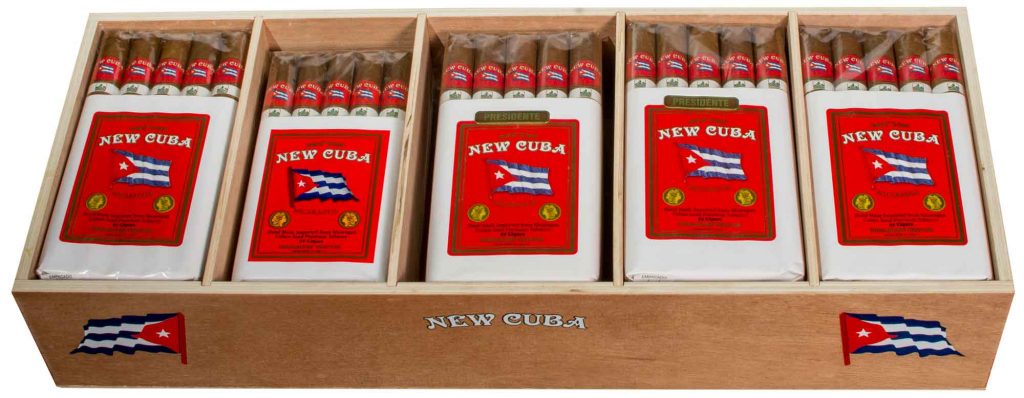
New Cuba Maduro – How Much Aganorsa Character Can You Put Into a Value Cigar?

Aganorsa New Cuba Maduro

New Cuba Maduro occupies a very different position from Rare Leaf, Aniversario or the more experimental JFR lines.

Its mission is simple:

Nicaraguan character at value-oriented pricing.

Current specialist retailers describe it as a Nicaraguan cigar using a Nicaraguan Maduro wrapper, Nicaraguan binder and Nicaraguan filler, with a Cuban-sandwich-style internal construction.

The Cuban-sandwich concept

A Cuban sandwich generally combines longer tobacco with shorter filler pieces rather than using an exclusively traditional long-filler bunch.

That distinction matters.

New Cuba Maduro should therefore not be presented as the darker equivalent of New Cuba Superior.

Superior represents the long-filler premium evolution.

Maduro represents:

the darker value expression.

And mixed filler does not automatically mean poor tobacco. It means a different construction strategy.

The Maduro profile

Retail descriptions repeatedly identify flavors in the family of:

cocoa, coffee, earth and pepper, with some also noting cream, cedar or leather.

The important educational point is that Maduro does not automatically mean maximum nicotine strength.

Different retailers classify New Cuba Maduro anywhere around medium through fuller territory, illustrating how subjective strength classifications can be.

Vitolas

The current retail market includes a broad range:

Robusto – 5 × 50Toro – 6 × 50Torpedo – 6 × 52Titan – 6 × 60Churchill – 7 × 48Presidente – 7½ × 50.

That makes New Cuba Maduro surprisingly useful for vitola education.

Start with Robusto.

Compare Robusto 5×50 with Toro 6×50 to isolate the effect of length.

Compare Robusto with Titan 6×60 to explore wrapper-to-filler ratio.

Try Torpedo to study how head geometry and cut can affect draw and smoke concentration.

New Cuba Maduro vs New Cuba Superior

This comparison is fundamental.

Superior: Ecuador Connecticut, Aganorsa Nicaraguan core, all-long-filler construction, approachable profile.

Maduro: Nicaraguan Maduro, Nicaraguan binder/filler, Cuban-sandwich construction, darker flavor register.

“Superior” therefore refers to a structural premium upgrade.

It does not mean every smoker must prefer it.

A Maduro lover may still prefer New Cuba Maduro.

Everyday-cigar philosophy

New Cuba Maduro is repeatedly marketed as an affordable everyday cigar.

That role matters.

A good humidor does not need to contain only special-occasion cigars.

There is room for:

rare cigars,

celebration cigars,

educational cigars,

and:

daily cigars.

New Cuba Maduro belongs naturally in the last category.

Pairing

Coffee is the obvious starting point because coffee and roasted notes already appear repeatedly in the cigar’s reported profile.

Espresso or medium-dark roast can reinforce cocoa and roast.

Cappuccino may soften pepper and highlight creamier impressions.

Bourbon can connect oak and vanilla with cocoa and earth.

A restrained aged rum can also work.

For the first analytical tasting, however:

water first.

Mister Tabaco pricing problem

The supplied Mister Tabaco price is:

MDL 527.

JFR Maduro is listed at:

MDL 539.

Only:

MDL 12 difference.

That is strategically important.

Internationally, New Cuba Maduro is fundamentally positioned as a value/bundle cigar.

At Mister Tabaco, however, its local shelf price sits almost directly beside JFR Maduro.

Therefore I would not artificially reposition New Cuba Maduro as a luxury cigar simply to justify the price.

The better strategy is transparency:

“This is Aganorsa’s value-oriented Maduro concept, using Cuban-sandwich construction and Nicaraguan tobacco.”

That is a stronger story because it is true.

Who should smoke it?

New Cuba Maduro makes sense for Maduro fans, coffee-and-cocoa profile lovers, Nicaraguan tobacco smokers, customers interested in understanding Cuban-sandwich construction, and aficionados looking for a cigar to compare directly against long-filler alternatives.

Common mistakes

Maduro does not automatically mean very strong.

Mixed filler does not mean bad tobacco.

Bundle does not mean machine-made; New Cuba Maduro is marketed as handmade in Nicaragua.

The wrapper is Nicaraguan Maduro, not Ecuadorian Maduro.

And New Cuba Maduro should not be described as all-long-filler like Superior; current descriptions explicitly identify the Cuban-sandwich construction.

Verdict

New Cuba Maduro is not trying to win a rarity contest.

It is trying to answer:

How much Nicaraguan Maduro character can Aganorsa deliver in a value-oriented cigar?

Its architecture is straightforward:

Nicaraguan Maduro wrapper

Nicaraguan binder

Nicaraguan filler

Cuban-sandwich construction.

And its flavor language centers on:

cocoa + coffee + earth + pepper.

That makes it useful not only as an everyday cigar, but as an educational one.

Smoke it beside New Cuba Superior.

Then beside JFR Maduro.

The lesson becomes much bigger than which cigar tastes better.

You begin to understand:

what construction, wrapper processing and positioning actually do to a cigar.

Mister Tabaco

At Mister Tabaco you’ll find the Aganorsa Leaf range: from flagship lines like Aniversario and Supreme Leaf, to the JFR collections built on the “Just For Retailers” philosophy, to the Guardian of the Farm and Rare Leaf editions. Explore our dedicated series on the brand to compare blends and choose the right cigar for you.

Continue the Aganorsa Series

→ Aganorsa Leaf – From Eduardo Fernández’s Vision to One of Nicaragua’s Most Distinctive Premium Tobacco Producers

→ Aganorsa Terroir: Jalapa vs Estelí vs Condega – How Soil, Climate and Leaf Position Shape Tobacco

→ Corojo 99 vs Criollo 98 vs Corojo 2012 – Understanding the Genetics Behind Aganorsa Leaf

→ Corojo vs Maduro vs Connecticut – How the Wrapper Changes an Aganorsa Cigar

→ Shade-Grown vs Sun-Grown – How Light and Leaf Position Shape a Premium Cigar

→ Signature Corojo vs Signature Maduro – One Premium Philosophy, Two Interpretations of Aganorsa Leaf

→ Supreme Leaf – Why This Line Became One of Aganorsa’s Most Recognizable Corojo Expressions

→ Aniversario Series – From Casa Fernández Miami Aniversario to One of Aganorsa Leaf’s Most Refined Premium Families

→ Guardian of the Farm Apollo Selección de Warped – The Dogs, the Corojo 99 and the Collaboration Behind a Top-10 Cigar

→ Guardian of the Farm NightWatch – How Aganorsa Turned Corojo 99 Into a Proprietary Maduro Wrapper

→ JFR 20th Anniversary – 20 Years of “Just For Retailers,” Mexican San Andrés and Aganorsa Value Philosophy

→ JFR Connecticut – Why a Light Wrapper Can Still Hide a Serious Aganorsa Core

→ JFR Corojo – The Benchmark of the JFR Family and One of the Most Direct Expressions of Aganorsa Style

→ JFR Maduro – Mexican San Andrés Maduro Over an Aganorsa Nicaraguan Core

→ JFR Lunatic Habano – When “Just For Retailers” Becomes Deliberately Excessive

→ JFR Lunatic Loco – Shade-Grown Corojo Maduro Meets Giant Perfecto Geometry

→ JFR Lunatic Maduro – San Andrés Maduro, Aganorsa Nicaragua and the Dark Side of Lunatic

→ JFR Lunatic Torch – The Cigar That Literally Shows You What the Wrapper Does

→ New Cuba Superior – How Aganorsa Turned a Budget Concept Into an Affordable Long-Filler Premium Cigar

→ New Cuba Maduro – How Much Aganorsa Character Can You Put Into a Value Cigar?

→ Rare Leaf Corojo & Maduro: When the Difference Isn’t the Recipe, It’s the Tobacco Selection

Tobacco products are intended for adults only. Smoking seriously damages your health.

Posted on — Leave a comment

New Cuba Superior – How Aganorsa Turned a Budget Concept Into an Affordable Long-Filler Premium Cigar

Aganorsa New Cuba Superior

1. How do you upgrade a value brand without destroying its purpose?

That is the central question behind New Cuba Superior.

The original New Cuba occupies Aganorsa’s budget-oriented space. In 2023, Aganorsa introduced New Cuba Superior as a long-filler premium evolution of that concept while deliberately keeping the cigar affordable.

So “Superior” is not simply a new band or box.

The architecture changed.

The philosophy did not.

2. Why Aganorsa created it

At launch, Terence Reilly explained that much of Aganorsa’s portfolio could be too intense for beginners or for smokers who simply preferred something milder. New Cuba Superior was designed specifically to fill that gap.

That means Superior should not be positioned as:

a stronger New Cuba.

It is better understood as:

a more premium New Cuba built for a more approachable palate.

3. Official blend

Aganorsa currently lists:

Wrapper: Ecuador ConnecticutBinder: Aganorsa, NicaraguaFiller: Aganorsa, Nicaragua.

The cigar therefore combines:

Ecuadorian wrapper

with:

Nicaraguan Aganorsa core.

It is not a Nicaraguan puro.

4. Long filler is the defining upgrade

Aganorsa explicitly states that New Cuba Superior is made entirely from long-filler leaf.

Cigar Aficionado contrasted that with the original New Cuba, describing the older line as mixed filler and Superior as the premium long-filler evolution.

That is the technical meaning of the upgrade.

Long filler gives the blender greater control over leaf placement, proportions, combustion and development.

5. Affordable does not mean cheap construction

At launch, U.S. suggested retail pricing for the initial sizes was reported around $6.50–$7.50 per cigar.

The key point is not the historical dollar figure.

It is the strategic intent:

premium long-filler construction at value-oriented pricing.

That makes New Cuba Superior unusual within the broader Aganorsa portfolio.

6. Why Ecuador Connecticut?

Aganorsa currently describes the cigar as light, sweet and approachable for new or casual smokers.

Ecuador Connecticut supports that goal.

Useful tasting directions can include:

cream,

toast,

nuts,

cedar,

light sweetness,

soft spice.

Those are sensory families, not guaranteed notes.

7. Mild does not mean flavorless

The wrapper may make the cigar more approachable, but underneath it remains an Aganorsa Nicaraguan binder and filler core.

That means the objective is not to remove personality.

It is to create:

flavor with less aggression.

For a beginner, that distinction matters enormously.

8. The Nicaraguan tobacco has real terroir behind it

Launch coverage reported Cuban-seed tobacco grown by Aganorsa in Condega, Estelí and Jalapa underneath the Ecuador Connecticut wrapper.

So beneath the easy-going exterior is a multi-region Nicaraguan core.

That makes Superior considerably more interesting than the phrase “mild Connecticut cigar” might suggest.

9. Current sizes

Aganorsa currently lists:

Corona – 5 × 44Robusto – 5 × 50Toro – 6 × 50Titan – 6 × 60.

All are sold in boxes of 25.

The original 2023 launch reporting listed Corona, Robusto and Toro; Titan appears on the current official page as a later extension.

10. Corona – wrapper study

At 44 ring gauge, the Corona provides the highest relative wrapper influence in the current family.

For experienced smokers wanting to study the Ecuador Connecticut contribution, it may be the most interesting size.

11. Robusto – best beginner recommendation

The 5 × 50 Robusto offers:

familiar geometry,

manageable duration,

balanced wrapper/filler ratio,

and an accessible mouthfeel.

For a first premium cigar, it is a very logical format.

12. Toro – same ring gauge, more development

Robusto is 5 × 50.

Toro is 6 × 50.

That gives you a clean experiment:

same diameter,

greater length.

You can study development and duration without materially changing the wrapper/filler ratio.

13. Titan – the filler-driven version

At 6 × 60, Titan moves New Cuba Superior into large-ring territory.

More filler can increase:

smoke volume,

body,

thermal mass,

and the relative importance of the internal blend.

It does not automatically mean greater nicotine strength.

14. Superior vs original New Cuba

This is the essential comparison.

New Cuba: budget-oriented mixed-filler concept.

New Cuba Superior: long-filler premium construction, Ecuador Connecticut wrapper and boxed presentation.

So Superior is not merely a packaging upgrade.

It is a genuine construction upgrade.

15. Superior vs JFR Connecticut

Both use Ecuador Connecticut over Aganorsa Nicaraguan binder and filler according to Aganorsa’s current portfolio information.

Yet they have different missions.

New Cuba Superior was explicitly designed for beginners and smokers wanting a milder profile.

JFR Connecticut retains more of the JFR identity.

This is an excellent demonstration that similar blend summaries do not create identical cigars.

16. Superior vs Aniversario Connecticut

The broader Aganorsa portfolio also includes Aniversario Connecticut.

That creates an excellent educational ladder:

New Cuba Superior – accessible premium

JFR Connecticut – value-oriented expression

La Validación Connecticut – core premium expression

Aniversario Connecticut – higher premium positioning.

Not bad-to-good.

Rather:

different degrees of selection, construction and refinement.

17. What should you taste?

Track:

CreaminessToastNuttinessCedarNatural SweetnessSoft PepperEarthBodyBalanceFinish.

Then ask:

Is it mild without becoming boring?

That is the real test of New Cuba Superior.

18. Who should try it?

Especially:

first-time premium cigar smokers,

Connecticut fans,

smokers who find other Aganorsa blends too intense,

casual aficionados,

customers who want long-filler construction without luxury pricing,

and experienced smokers looking for a relaxed morning or coffee cigar.

19. Mister Tabaco positioning

The supplied price is:

MDL 356.

That places it at the same supplied price as JFR 20th Anniversary and only MDL 58 above JFR Corojo.

This is useful because the recommendation can be based on palate rather than price:

Superior: lighter Connecticut expression.

JFR Corojo: more direct Aganorsa Corojo identity.

20th Anniversary: darker San Andrés direction.

Same general price territory.

Very different experiences.

20. Common mistakes

Superior is not simply New Cuba in a nicer box; the move to all-long-filler construction is a real structural upgrade.

Connecticut does not mean flavorless.

Mild does not mean low quality.

Superior was not designed to be stronger; it was specifically created for smokers seeking a more approachable profile.

It is not a Nicaraguan puro because the wrapper is Ecuadorian.

Titan is not automatically stronger simply because it has a 60 ring gauge.

21. FAQ

When did New Cuba Superior launch? It was introduced in 2023.

What makes it “Superior”? The line is made entirely with long-filler tobacco, unlike the mixed-filler budget orientation of original New Cuba.

Wrapper? Ecuador Connecticut.

Binder? Aganorsa Nicaragua.

Filler? Aganorsa Nicaragua.

Where is the Nicaraguan tobacco grown? Launch reporting specified Cuban-seed tobacco from Aganorsa farms in Condega, Estelí and Jalapa.

Current sizes? Corona 5×44, Robusto 5×50, Toro 6×50 and Titan 6×60.

Best first size? Robusto.

Best for wrapper study? Corona.

Conclusion – premium does not have to mean intimidating

After Corojo Maduro, 80-ring Perfectos and brush-foot experiments, New Cuba Superior looks almost understated.

That is precisely its role.

It combines:

Ecuador Connecticut

with:

Aganorsa Nicaraguan long filler.

And Aganorsa created it specifically for customers who wanted a milder, more approachable entry into its tobacco universe.

That does not make it lesser.

It makes it:

the doorway.

And every serious premium cigar portfolio needs a good doorway.

Mister Tabaco

At Mister Tabaco you’ll find the Aganorsa Leaf range: from flagship lines like Aniversario and Supreme Leaf, to the JFR collections built on the “Just For Retailers” philosophy, to the Guardian of the Farm and Rare Leaf editions. Explore our dedicated series on the brand to compare blends and choose the right cigar for you.

Continue the Aganorsa Series

→ Aganorsa Leaf – From Eduardo Fernández’s Vision to One of Nicaragua’s Most Distinctive Premium Tobacco Producers

→ Aganorsa Terroir: Jalapa vs Estelí vs Condega – How Soil, Climate and Leaf Position Shape Tobacco

→ Corojo 99 vs Criollo 98 vs Corojo 2012 – Understanding the Genetics Behind Aganorsa Leaf

→ Corojo vs Maduro vs Connecticut – How the Wrapper Changes an Aganorsa Cigar

→ Shade-Grown vs Sun-Grown – How Light and Leaf Position Shape a Premium Cigar

→ Signature Corojo vs Signature Maduro – One Premium Philosophy, Two Interpretations of Aganorsa Leaf

→ Supreme Leaf – Why This Line Became One of Aganorsa’s Most Recognizable Corojo Expressions

→ Aniversario Series – From Casa Fernández Miami Aniversario to One of Aganorsa Leaf’s Most Refined Premium Families

→ Guardian of the Farm Apollo Selección de Warped – The Dogs, the Corojo 99 and the Collaboration Behind a Top-10 Cigar

→ Guardian of the Farm NightWatch – How Aganorsa Turned Corojo 99 Into a Proprietary Maduro Wrapper

→ JFR 20th Anniversary – 20 Years of “Just For Retailers,” Mexican San Andrés and Aganorsa Value Philosophy

→ JFR Connecticut – Why a Light Wrapper Can Still Hide a Serious Aganorsa Core

→ JFR Corojo – The Benchmark of the JFR Family and One of the Most Direct Expressions of Aganorsa Style

→ JFR Maduro – Mexican San Andrés Maduro Over an Aganorsa Nicaraguan Core

→ JFR Lunatic Habano – When “Just For Retailers” Becomes Deliberately Excessive

→ JFR Lunatic Loco – Shade-Grown Corojo Maduro Meets Giant Perfecto Geometry

→ JFR Lunatic Maduro – San Andrés Maduro, Aganorsa Nicaragua and the Dark Side of Lunatic

→ JFR Lunatic Torch – The Cigar That Literally Shows You What the Wrapper Does

→ New Cuba Superior – How Aganorsa Turned a Budget Concept Into an Affordable Long-Filler Premium Cigar

→ New Cuba Maduro – How Much Aganorsa Character Can You Put Into a Value Cigar?

→ Rare Leaf Corojo & Maduro: When the Difference Isn’t the Recipe, It’s the Tobacco Selection

Tobacco products are intended for adults only. Smoking seriously damages your health.

Posted on — Leave a comment

JFR Lunatic Torch – The Cigar That Literally Shows You What the Wrapper Does

Aganorsa JFR Lunatic Torch

1. What if you could smoke a cigar before its wrapper joined the blend?

That is the idea behind JFR Lunatic Torch.

The bottom section of the cigar is deliberately left without wrapper, exposing binder and filler. Aganorsa calls this a brush foot and explains that the smoker initially experiences the core tobaccos before the cigar becomes more rounded once the wrapper begins burning.

The sequence is therefore:

core first → wrapper second.

Few commercial cigars teach wrapper influence so directly.

2. Official blend

Aganorsa currently lists:

Wrapper: Aganorsa Corojo, NicaraguaBinder: Aganorsa, NicaraguaFiller: Aganorsa, Nicaragua.

So Torch is a true:

Nicaraguan puro.

And all three principal components are Aganorsa.

3. Historical blend detail

When the line was revamped in 2020, Cigar Aficionado reported greater specificity:

Wrapper: Jalapa Corojo ’99Binder: double binderFiller: tobaccos from Estelí and Jalapa.

That gives the cigar enormous educational value.

The opening portion allows you to experience the binder/filler core before adding a very specific Jalapa Corojo ’99 wrapper.

4. Why the brush foot matters

In most cigars, every component begins burning together.

Torch separates the experience.

Before the wrapper:

binder + filler.

After the wrapper:

binder + filler + Corojo.

Cigar Aficionado described the opening of Torch Imagine as spicy and herbal, then nuttier and sweeter once the wrapper entered combustion.

Those are reference notes rather than mandatory flavors.

The key point is that the transition was clearly perceptible.

5. Wrapper influence without fake percentages

You will often hear claims that the wrapper provides some fixed percentage of cigar flavor.

That is too simplistic.

Wrapper influence changes with:

ring gauge,

blend strength,

wrapper thickness,

filler mass,

binder character,

smoking pace.

Torch offers a better test:

smoke the core, then add the wrapper and observe.

No invented percentage required.

6. Torch history

The line originally appeared in 2016 in a single size. In 2020, Aganorsa revamped it with new packaging and three new large-ring vitolas while discontinuing the original Churchill.

In 2021, the company added the Imagine 5½ × 50, responding to demand for a Robusto format.

The current official range is:

Imagine – 5½ × 50Visionaries – 6½ × 52Dreamlands – 6½ × 60Mad Folk – 4¾ × 70.

All are boxed in tens.

7. Imagine – the best place to start

For the first Torch experience, I would choose:

Imagine 5½ × 50.

Its 50 ring gauge keeps the wrapper-to-filler relationship relatively balanced and makes the brush-foot transition easier to study than on a very large ring cigar.

Cigar Aficionado rated Imagine 92 points.

More important than the number was the review’s emphasis on the sensory transition once the wrapper entered the burn.

8. Visionaries vs Dreamlands

This may be the best size comparison in the range:

Visionaries – 6½ × 52

Dreamlands – 6½ × 60.

Same length.

Different diameter.

That means you can study:

wrapper-to-filler ratio,

smoke volume,

body,

temperature,

and the clarity of the brush-foot transition

while keeping length constant.

Excellent experimental design for an aficionado.

9. Mad Folk – 70 ring gauge

Mad Folk measures 4¾ × 70.

At this size, filler mass becomes far more dominant.

The educational question changes:

Can I still clearly identify the moment when Corojo joins the blend?

That makes Mad Folk less about maximum wrapper influence and more about the relationship between wrapper and a very large core.

10. Torch vs JFR Corojo

JFR Corojo gives you the completed Aganorsa-Corojo system from the first puff.

Torch delays the wrapper.

A useful shorthand:

JFR Corojo = benchmark.

Torch = laboratory.

Both are valuable, but they teach different things.

11. Torch vs Apollo

Guardian Apollo uses a closed foot, temporarily emphasizing wrapper at the start.

Torch does almost the opposite:

it temporarily removes wrapper influence.

So:

Apollo = wrapper first.

Torch = wrapper later.

Two different constructions demonstrating the same principle:

wrapper matters.

12. Torch vs the rest of Lunatic

Lunatic Habano uses Ecuador Habano wrapper.

Torch uses Aganorsa Corojo from Nicaragua.

Loco explores Shade-Grown Corojo Maduro and Perfecto geometry.

Lunatic Maduro explores the darker side of the family.

Together, the subfamily becomes an unusually rich study of:

wrapper origin,

genetics,

processing,

shape,

ring gauge,

and construction.

13. How to light it

Do not trim away the exposed tobacco.

Do not burn forward to the wrapper before you begin.

Light the exposed binder and filler gently and evenly.

Then smoke normally.

The entire point is to experience the first stage before the wrapper joins the combustion.

Removing the shaggy foot destroys the experiment.

14. A proper tasting method

Before the wrapper burns, score:

StrengthBodyPepperHerbal CharacterEarthWoodSweetnessCreaminessFinish.

Once the wrapper enters combustion, score the exact same categories again.

Then ask:

What increased?

What disappeared?

What became sweeter?

What became rounder?

What changed in the finish?

That is far more useful than simply writing “good cigar.”

15. Why the cigar can feel rounder after the wrapper appears

Aganorsa explicitly says the initial spice from the exposed binder and filler settles into a more rounded blend once the wrapper begins burning.

That illustrates a sophisticated point:

a wrapper does not merely add one new flavor.

It can alter the balance of everything underneath it.

Wrapper influence is therefore structural as well as aromatic.

16. Pairing

For the first serious Torch tasting:

water only.

The purpose is to identify the before/after transition.

Coffee, rum or whisky introduce unnecessary variables.

After you understand the cigar, pairings such as espresso, medium-roast coffee, dry bourbon, oak-driven whisky, restrained aged rum or Cognac can work well.

But first:

protect the experiment.

17. Mister Tabaco positioning

The supplied Mister Tabaco price is:

MDL 385.

That puts Torch only MDL 87 above the supplied JFR Corojo price.

Commercially, that is a compelling position because the customer is not merely buying another cigar.

They are buying:

a sensory demonstration of blending.

A simple retail explanation is enough:

“Smoke the exposed tobacco first. When the Corojo wrapper begins burning, pay attention to how the cigar changes.”

The product sells its own story.

18. Who should try it?

Especially:

Corojo fans,

Aganorsa smokers,

customers interested in blending,

aficionados studying wrapper influence,

smokers who already know JFR Corojo,

and curious beginners who want to understand cigar construction rather than simply memorize terminology.

19. Common mistakes

The shaggy foot is not a defect.

Do not cut it off.

Do not pre-burn the cigar all the way to the wrapper.

The first puffs do not represent the complete blend.

Torch is not simply the regular Lunatic blend with unusual construction; the 2020 relaunch material specifically noted that Torch has a different blend from core JFR Lunatic.

Its wrapper is Nicaraguan Aganorsa Corojo, not Ecuador Habano.

It is an all-Nicaraguan cigar.

20. FAQ

What is JFR Lunatic Torch? An all-Nicaraguan Aganorsa cigar with a brush/shaggy foot designed to let the smoker taste binder and filler before the wrapper enters combustion.

Wrapper? Aganorsa Corojo, Nicaragua.

More precise wrapper information? Relaunch reporting identifies Jalapa Corojo ’99.

Binder? Aganorsa Nicaragua; historical reporting specifies a double binder.

Filler? Aganorsa Nicaragua, with Estelí and Jalapa tobaccos reported in the 2020 blend description.

Is it a Nicaraguan puro? Yes.

Current sizes? Imagine 5½ × 50, Visionaries 6½ × 52, Dreamlands 6½ × 60 and Mad Folk 4¾ × 70.

Best first size? Imagine.

Imagine rating? 92 points from Cigar Aficionado.

Conclusion – possibly the best educational cigar in JFR

JFR Corojo teaches you what the Aganorsa baseline tastes like.

Lunatic Habano teaches you about geometry.

Loco teaches you about Corojo Maduro and Perfecto construction.

Torch teaches something even more fundamental:

what the wrapper actually does.

It begins by taking that wrapper away.

You smoke:

binder + filler.

Then the combustion reaches:

Jalapa Corojo ’99.

And the blend changes.

That is why Torch should not be positioned at Mister Tabaco as merely another unusual Lunatic.

It is:

the cigar laboratory.

Mister Tabaco

At Mister Tabaco you’ll find the Aganorsa Leaf range: from flagship lines like Aniversario and Supreme Leaf, to the JFR collections built on the “Just For Retailers” philosophy, to the Guardian of the Farm and Rare Leaf editions. Explore our dedicated series on the brand to compare blends and choose the right cigar for you.

Continue the Aganorsa Series

→ Aganorsa Leaf – From Eduardo Fernández’s Vision to One of Nicaragua’s Most Distinctive Premium Tobacco Producers

→ Aganorsa Terroir: Jalapa vs Estelí vs Condega – How Soil, Climate and Leaf Position Shape Tobacco

→ Corojo 99 vs Criollo 98 vs Corojo 2012 – Understanding the Genetics Behind Aganorsa Leaf

→ Corojo vs Maduro vs Connecticut – How the Wrapper Changes an Aganorsa Cigar

→ Shade-Grown vs Sun-Grown – How Light and Leaf Position Shape a Premium Cigar

→ Signature Corojo vs Signature Maduro – One Premium Philosophy, Two Interpretations of Aganorsa Leaf

→ Supreme Leaf – Why This Line Became One of Aganorsa’s Most Recognizable Corojo Expressions

→ Aniversario Series – From Casa Fernández Miami Aniversario to One of Aganorsa Leaf’s Most Refined Premium Families

→ Guardian of the Farm Apollo Selección de Warped – The Dogs, the Corojo 99 and the Collaboration Behind a Top-10 Cigar

→ Guardian of the Farm NightWatch – How Aganorsa Turned Corojo 99 Into a Proprietary Maduro Wrapper

→ JFR 20th Anniversary – 20 Years of “Just For Retailers,” Mexican San Andrés and Aganorsa Value Philosophy

→ JFR Connecticut – Why a Light Wrapper Can Still Hide a Serious Aganorsa Core

→ JFR Corojo – The Benchmark of the JFR Family and One of the Most Direct Expressions of Aganorsa Style

→ JFR Maduro – Mexican San Andrés Maduro Over an Aganorsa Nicaraguan Core

→ JFR Lunatic Habano – When “Just For Retailers” Becomes Deliberately Excessive

→ JFR Lunatic Loco – Shade-Grown Corojo Maduro Meets Giant Perfecto Geometry

→ JFR Lunatic Maduro – San Andrés Maduro, Aganorsa Nicaragua and the Dark Side of Lunatic

→ JFR Lunatic Torch – The Cigar That Literally Shows You What the Wrapper Does

→ New Cuba Superior – How Aganorsa Turned a Budget Concept Into an Affordable Long-Filler Premium Cigar

→ New Cuba Maduro – How Much Aganorsa Character Can You Put Into a Value Cigar?

→ Rare Leaf Corojo & Maduro: When the Difference Isn’t the Recipe, It’s the Tobacco Selection

Tobacco products are intended for adults only. Smoking seriously damages your health.